
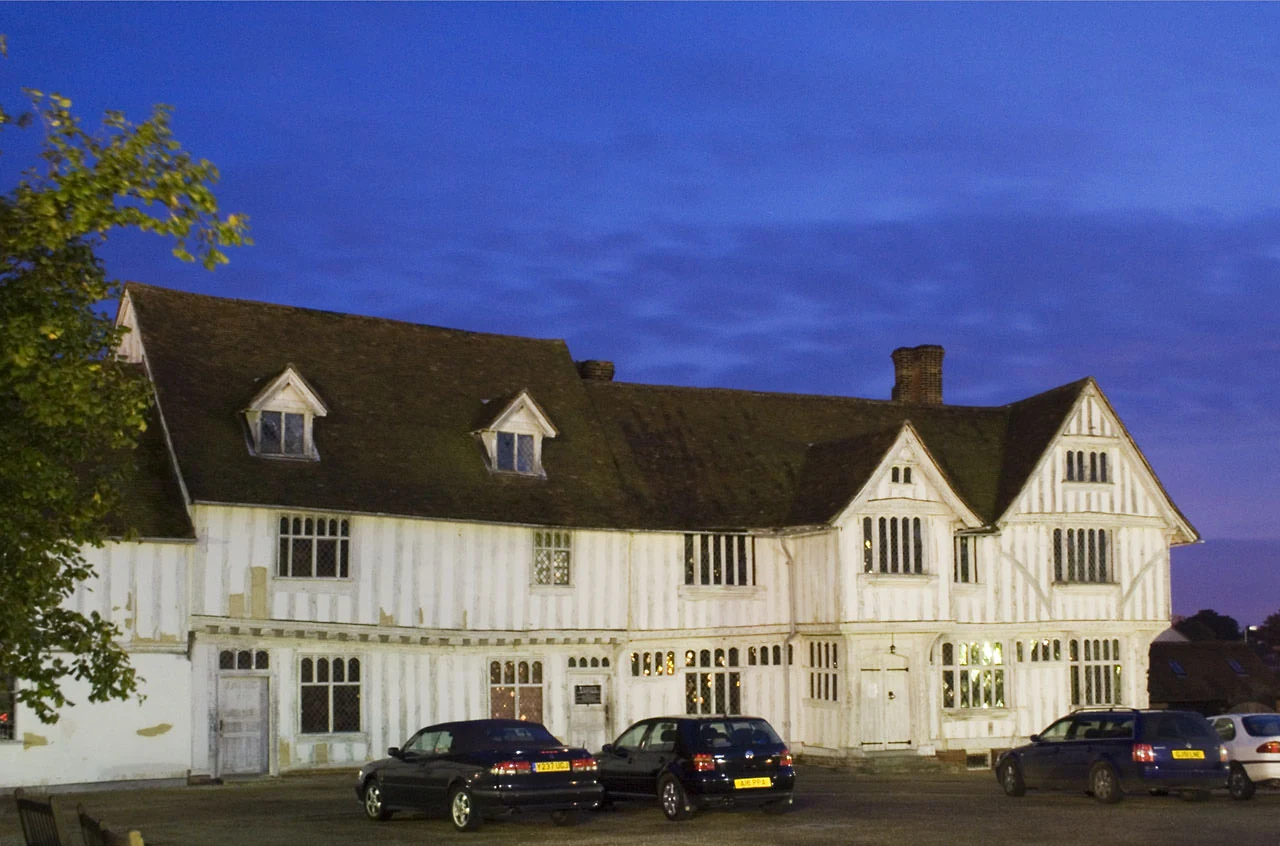
On the market place of Lavenham, the Guildhall of Corpus Christi raises its splendid timber frame. Built at the height of the village's drapery prosperity, it tells the destiny of a building caught up in the upheavals of the Reformation: born for a religious confraternity, it was stripped of it a generation after its building.
The hall of a drapery confraternity
The Guildhall was built in 1529, in the full glory of drapery Lavenham — the town was then growing rich on the trade in its famous blue cloth. It was built for the Guild of Corpus Christi, a religious confraternity of merchants and notables, founded the same year. These guilds mixed devotion and sociability: they celebrated masses, organised processions, maintained solidarity among their members. The building, with its jettied frame and its projecting gabled porch, embodies both the wealth and the piety of the early Tudor bourgeoisie.
A function lost at the Reformation
The destiny of the Guildhall turned a generation after its building. The Reformation suppressed the religious guilds, judged 'superstitious': the confraternity of Corpus Christi was dissolved, and the building lost its reason for being. It then knew a long series of reconversions characteristic of the fate of pre-Reformation buildings: house of correction (bridewell, 1689), workhouse (1787), prison. This trajectory — from a pious confraternity to a poorhouse — sums up on its own the religious and social upheavals the Reformation imposed on England. To see: the jettied timber frame, the projecting gabled porch (north-west front), the interior exhibition on the guild then the workhouse.
Did you know?
The Lavenham Guildhall has known almost every use a community can give a great building: hall of a religious confraternity, prison, spinning workshop, poorhouse, mortuary, lookout post in the Second World War, and finally museum. In five centuries, this timber house has embraced all the vicissitudes of its village — a condensed image, under one roof, of English social history since the Reformation.
Notes
The Guildhall of Corpus Christi lies on the market place of Lavenham, Suffolk; a National Trust property since 1951, open to the public. Seasonal hours to check.
Quiz
- For whom was the Guildhall built in 1529?
- The religious Guild of Corpus Christi
- The king
- An army
- What happened to it at the Reformation?
- Its confraternity was suppressed, it lost its function
- It was enlarged
- It became a cathedral
- What was it notably reconverted into?
- A prison then workhouse (poorhouse)
- A royal palace
- A theatre