
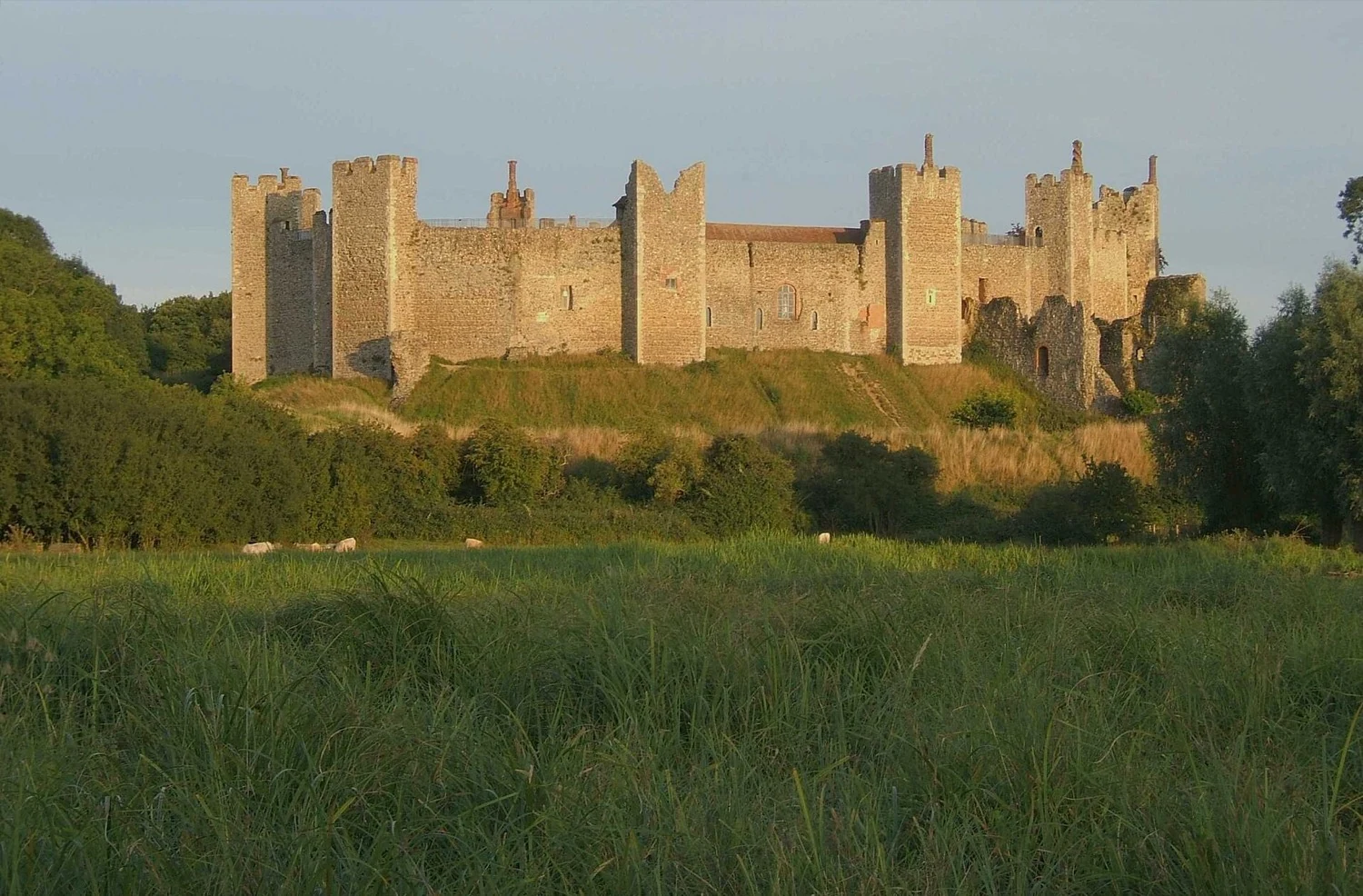
In Suffolk, Framlingham still raises the almost intact ring of its medieval walls, bristling with thirteen towers. A stronghold of the powerful Howard family, this fortress was, in 1553, the scene of one of the great reversals of Tudor history: it was here that Mary I gathered her supporters and was proclaimed Queen of England.
A Howard fortress
Built at the end of the twelfth century, Framlingham is a remarkable example of a medieval castle without a central keep, reduced to a powerful curtain wall flanked by towers linked by a wall-walk. In the fifteenth and sixteenth centuries it belonged to the Howards, Dukes of Norfolk, one of the greatest families in the kingdom — the very one that gave two queens to Henry VIII (Anne Boleyn and Catherine Howard were Howards) and knew the highest favours as well as the most brutal disgraces. The Howards adapted the old fortress to the comfort of the age, adding fireplaces and windows without erasing its warlike look.
1553: the turning point of a reign
In July 1553, on the death of the young king Edward VI, a coup tried to place Lady Jane Grey on the throne, setting aside the rightful heir, the Catholic Mary Tudor. Mary took refuge at Framlingham, a safe and faithful fortress, and called her supporters there. Within a few days the nobility and the people flocked in; the army sent against her went over to her side; Jane Grey was abandoned. It was from Framlingham that Mary marched on London to be crowned the first reigning queen in English history. The old Suffolk fortress was thus, for a few days, the centre of the kingdom.
What to see
- The almost intact medieval curtain wall, its thirteen towers and its wall-walk.
- The Tudor chimneys added by the Howards on the walls.
- The memory of the rally of 1553 around Mary Tudor.
- The view from the ramparts over the mere and the Suffolk countryside.
Did you know?
Framlingham knew the two faces of Howard fortune: a fortress of an all-powerful family, it also passed to the Crown when the Howards fell from favour — the Duke of Norfolk was imprisoned in the Tower in 1546, escaping the scaffold by a whisker because Henry VIII died the day before the execution. The castle thus embodies the giddy fate of the great Tudor families, one day at the summit, the next in the Tower.
Practical information
Framlingham Castle lies at Framlingham, in Suffolk, north-east of London. It is today a site in the care of English Heritage, whose ramparts can be walked. Opening hours and days are liable to change with the seasons; it is best to check them against the official sources before visiting.
Quiz
- Which queen was proclaimed at Framlingham in 1553?
- Mary I Tudor
- Elizabeth I
- Jane Grey
- Which great family owned Framlingham?
- The Howards, Dukes of Norfolk
- The Cecils
- The Sidneys
- What is the castle's architectural feature?
- A curtain wall with thirteen towers, without a central keep
- A Renaissance dome
- An underground labyrinth