
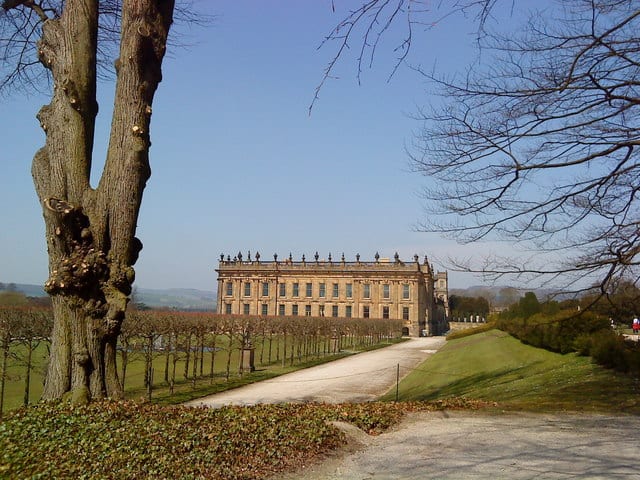
In the hollow of the Derwent valley, within the Peak District, Chatsworth today presents the baroque front of a princely palace. Let it be said plainly, with no disguise: the building one admires is later than the Renaissance, rebuilt from the 1680s onward by the first Duke of Devonshire. Yet beneath that classical dress sleeps a far older house, and it is this one that belongs to our story — the first Chatsworth, among the most ambitious building projects of Elizabeth's reign, the work of one of the most fascinating women of sixteenth-century England: Elizabeth Hardwick, known to all as Bess of Hardwick.
The story begins in 1549, when Sir William Cavendish (1501–1557) — knight, Member of Parliament and former servant of Henry VIII — bought the Chatsworth estate. He had married Bess in 1547, his third marriage and her second. From 1552 the couple set about building a vast mansion. William died in 1557, but Bess, a tenacious widow and formidable builder, completed the house in the 1560s: a quadrangle set around a great central court, the main entrance on the west front marked by four towers, the great hall placed to the east in the still-living medieval tradition. This first Chatsworth was counted among the "Seven Wonders of the Peak".
It was within these walls that the episode unfolded which binds Chatsworth forever to the great currents of history. Bess took as her fourth husband George Talbot, sixth Earl of Shrewsbury. In 1568 Elizabeth I entrusted Shrewsbury with the custody of Mary, Queen of Scots, the deposed Scottish queen and prisoner. From 1570 the earl brought his captive to Chatsworth on several occasions — nine visits in all. Mary lodged in the top-floor apartment above the great hall, still called today the "Queen of Scots rooms". In the park survives Queen Mary's Bower, a small enclosed terrace ringed with water where the captive queen is said to have been allowed to take the air under guard, near the Derwent. Between 1569 and 1571 Bess and Mary spent long hours together; out of that watched intimacy came the celebrated "Oxburgh Hangings", in which the two women's needlework made common cause. Here lies the whole ambiguity of a velvet gaol: two great ladies, one keeper, one captive, stitching side by side while, far off, the fate of two crowns was being decided.
To visit Chatsworth today, then, is to look with a double eye. The visible house, with its gilded saloons and painted ceilings, tells of seventeenth- and eighteenth-century splendour. But the site itself still carries the memory of the sixteenth: the layout of the estate, its position in the valley, Mary Stuart's Bower, and above all the shadow of Bess of Hardwick, who did not stop at Chatsworth. When her fourth marriage broke down, she raised nearby the extraordinary Hardwick Hall, "more glass than wall" — an architectural manifesto that sums up in itself the daring of a woman who rose from the minor gentry, through four marriages and a genius for building, to become one of the richest and most powerful in England, ancestress of ducal dynasties.
It is worth saying, too, what place Chatsworth held among the "Seven Wonders of the Peak", those Derbyshire curiosities that the learned of the seventeenth century liked to catalogue: the Elizabethan house figured there as the work of human hands amid the prodigies of nature — caverns, springs and summits. That company says well enough what an impression of magnificence the first Chatsworth made on its contemporaries, in a region still wild and little built upon. The Cavendishes, Bess's descendants, never ceased from then on to enrich and enlarge the estate, until they had made of it the ducal residence we know; yet all that later grandeur proceeds, in a straight line, from the founding daring of a sixteenth-century woman.
Chatsworth thus belongs fully to our atlas, not for the stones one sees today but for what they cover: a vanished Elizabethan house, a captive queen, an extraordinary builder. It is the very type of place where the Renaissance layer, invisible at first glance, asks to be sought out — and richly rewards whoever takes the trouble to read it.