
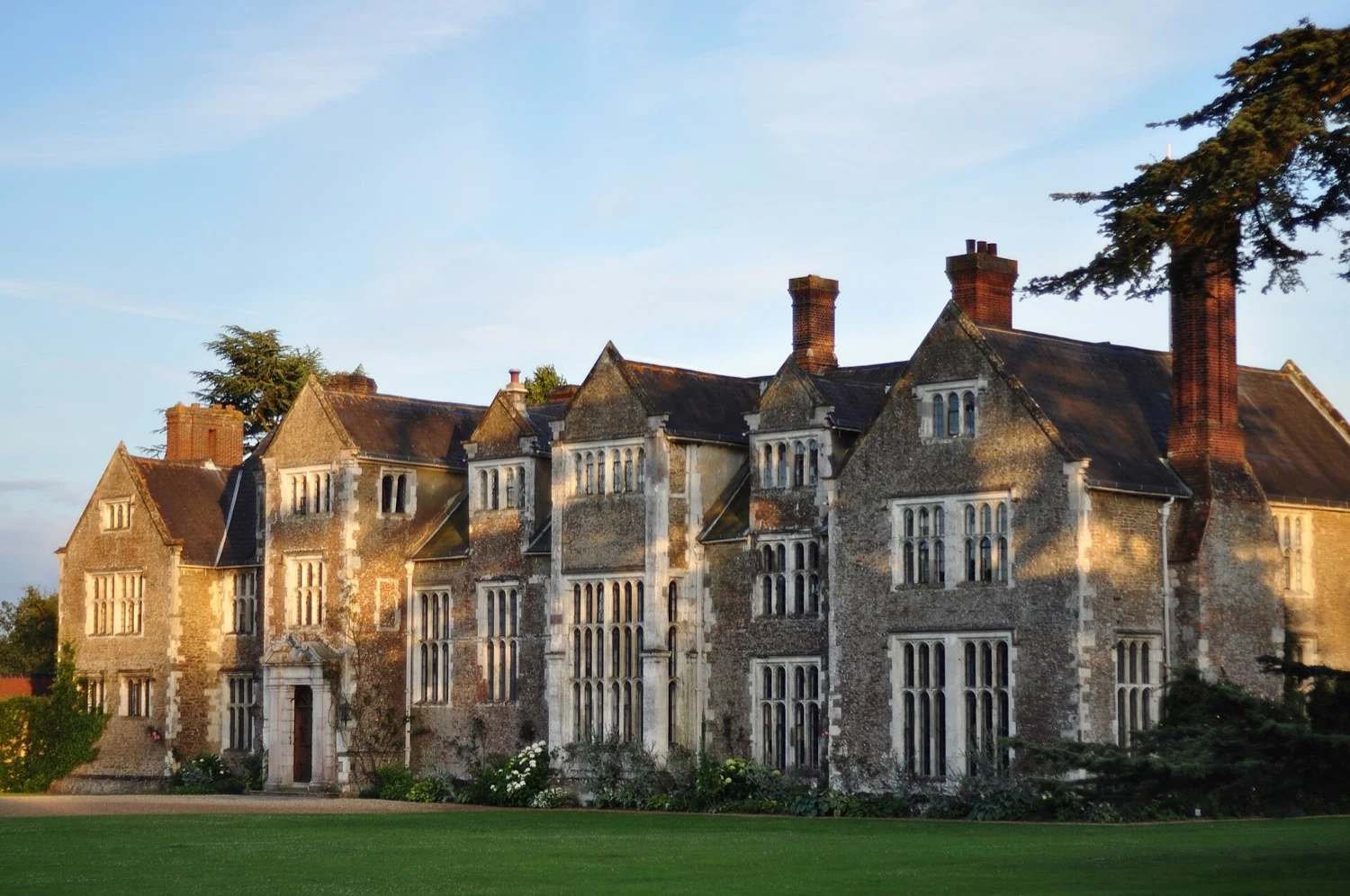
In the Surrey countryside, Loseley Park presents the sober, harmonious façade of a classic Elizabethan house. Built around 1560-1570 by Sir William More, a gentleman in the service of Elizabeth I, it unites, in a single house, the new elegance and the memory of the dissolved abbeys.
A house for receiving the queen
Sir William More, a rich notable and faithful administrator of the Crown in Surrey, had Loseley built to keep his rank and, it is said, to be able to receive the sovereign with dignity. The calculation was sound: Elizabeth I stayed here several times, as did James I later. The house, U-shaped, with long windows and a balanced façade, embodies the Elizabethan taste for measure and light. Inside, the great hall keeps panelling, a carved chimneypiece and a wrought ceiling, the typical decoration of a well-off gentry house.
The stone of the abbeys
Loseley carries, in its very walls, the trace of the Reformation: part of the stone that built it comes from the ruins of Waverley Abbey, the first Cistercian abbey in England, dissolved by Henry VIII. Like so many houses of the age, the new house is thus made, literally, of the debris of the old religious world. Sir William More also kept an abundant correspondence and archives, a precious witness to the life of a gentleman in the service of the Tudor state.
What to see
- The Elizabethan façade, U-shaped, sober and luminous.
- The great hall with its panelling, carved chimneypiece and wrought ceiling.
- The stones of Waverley Abbey reused in the building.
- The gardens and park surrounding the house.
Did you know?
Part of Loseley's walls comes from Waverley Abbey, dissolved shortly before: the new house of a servant of Elizabeth I was thus built with the stones of the first Cistercian monastery in England. Nothing says the English Renaissance better than this transfer of matter — the praying stone of the monks become the parlour of a gentleman, where the queen was received.
Practical information
Loseley Park lies near Guildford, in Surrey, south-west of London. It is a private house, still lived in by the descendants of the More-Molyneux family, open to the public with its gardens at certain times. Opening hours and days are liable to change; it is best to check them against the official sources before visiting.
Quiz
- Which gentleman had Loseley Park built around 1560-1570?
- Sir William More
- Sir John Thynne
- Sir Walter Raleigh
- Where does part of Loseley's stone come from?
- The ruins of Waverley Abbey
- An Italian quarry
- Nonsuch Palace
- Which sovereign stayed at Loseley?
- Elizabeth I
- Mary Queen of Scots
- Catherine of Aragon