
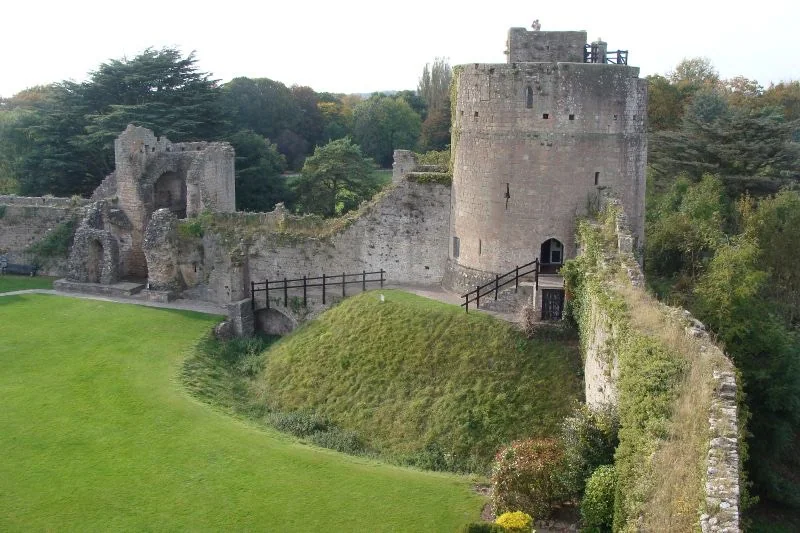
In Monmouthshire, Caldicot Castle offers the very example of the decline of the Welsh Marcher fortresses in Tudor times. A once-powerful medieval castle, it slid in the sixteenth century towards abandonment, as the border was pacified and its owners saw in it only a source of rents.
From a fallen duke to the Duchy of Lancaster
Caldicot belonged to Edward Stafford, 3rd Duke of Buckingham — the richest man in England, builder of Thornbury. But Buckingham was executed for treason in 1521 by Henry VIII, and his property confiscated: Caldicot then entered the Duchy of Lancaster, that great Crown domain. The castle, now one royal holding among others, ceased to be a centre of seigneurial power to become a mere property administered at a distance.
The slide towards the farm
In the sixteenth century, Caldicot was leased to the Somersets, Earls of Worcester, whose base was Raglan. But these tenants were interested only in the revenues of the estate: no more investment was made in the fabric. The castle gradually slid towards the state of a farmyard, then a ruin — the fate of many Marcher fortresses after the Laws in Wales Acts (1535-1542) which, by integrating Wales and abolishing the Marcher lordships, removed any military reason for being from these strongholds. By the sixteenth century, the old fortress was 'little more than a farmyard'. Caldicot thus illustrates the side of decline: the pacification of the border sealed the slow death of its castles. To see: the medieval gatehouse, the round tower, the curtain walls (restored in Victorian times by the collector Cobb).
Did you know?
Caldicot knew two deaths and a resurrection: a powerful fortress in the Middle Ages, it declined to be 'little more than a farmyard' in the sixteenth century, then fell into ruin. It was only in Victorian times that a rich collector, Joseph Cobb, bought it back and restored it out of love for the Middle Ages — giving it a third life, romantic this time. The castle thus illustrates the whole cycle: medieval glory, Tudor decline, Victorian revival.
Notes
Caldicot Castle lies at Caldicot, Monmouthshire; castle and park open to the public (locally managed). Hours to check.
Quiz
- What did Caldicot become after Buckingham's execution in 1521?
- It entered the Duchy of Lancaster (a Crown holding)
- It was razed
- It was given to the pope
- What do the Laws in Wales Acts illustrate for Caldicot?
- The end of the military reason for being of the Marcher fortresses
- An invasion
- The Dissolution
- What did the castle slide into in the sixteenth century?
- A farmyard, then a ruin
- A cathedral
- A war harbour