
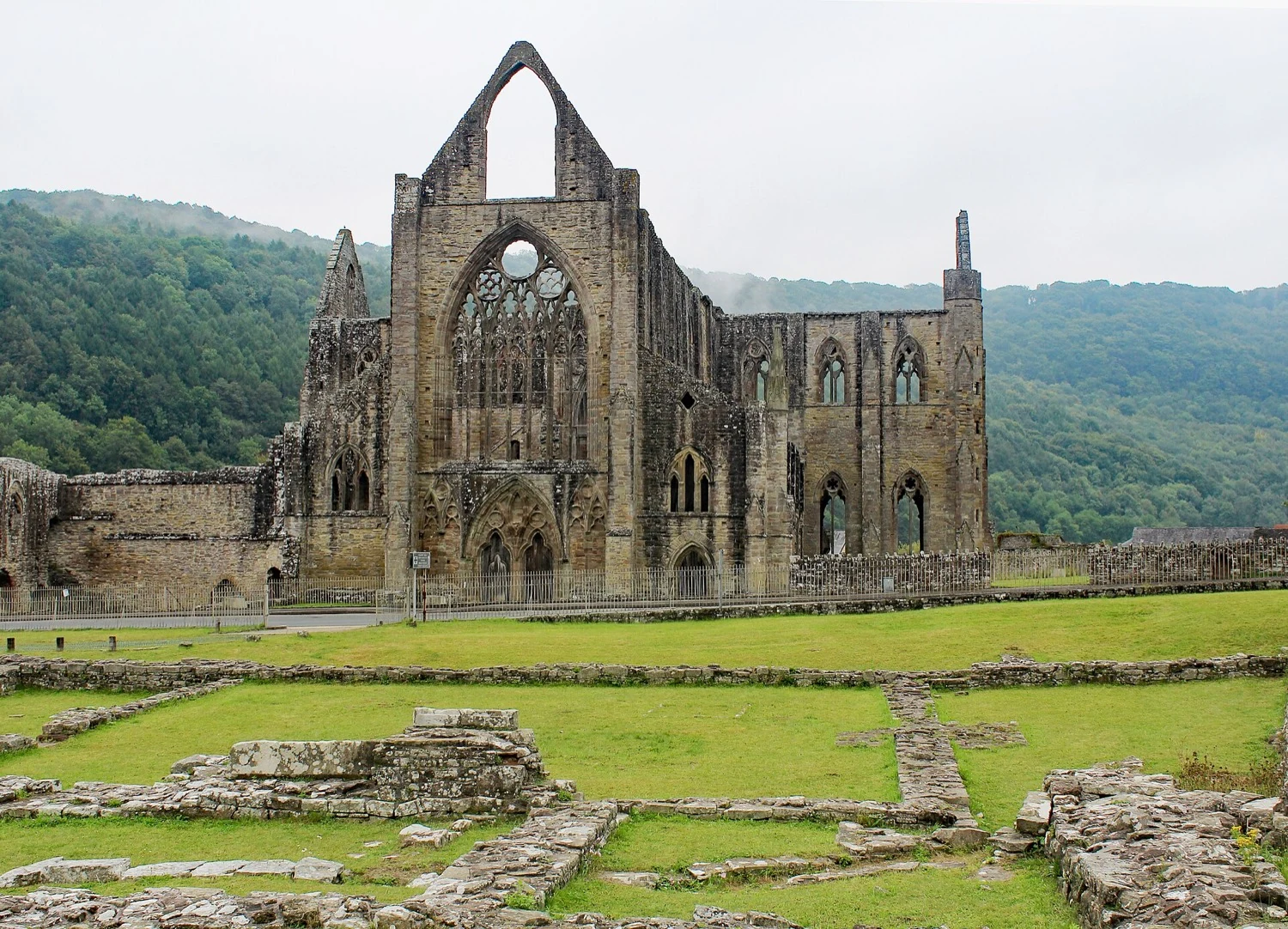
In the Wye valley, on the Welsh bank, the ruins of Tintern Abbey rank among the most famous in Britain. This great Cistercian abbey has become the very icon of the Dissolution of the Monasteries — and, two centuries later, a manifesto of the Romantic Sublime.
The richest Welsh abbey
Founded in the twelfth century, Tintern was, on the eve of the Reformation, the richest abbey in Wales: its net revenue reached £192 in 1535. A great Cistercian house, it radiated over the Wye valley, with its magnificent abbey church with its soaring vault and its great west window. Its very prosperity was to condemn it, when Henry VIII decided to close the monasteries and confiscate their property.
The surrender of 1536
On 3 September 1536, Abbot Wych surrendered Tintern and its domains to the king's visitors, ending four centuries of monastic life. The abbey was struck by the first Act of Suppression (1536), which targeted the houses whose revenue was below £200 — Tintern, at £192, fell just under the threshold, a paradoxical victim of its relative accounting modesty. The estate was granted to Henry Somerset, 2nd Earl of Worcester, lord of Chepstow. The sale of the roof lead began the ruin of the building, left open to the sky. Tintern thus illustrates, spectacularly, the brutality of the Dissolution: the finest abbey in Wales reduced to a skeleton of stone. To see: the great abbey church with its collapsed vault and its west window, the nave arcades, the romantic setting of the Wye valley.
Did you know?
Two centuries after its ruin, Tintern knew a second glory: in the Romantic age, its ivy-covered arches, bathed in the light of the Wye valley, became the very emblem of the Sublime. The painter Turner made famous watercolours of it, and the poet Wordsworth dedicated to it one of his greatest poems (Lines Composed a Few Miles above Tintern Abbey, 1798). The ruin that the Reformation had made became thus, for the Romantics, an involuntary masterpiece — beauty born of destruction.
Notes
Tintern Abbey lies at Tintern, Monmouthshire, on the Welsh bank of the Wye; ruins run by Cadw, open to visits. Seasonal hours to check.
Quiz
- What was Tintern on the eve of the Reformation?
- The richest abbey in Wales
- A castle
- A university
- When was it surrendered to the king?
- On 3 September 1536
- In 1485
- In 1605
- Which Romantic artists celebrated it?
- Turner (painting) and Wordsworth (poetry)
- Shakespeare and Marlowe
- Holbein and Hilliard