
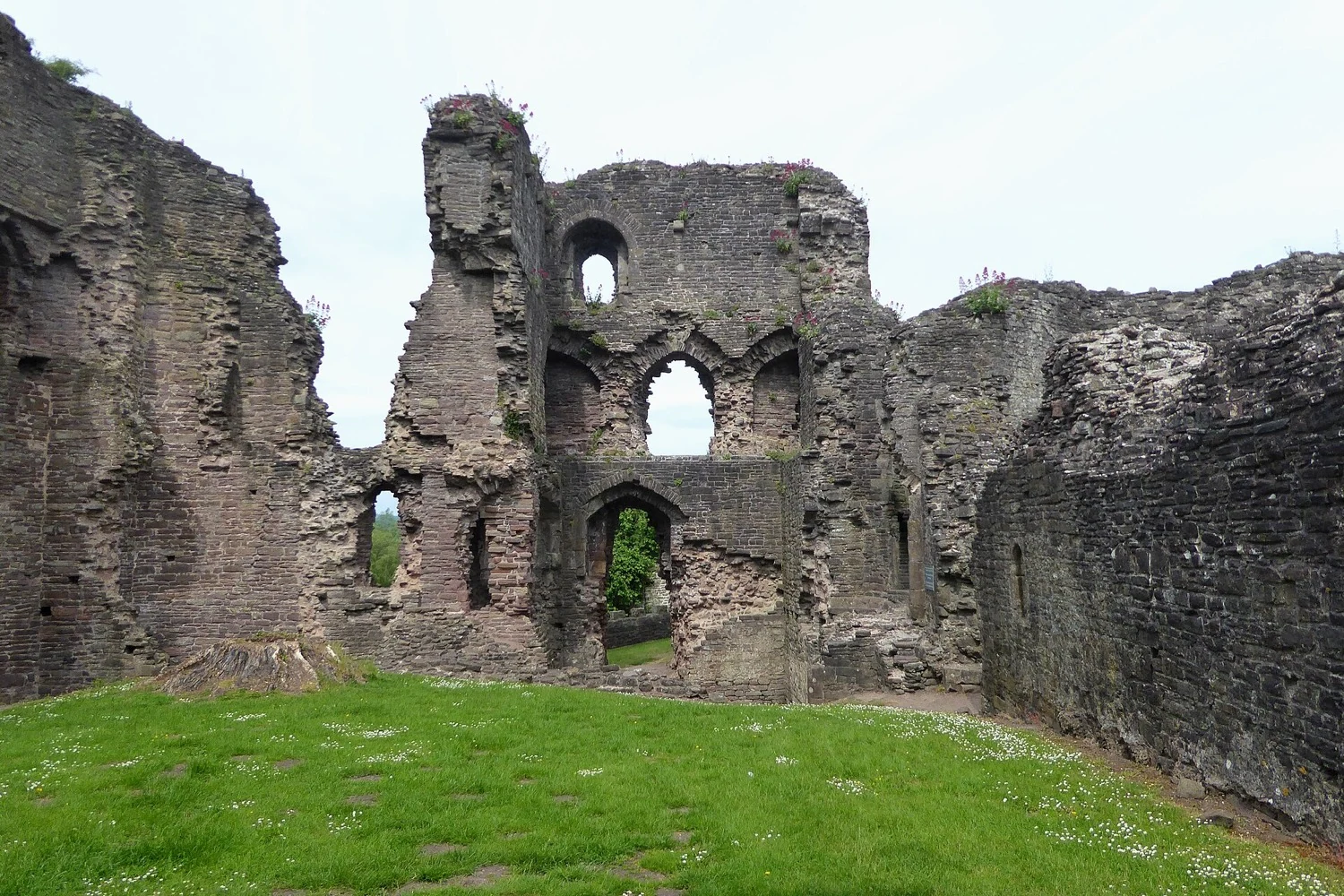
At Abergavenny (Y Fenni), at the gates of the Black Mountains, the ruins of a castle dominate the Usk valley. In Tudor times, this fortress, no longer permanently inhabited, was above all looked at — described by the great antiquaries of the English Renaissance, who cast a new, learned eye on the realm's heritage.
A fortress under the humanist gaze
In the sixteenth century, Abergavenny was no longer the permanent residence of a great lord, but the castle remained standing and 'in good repair'. This is what the antiquary John Leland noted during his great itinerant enquiry of the 1540s — that Itinerary where, on Henry VIII's orders, he travelled England and Wales to describe its monuments, towns and antiquities. This humanist gaze, curious and methodical, on heritage was in itself a novelty of the Renaissance: people were beginning to study old monuments for their own sake, to inventory them, to write their history.
A dark memory
Abergavenny nevertheless carried a sinister reputation. The antiquary William Camden, in his monumental Britannia (1586), would call it 'more stained with treasons than any other castle in Wales' — an allusion notably to the famous 'massacre of Abergavenny' of 1175, where the Norman lord had treacherously had Welsh chieftains killed after inviting them to a banquet. This dark memory, transmitted by the chroniclers, was still vivid in Tudor times. Abergavenny thus illustrates how the English Renaissance, through its antiquaries, built the historical narrative of the realm — mixing learned description and the memory of old infamies. To see: the ruins of the gatehouse and towers, the keep on the motte (housing the museum), the views over the Usk valley.
Did you know?
John Leland, the man who described Abergavenny in the 1540s, was the first great 'antiquary' of England — the ancestor of historians and archaeologists. Commissioned by Henry VIII, he criss-crossed the realm to list its monuments and libraries, notably those of the monasteries the Dissolution threatened. His work, left unfinished (he sank into madness), saved the memory of countless places — and inaugurated, in the Renaissance, the learned gaze on national heritage.
Notes
Abergavenny Castle lies at Abergavenny, Monmouthshire; ruins and museum (in the keep) open to the public. Hours to check.
Quiz
- Which antiquary described Abergavenny in the 1540s?
- John Leland
- Shakespeare
- Thomas More
- What was Leland doing on Henry VIII's orders?
- Listing the realm's monuments and libraries
- Raising taxes
- Commanding the army
- How did Camden describe Abergavenny?
- 'More stained with treasons than any castle in Wales'
- 'The finest in the world'
- 'A mere warehouse'