
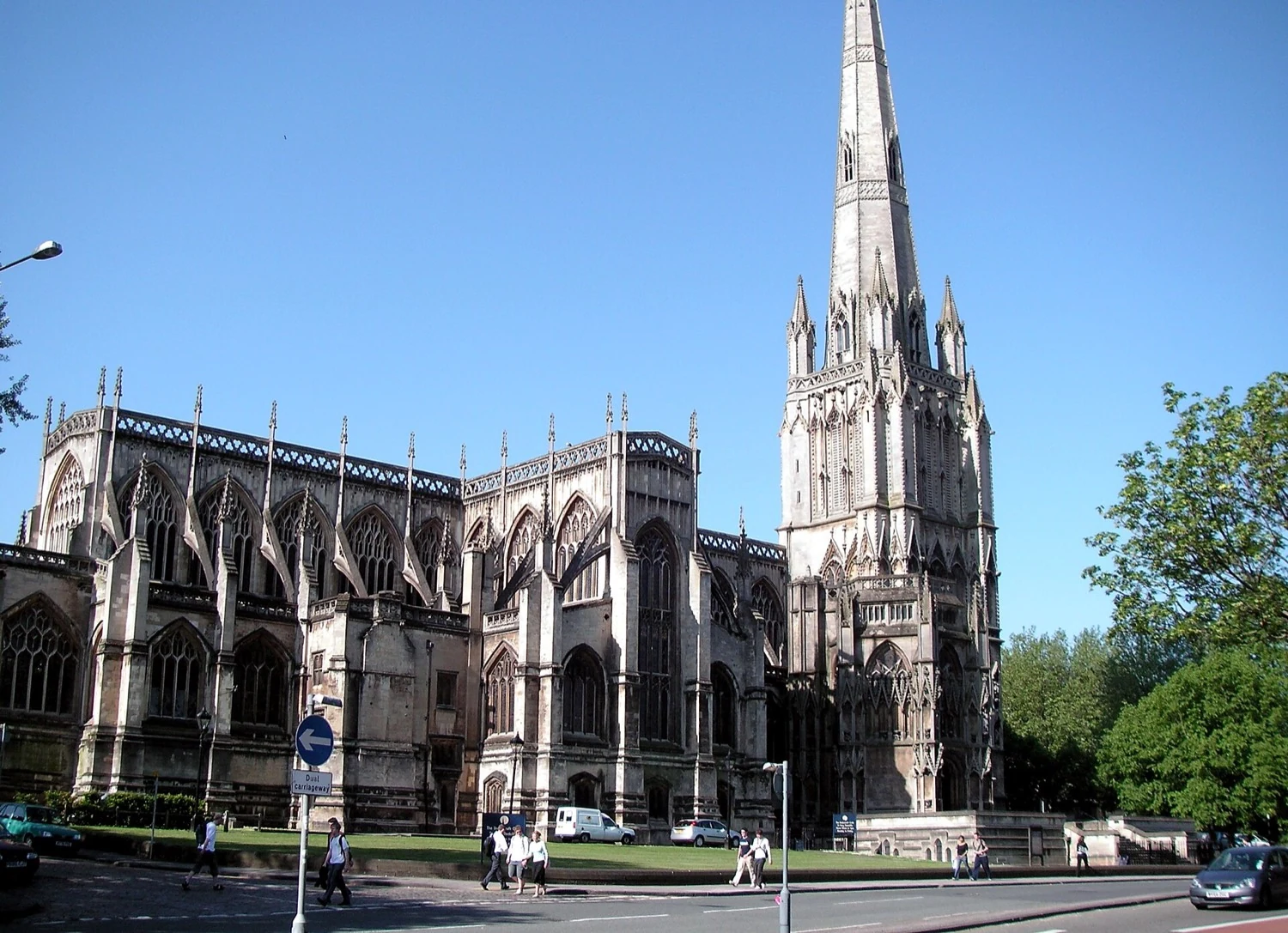
In the Redcliffe district of Bristol, this immense parish church rivals many cathedrals in splendour. Built by the wealth of the merchants of a great port, it is the symbol of Bristol's commercial power in the Renaissance — and received, it is said, the finest compliment ever paid to an English church, from the mouth of the queen herself.
The church of the Bristol merchants
St Mary Redcliffe owes its grandeur to the money of trade. Bristol was one of the great ports of England, turned towards the Atlantic, and its merchants vied in generosity towards their parish church. The most famous of them, William Canynges, a rich shipowner of the fifteenth century, has his polychrome tomb here. The Lady Chapel was enlarged in 1494 under Sir John Juyn. The church, with its stone vaults — rare for a parish building —, its more than a thousand gilded bosses and its hexagonal north porch, displays a wealth worthy of a cathedral: it is the portrait, in stone, of a proud and prosperous merchant class.
Elizabeth's compliment
In 1574, during a visit to Bristol, Elizabeth I visited St Mary Redcliffe and is said to have called it 'the fairest, goodliest and most famous parish church in England' — a phrase that has remained famous (historians debate its exact authenticity, but it has come through the centuries). The queen also marked her favour concretely: by letters patent (1588, 1591), she restored to the church funds that had been confiscated. This royal patronage towards a mere parish church bears witness to the exceptional prestige of the place. To see: the hexagonal north porch (1325), the stone vaults, the more than 1,100 carved gilded bosses, the polychrome tomb of William Canynges.
Did you know?
The phrase attributed to Elizabeth I — 'the fairest, goodliest and most famous parish church in England' — has been the pride of Bristol for more than four centuries. It matters little, in the end, that historians debate its exact authenticity: the mere fact that a queen could have spoken it, and that the town took such pride in it, says enough of the splendour of a church built not by a king nor a bishop, but by merchants.
Notes
St Mary Redcliffe lies in the Redcliffe district of Bristol; a working parish church, open to visits. Hours to check.
Quiz
- Thanks to whom was St Mary Redcliffe so richly built?
- The merchants of Bristol
- The Norman kings
- The Benedictine monks
- How is Elizabeth I said to have described it in 1574?
- The fairest parish church in England
- A ruin
- A mere chapel
- Who was William Canynges?
- A rich merchant patron (tomb)
- A bishop
- A pirate