
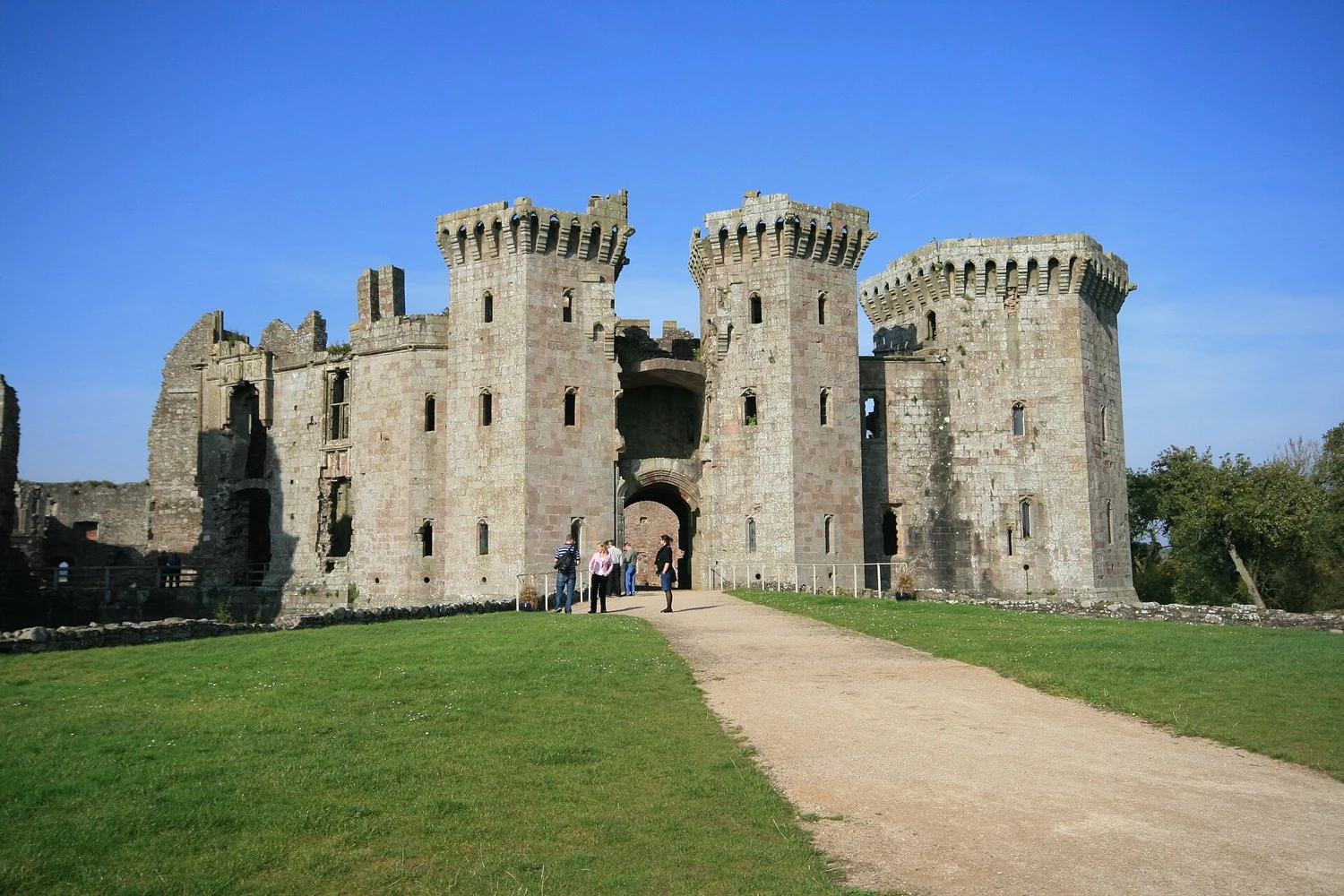
In the Monmouthshire countryside, the majestic ruins of Raglan Castle still raise their great hexagonal tower ringed by a moat. Built at the end of the Middle Ages and sumptuously embellished under the Tudors, Raglan is the last great castle of display in Wales: at once fortress, palace and manifesto of power.
A fortress turned palace
Raglan was built in the fifteenth century by rich lords, among them William Herbert, in a style on the hinge of the fortress and the pleasure house. Its centrepiece is the Great Tower, a hexagonal keep isolated by its own moat, a symbol of power as much as a defensive work. Passing to the Somersets, Earls and then Marquesses of Worcester, the castle was, throughout the sixteenth century, transformed into a sumptuous house: long galleries, richly adorned apartments, a timber-roofed great hall, fountains and gardens. Raglan became one of the most magnificent aristocratic residences in Britain, where guests were received with princely splendour.
The twilight of a world
Raglan illustrates the moment when the medieval castle becomes a Renaissance house without giving up its warlike splendour. The Somersets, one of the great Welsh families integrated into the high nobility of the kingdom, displayed here a brilliant court, a renowned library, Italian-style gardens. The castle knew its height at the end of the sixteenth and the start of the seventeenth century. Its fate turned later, during the English Civil War (1640s): besieged and taken, Raglan was deliberately dismantled, its Great Tower mined and thrown down. Of its glory only superb ruins remain — the memory of the last great sumptuous castle of Wales.
What to see
- The hexagonal Great Tower ringed by its moat.
- The great hall, the galleries and the ruined state apartments.
- The remains of the Renaissance gardens and fountains.
- The ensemble, witness of the passage from fortress to house of splendour.
Did you know?
The Great Tower of Raglan resisted so well during the Civil War siege that, to prevent it serving again, the victors set about demolishing it methodically — a work so difficult that it took weeks to overcome its thick walls. The hexagonal tower, symbol of the Somersets' power, owed its ruin to its own solidity: too strong to be left standing, it was thrown down stone by stone. What is admired today is only the skeleton of a colossus.
Practical information
Raglan Castle lies near Monmouth, in Monmouthshire, in the south-east of Wales. It is today a site in the care of Cadw (the Welsh heritage service), open to the public. Opening hours and days are liable to change with the seasons; it is best to check them against the official sources before visiting.
Quiz
- What is the centrepiece of Raglan Castle?
- The hexagonal Great Tower, ringed by a moat
- A gilded dome
- A cathedral
- Which family sumptuously embellished Raglan in the sixteenth century?
- The Somersets (Earls of Worcester)
- The Cecils
- The Boleyns
- How was Raglan ruined?
- Dismantled after a Civil War siege
- Destroyed by a fire
- Swept away by a flood