
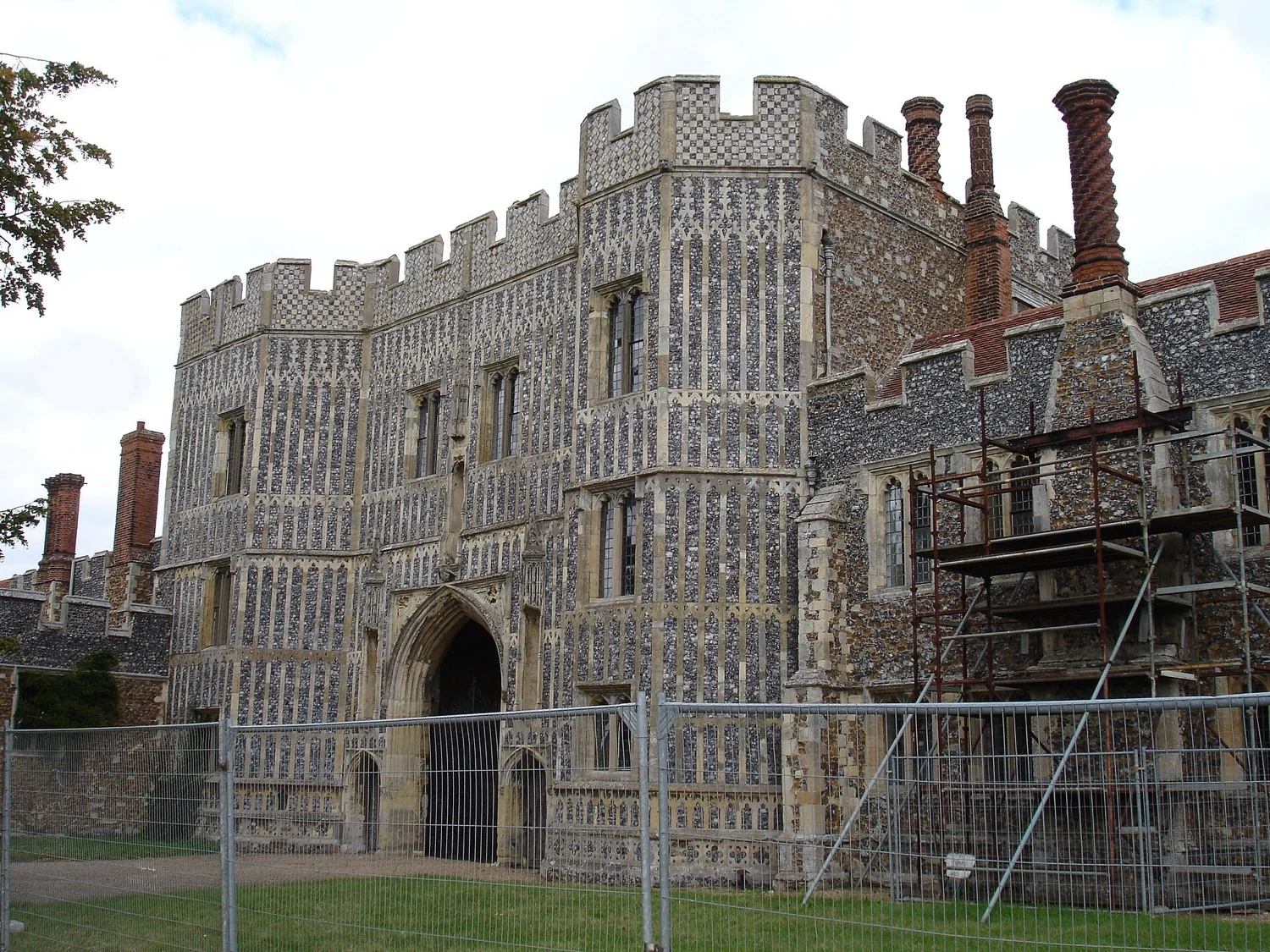
On the Essex coast, St Osyth Priory keeps a magnificent late-medieval gatehouse and the remains of one of the greatest monasteries in the county. Dissolved by the Reformation, converted into a Tudor house, the site is also linked to a dark episode of Elizabethan history: the resounding witchcraft trial of 1582.
From a great monastery to a Tudor house
An Augustinian priory founded around 1121, St Osyth was one of the most important in Essex. It was dissolved in 1539 during the great wave of suppression of the monasteries. After a brief passage through Thomas Cromwell — the architect of the Dissolution —, it was acquired by Thomas Darcy, 1st Baron Darcy of Chiche, who converted the vast monastic complex into a Tudor house, recognisable by its chequerwork masonry alternating flint and stone. It is once again an example of the redistribution of Church property to the nobility and the servants of the Crown, one of the great economic springs of the period.
The witches of St Osyth (1582)
The village has remained famous above all for the witchcraft trial of 1582, one of the most resounding of the Elizabethan age. From the accusations brought against a certain Ursula Kemp, a veritable witch-hunt fell upon St Osyth: several women were accused, tried, and some executed. This trial, marked by the recourse to children's 'confessions' and to chain denunciation, is a major case study of the repression of witchcraft in England — a fear that ran through the whole Renaissance and which, under James I (author of a treatise on demonology), reached its peak. To see: the great late-fifteenth-century gatehouse with decorative flint-work, the Abbot's Tower and the chapel ruins, the chequerwork masonry of the Tudor conversion.
Did you know?
The St Osyth trial of 1582 is one of the few of which a detailed printed account of the time has been preserved. In it one sees how the fear of witches fed on village grudges, unexplained misfortunes (dead cattle, sick children) and extracted testimonies — including from children denouncing their own mother. These mechanisms of the Elizabethan witch-hunt prefigure those that, a century later, would set Salem ablaze, in New England.
Notes
St Osyth Priory lies at St Osyth, Essex; a scheduled monument (several Grade I buildings), access according to openings. Hours to check.
Quiz
- What did the priory of St Osyth become after 1539?
- A Tudor house (via Thomas Darcy)
- A cathedral
- An artillery fort
- For which episode is the village famous?
- A great witchcraft trial (1582)
- A naval battle
- A coronation
- Who was at the heart of the 1582 accusations?
- Ursula Kemp
- Anne Boleyn
- Mary Stuart