
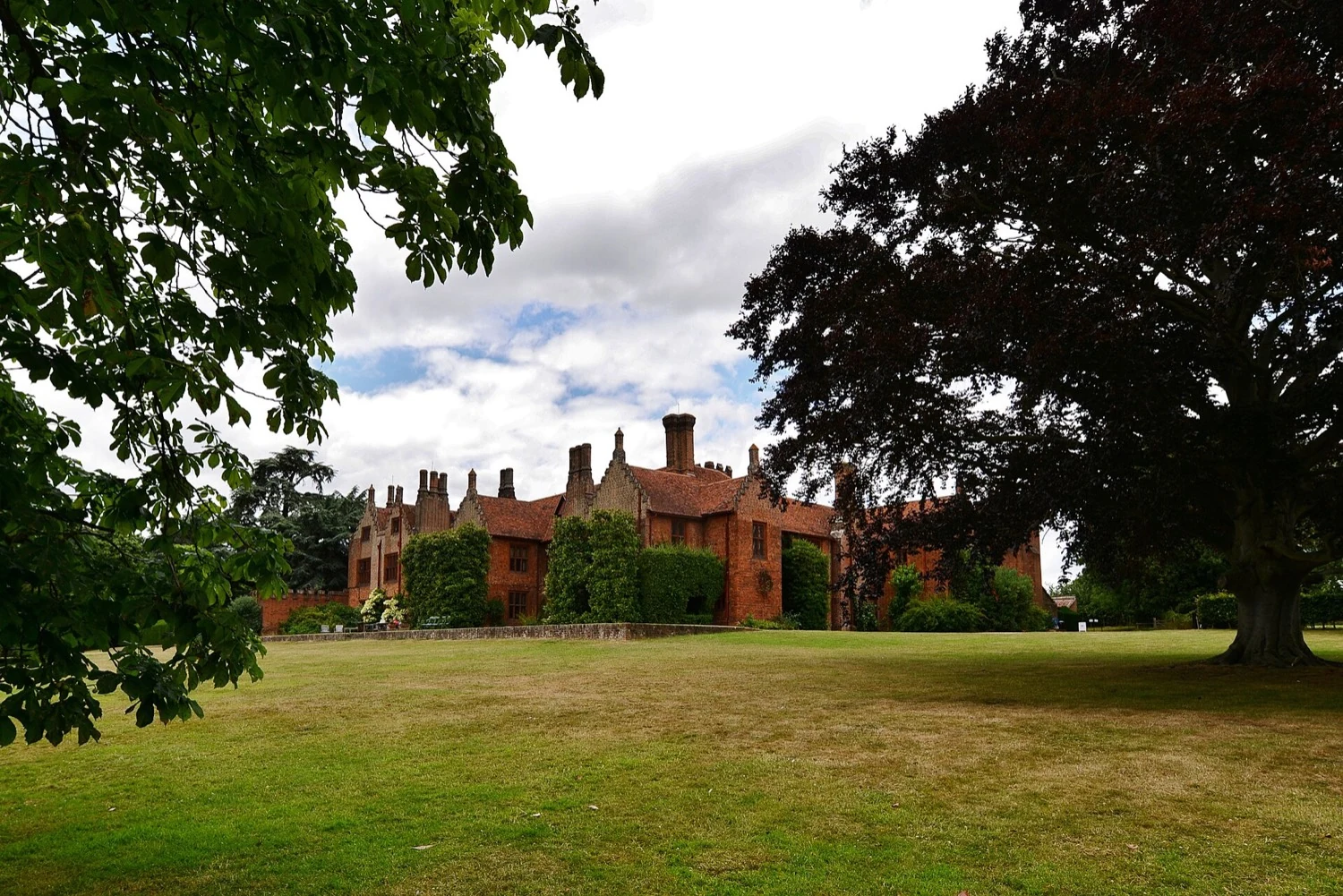
Near Chelmsford, in Essex, Ingatestone Hall is a fine Tudor brick manor built by one of the great servants of the state. But its most fascinating interest lies in the faith of its masters: the Petres, who remained Catholic in the Protestant England of Elizabeth, hid priests here — and the greatest composer of the time wrote here for their forbidden masses.
The house of a secretary of four sovereigns
Ingatestone was built from 1539 to 1556 by Sir William Petre, a statesman of exceptional longevity: he was Secretary of State to four successive sovereigns — Henry VIII, Edward VI, Mary I and Elizabeth I —, coming through all the religious reversals of the century without ever falling. He built his brick manor on lands of Barking Abbey, acquired after the Dissolution. His U-plan house, with its crow-stepped gables and its tall ornate chimneys, received Elizabeth I in 1561. The motto of the clock tower, 'Sans Dieu Rien' ('Nothing without God'), tells the piety of a family that would pay dearly for its loyalty to the old faith.
Hidden priests and clandestine music
For the Petres remained Catholic (recusants) in an England where the Mass was forbidden and where hiding a priest could lead to the scaffold. Ingatestone keeps two 'priest holes' — hiding places arranged to conceal priests during searches. In the 1590s, the greatest English composer of his time, William Byrd, himself a Catholic, composed here part of his clandestine liturgical music, intended for the masses celebrated in secret in the house. A priest linked to the family, St John Payne, was executed in 1582. Ingatestone is thus a moving condensed image of Elizabethan religious tensions: loyalty, clandestinity, the risk of death — and the beauty of the music born of this resistance. To see: the U-plan Tudor structure (crow-stepped gables, ornate chimneys), the two priest holes, the Long Gallery, the clock tower with its motto 'Sans Dieu Rien'.
Did you know?
Part of the finest English sacred music was written to be sung in hiding: in the 1590s, William Byrd composed at Ingatestone (and in other Catholic houses) masses intended for the clandestine celebrations of the recusants, in low voices, doors locked, the priest ready to slip into his hiding place. These masterpieces, born of danger and forbidden faith, rank today among the summits of Renaissance music.
Notes
Ingatestone Hall lies at Ingatestone, near Chelmsford, Essex; still inhabited by the Petre descendants (Grade I), open to the public seasonally. Hours to check.
Quiz
- To how many sovereigns was Sir William Petre Secretary of State?
- Four (Henry VIII to Elizabeth I)
- Only one
- None
- What is a 'priest hole' at Ingatestone?
- A hiding place to conceal priests
- A well
- A wine cellar
- Which composer wrote here for the clandestine masses?
- William Byrd
- Thomas Tallis
- John Dowland