
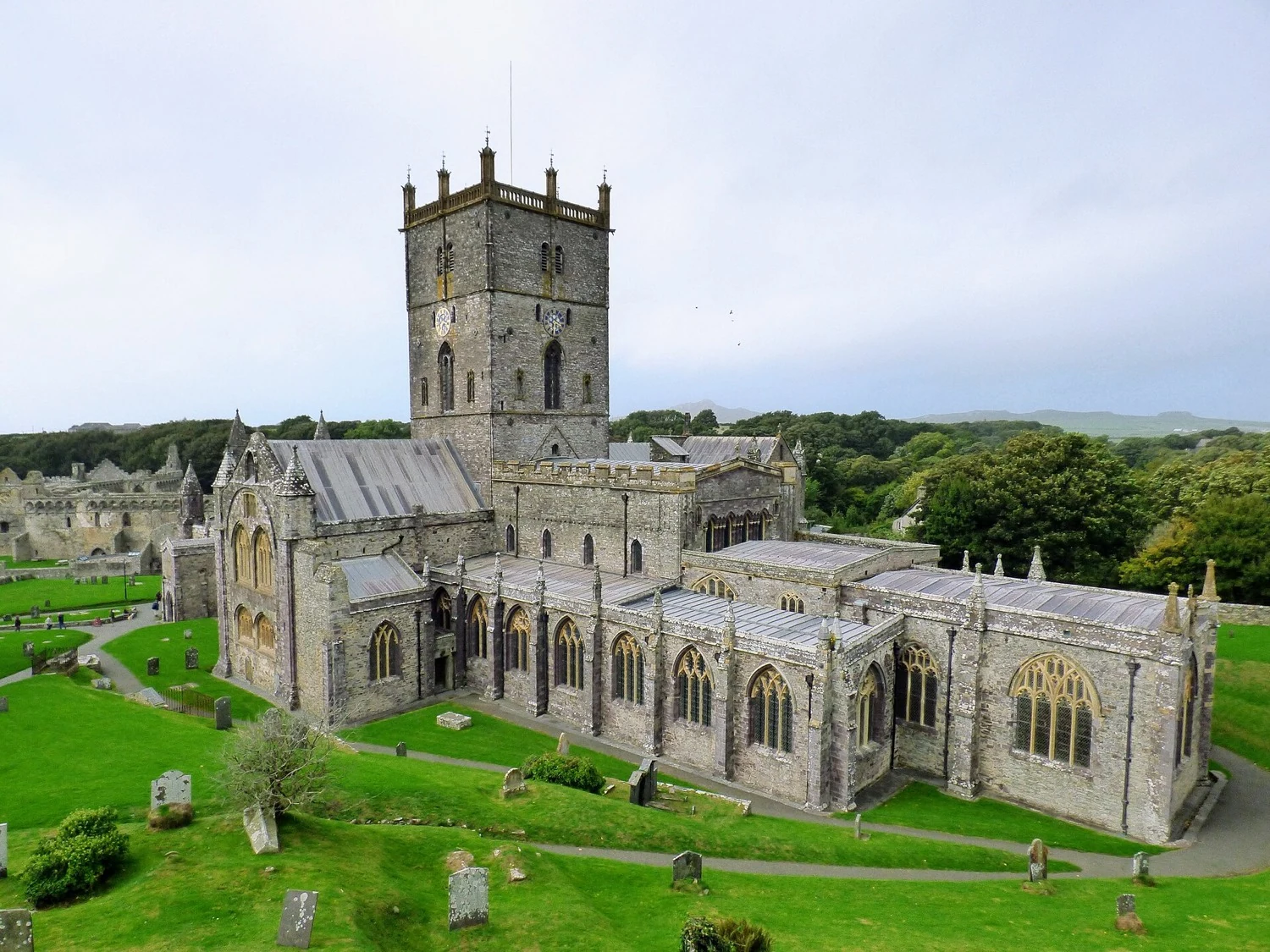
At the far west of Wales, in a valley that hides it from the sight of the sea, St Davids Cathedral stands near the ruins of its bishops' palace. It is the spiritual heart of the Welsh nation: the shrine of St David (Dewi Sant), patron of the country, whose tomb drew centuries of pilgrims.
The shrine of the patron saint
St Davids owes its name and its glory to St David (Dewi Sant, sixth century), founder of a monastery on this spot and patron of Wales. In the Middle Ages the cathedral built on his tomb became one of the great places of pilgrimage in Western Christendom — two pilgrimages to St Davids were said to equal one to Rome. Hidden in its valley to escape the raiders come from the sea, the cathedral, of purple sandstone, impresses by its nave with leaning piers and its magnificent oak ceiling. Beside it rose the sumptuous Bishop's Palace, the bishops' residence, adorned with decorative arcading — a sign of the wealth and power of the Welsh Church before the Reformation.
The Reformation at land's end
The Reformation reached even this isolated sanctuary. The pilgrimages were abolished, the shrine of St David stripped of its ornaments, the relics dispersed. The Bishop's Palace, too vast and too costly for a soberer reformed Church, was gradually abandoned and fell into ruin — its elegant arcades now open to the sky. The cathedral, for its part, survived as an episcopal see and place of worship. St Davids thus embodies the fate of the Welsh Church at the Renaissance: stripped of its medieval splendours, but kept as the heart of a people's faith. It was here too that, at the end of the sixteenth century, the effort to translate the Bible into Welsh radiated, decisive for the country's language and faith.
What to see
- The sandstone cathedral in its valley, its nave with leaning piers.
- The carved oak ceiling of the nave.
- The tomb (shrine) of St David, patron of Wales.
- The ruins of the Bishop's Palace and its decorative arcading.
Did you know?
In the Middle Ages, St Davids was a pilgrimage goal so revered that the Church declared two journeys to St Davids worth one pilgrimage to Rome, and three worth a pilgrimage to Jerusalem. That says the importance of this sanctuary lost at the end of the Welsh lands. The Reformation ended these pilgrimages; but the cathedral still holds in its valley, and St David remains, every 1 March, celebrated as the patron of Wales.
Practical information
St Davids lies at the western tip of Pembrokeshire, in Wales; it is the smallest 'city' in Britain. The cathedral is a working place of worship open to visitors; the ruined Bishop's Palace is in the care of Cadw. Hours are liable to change; it is best to check them against the official sources before visiting.
Quiz
- Whose tomb does St Davids hold?
- St David (Dewi Sant), patron of Wales
- St Patrick
- St George
- What did the Bishop's Palace become after the Reformation?
- It was abandoned and fell into ruin
- It became a royal castle
- It was turned into a university
- What were two pilgrimages to St Davids said to be worth?
- One pilgrimage to Rome
- A year of indulgences
- A title of nobility