
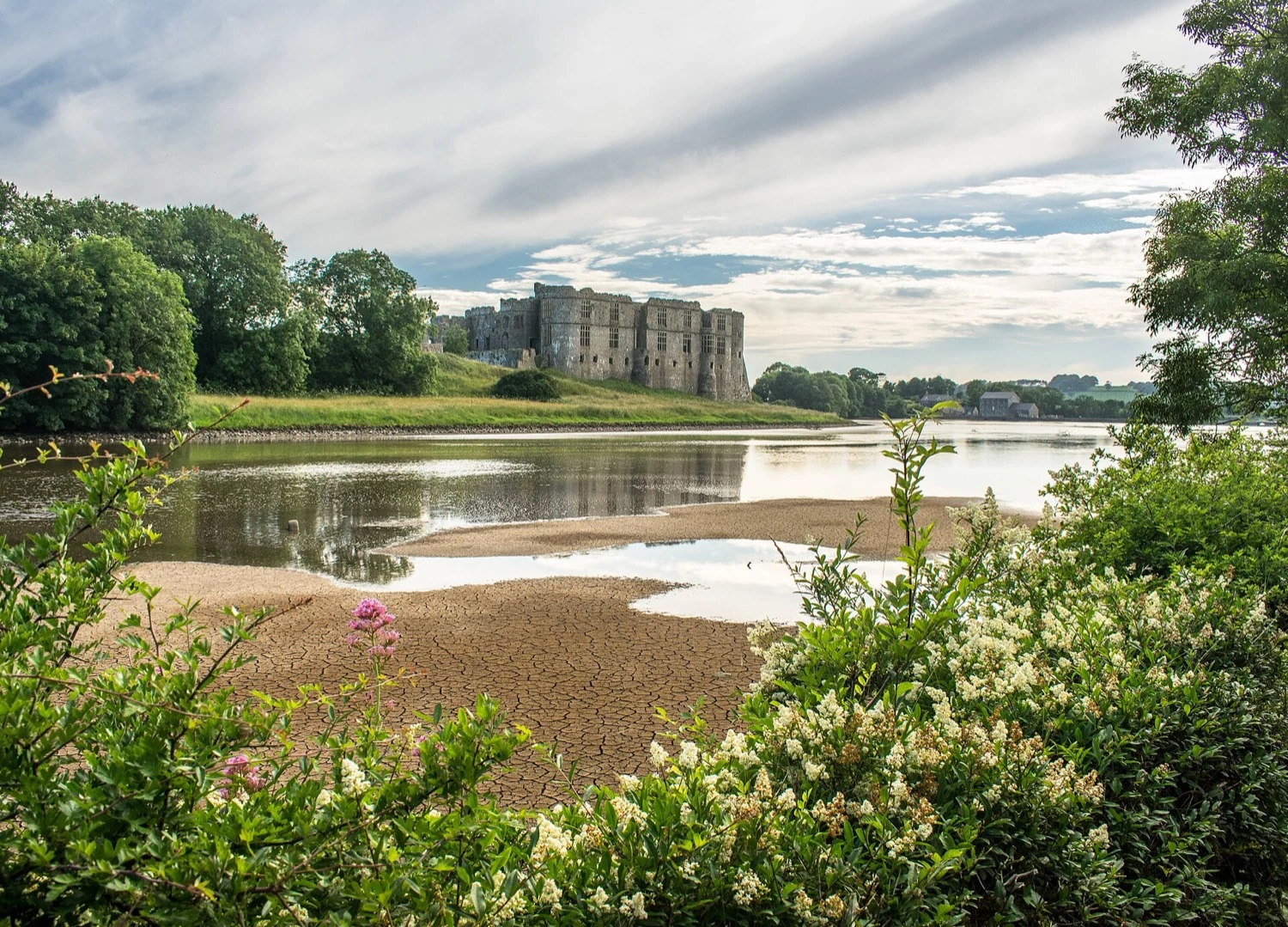
By a tidal inlet of Pembrokeshire, Carew Castle offers a striking contrast: on one side, the stern walls of a medieval fortress; on the other, a wing pierced with immense Elizabethan windows, open to the landscape. This marriage of war and light is the work of Sir John Perrot, one of the most colourful figures of the age.
From fortress to house of light
Carew was originally a medieval fortress guarding a strategic crossing in the Welsh west. In the sixteenth century it passed to Sir John Perrot, a Pembrokeshire gentleman of meteoric fortune. Rather than raze the old stronghold, Perrot added, around 1580, a magnificent north wing in the pure Elizabethan style: vast windows, a long gallery, comfortable apartments. The castle thus shows, on a single silhouette, the passage from one world to another: the fortress turned towards defence and the house turned towards the landscape and the pleasure of the eye. Perrot wanted, it was said, a residence worthy of receiving the queen — whom he never received.
Sir John Perrot, an eventful fate
Sir John Perrot (c. 1528-1592) was an extraordinary character: imposing, choleric, ambitious, he made a brilliant career in the Crown's service, rising to be Lord Deputy of Ireland, charged with governing it in the name of Elizabeth I. Rumour, unverifiable but stubborn, held him to be a natural son of Henry VIII — whose build and temperament he is said to have had. His fortune ended badly: accused of treason, he was condemned to death and died in the Tower of London in 1592, before the execution. Carew keeps the memory of this outsized man, whose unfinished wing of glass bears witness to both the ambition and the fall.
What to see
- The Elizabethan north wing with its immense windows, Perrot's work.
- The walls and towers of the original medieval fortress.
- The waterside setting (the tidal inlet and the neighbouring tidal mill).
- The memory of Sir John Perrot and his tragic fate.
Did you know?
It was long whispered that Sir John Perrot was a natural son of Henry VIII: he is said to have had his tall stature, his red beard, his thundering voice and his hot temper. Nothing ever proved it, but the resemblance struck contemporaries. True or false, Perrot's fate had something Tudor about it to the end: risen to the summit of power, he ended accused of treason and died a prisoner in the Tower — like so many kin, real or supposed, of the royal house.
Practical information
Carew Castle lies near Pembroke, in Pembrokeshire, in the west of Wales. It is today a site in the care of the Pembrokeshire Coast National Park, open to the public, with its neighbouring tidal mill. Opening hours and days are liable to change with the seasons; it is best to check them against the official sources before visiting.
Quiz
- What did Sir John Perrot add to the fortress of Carew around 1580?
- An Elizabethan wing with immense windows
- A defensive keep
- A Romanesque chapel
- What rumour ran about Sir John Perrot's origins?
- That he was a natural son of Henry VIII
- That he descended from the kings of Scotland
- That he was Italian
- How did Sir John Perrot end?
- Condemned for treason, he died in the Tower of London
- He became King of Ireland
- He retired to a monastery