
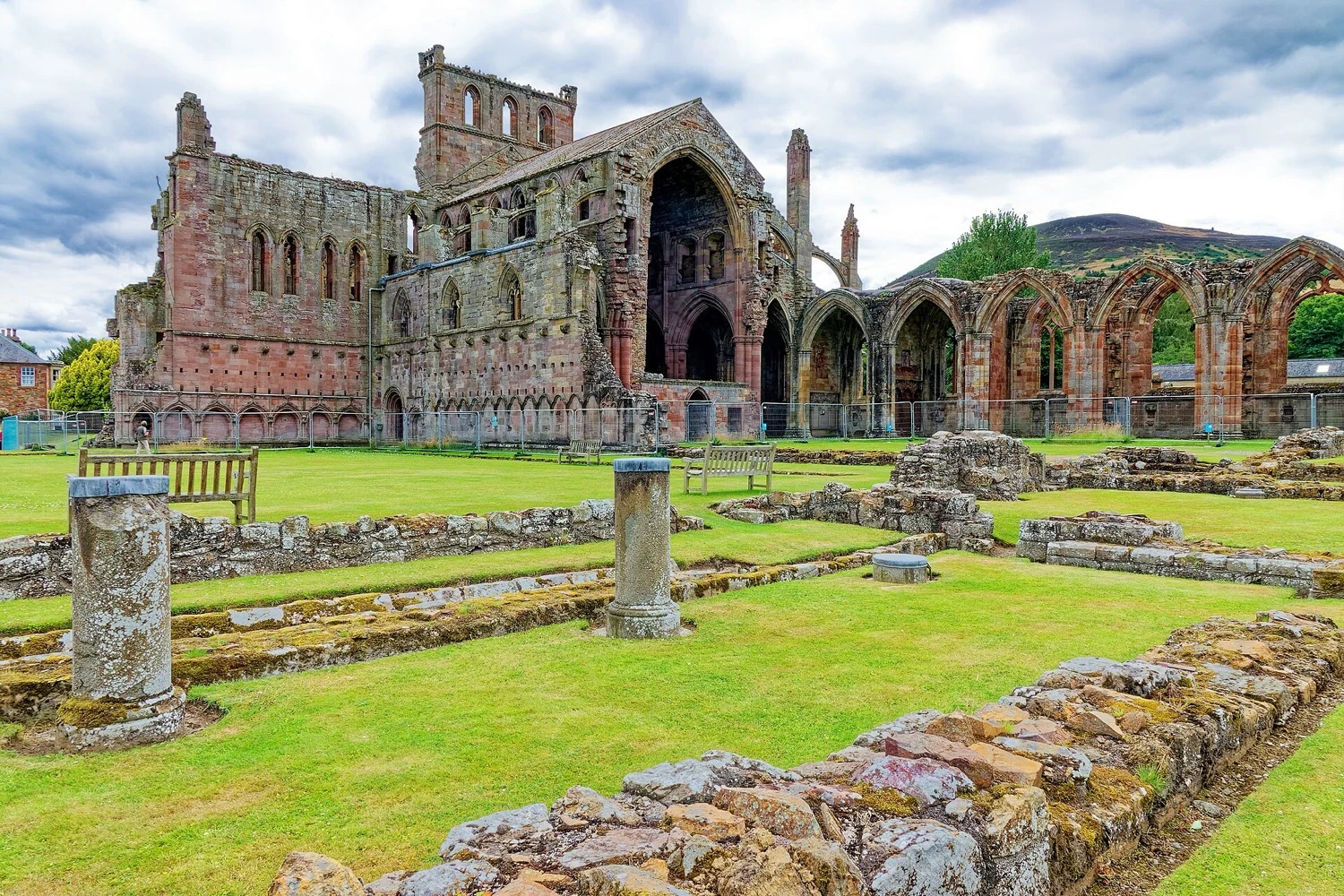
In the gentle valley of the Tweed, in the heart of the Scottish Borders, Melrose Abbey raises its ruins of pink sandstone, among the finest in Britain. A Cistercian abbey of rare ornamental richness, it was ruined by the wars with England and then carried off by the Reformation — but keeps, legend says, the heart of King Robert Bruce.
An abbey of the Borders
Founded in 1136 by Cistercians at the call of King David I, Melrose became one of the richest and finest abbeys in Scotland. Located in the Borders, a frontier region constantly ravaged by the Anglo-Scottish wars, it was several times plundered and burned by English armies, then rebuilt. Its last great rebuilding, in the fifteenth century, gave it a profusion of carvings of extraordinary fineness: fantastic gargoyles, minute foliage, statues of saints, and even a famous pig playing the bagpipes perched on the heights. Melrose, on the eve of the Renaissance, was a jewel of late Gothic art.
The Reformation and the ruin
The fate of Melrose turned in the sixteenth century. Damaged one last time by the English in the 1540s (during the 'Rough Wooing', the war waged to force a marriage between the child Mary Stuart and Henry VIII's son), the abbey never really recovered. The Scottish Reformation of 1560, led by John Knox and Parliament, abolished the monastic order: the monks died out little by little, the abbey ceased to function, its stones were partly reused. Of this masterpiece only ruins remain — but ruins of striking beauty. Tradition holds that the heart of Robert Bruce, hero of Scottish independence, is buried here: an urn found during excavations has revived this legend dear to Scottish hearts.
What to see
- The pink sandstone ruins and their carvings of rare fineness.
- The famous bagpipe-playing pig carved on the heights.
- The spot where the heart of Robert Bruce is said to be buried.
- The setting of the Tweed valley, in the heart of the Borders.
Did you know?
Robert Bruce, King of Scotland and hero of independence, is said to have asked, at his death in 1329, that his heart be carried on crusade against the infidels, then brought back and buried at Melrose. The heart, legend says, travelled as far as Spain in the fighting, before returning to rest in the abbey. In 1996, archaeologists exhumed there a small lead urn containing an embalmed heart: without absolute certainty, many see in it the heart of the great king, given back at last to the soil of Scotland.
Practical information
Melrose Abbey lies at Melrose, in the Scottish Borders, in the south-east of Scotland. It is today a ruin in the care of Historic Environment Scotland, open to the public. Opening hours and days are liable to change (conservation works may limit access); it is best to check them against the official sources before visiting.
Quiz
- Whose heart is said to be buried at Melrose?
- Robert Bruce
- James V
- Macbeth
- Which event of 1560 ended the monastic life of Melrose?
- The Scottish Reformation
- An earthquake
- The plague
- What unusual carving adorns the heights of Melrose?
- A pig playing the bagpipes
- A winged dragon
- A mermaid