
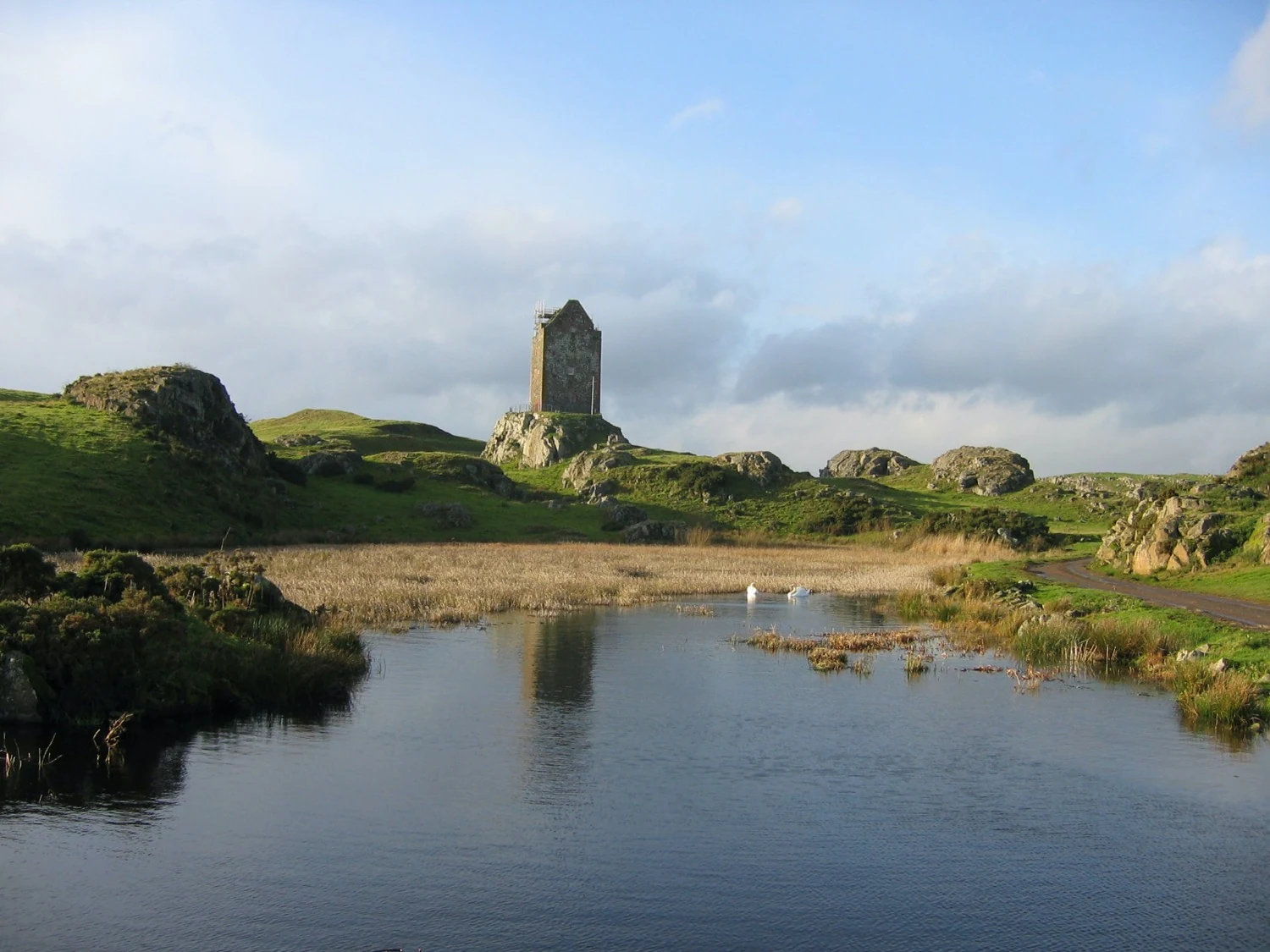
West of Kelso, raised on the crag of Lady Hill, Smailholm Tower is the very emblem of the age of the Border Reivers — those raiding horsemen who plundered the Anglo-Scottish frontier. A bare, tall peel tower, made to survive raids.
A tower to survive
Built in the fifteenth or early sixteenth century by the Pringle family (formerly Hoppringle), vassals of the Earl of Douglas, Smailholm is a peel tower — a watchtower and refuge typical of the marches. Its basalt walls, 2.4 m thick, its position on a crag, its stone vault: everything is designed to protect people and cattle during raids. During the wars of the mid-sixteenth century (raids of 1543, 1544, 1546), the English garrison of Wark Castle plundered it and carried off prisoners and cattle. To see: the four-storey rectangular tower, the vault of the top level, the barmkin and the chapel foundations.
Did you know?
Smailholm inspired the imagination of the poet Walter Scott, who spent his childhood at a nearby farm and fed on the Border ballads at the foot of this tower. The Reivers' peel tower thus became, much later, one of the sources of Scottish Romanticism — the stone of the raids turned into a cradle of legends.
Notes
Smailholm Tower lies about 8 km west of Kelso, Scottish Borders; a site in the care of Historic Environment Scotland. Hours to check.
Quiz
- What is a 'peel tower' like Smailholm?
- A watchtower and refuge of the marches
- A cathedral
- A royal palace
- Against whom did Smailholm protect?
- Border raids (Border Reivers, English)
- The Vikings
- The Romans
- Which family built it?
- The Pringles (Hoppringle)
- The Gordons
- The Stuarts