
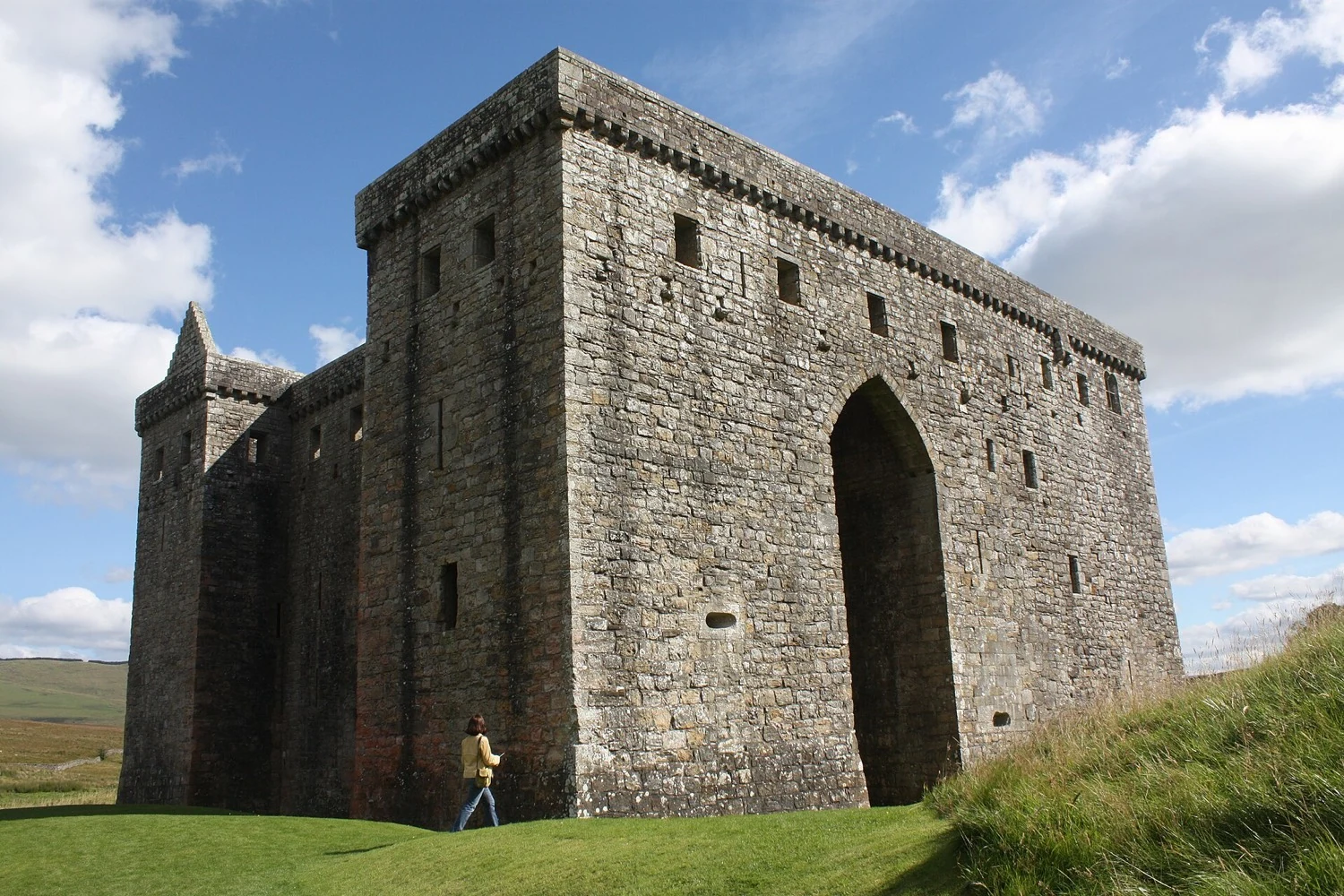
In the Borders, near Newcastleton, Hermitage Castle raises its austere, almost sinister mass — the 'guardhouse of the bloodiest valley in Britain'. A key fortress of the marches, it is linked to a famous episode of Mary Stuart's destiny.
The lock of the marches
Originally a thirteenth-century fortress, given a powerful stone tower in the mid-fourteenth, Hermitage commanded the border against English raids and the Border Reivers. Held notably by the Douglases and then the Hepburns, it embodies the permanent war of the marches — a place of blood and iron, far from the refinements of the north-eastern castles.
Mary Stuart's ride
In October 1566, an episode become legendary: Mary Stuart rode from Jedburgh — some forty kilometres there and back in the day — to visit James Hepburn, 4th Earl of Bothwell, wounded at the castle by the reiver John Elliot of Park. This imprudent visit fed the rumours of their liaison; their marriage the following year would precipitate the queen's fall. Hermitage, obsolete after the Union of the Crowns of 1603, thus embodies the intrigues and passions at the heart of the Stuart drama. To see: the semi-ruined tower house and its barmkin, the ruined chapel, the border-valley landscape.
Did you know?
Shortly before Mary's visit (1566), Bothwell had captured the reiver John Elliot of Park; the latter, trying to flee, gravely wounded the earl with a two-handed sword-stroke before being cut down. It was this wounded Bothwell that the queen came to see at full gallop — a ride from which she nearly died of fever, and which sealed her reputation.
Notes
Hermitage Castle lies near Newcastleton, Scottish Borders; a site in the care of Historic Environment Scotland. Hours to check.
Quiz
- Why did Mary Stuart ride to Hermitage in 1566?
- To visit the wounded Bothwell
- For a coronation
- To flee England
- What was Hermitage for?
- A defensive lock of the border marches
- A royal pleasure palace
- A monastery
- What did Hermitage become after 1603?
- Obsolete (the end of the border wars)
- The capital of Scotland
- A royal museum