
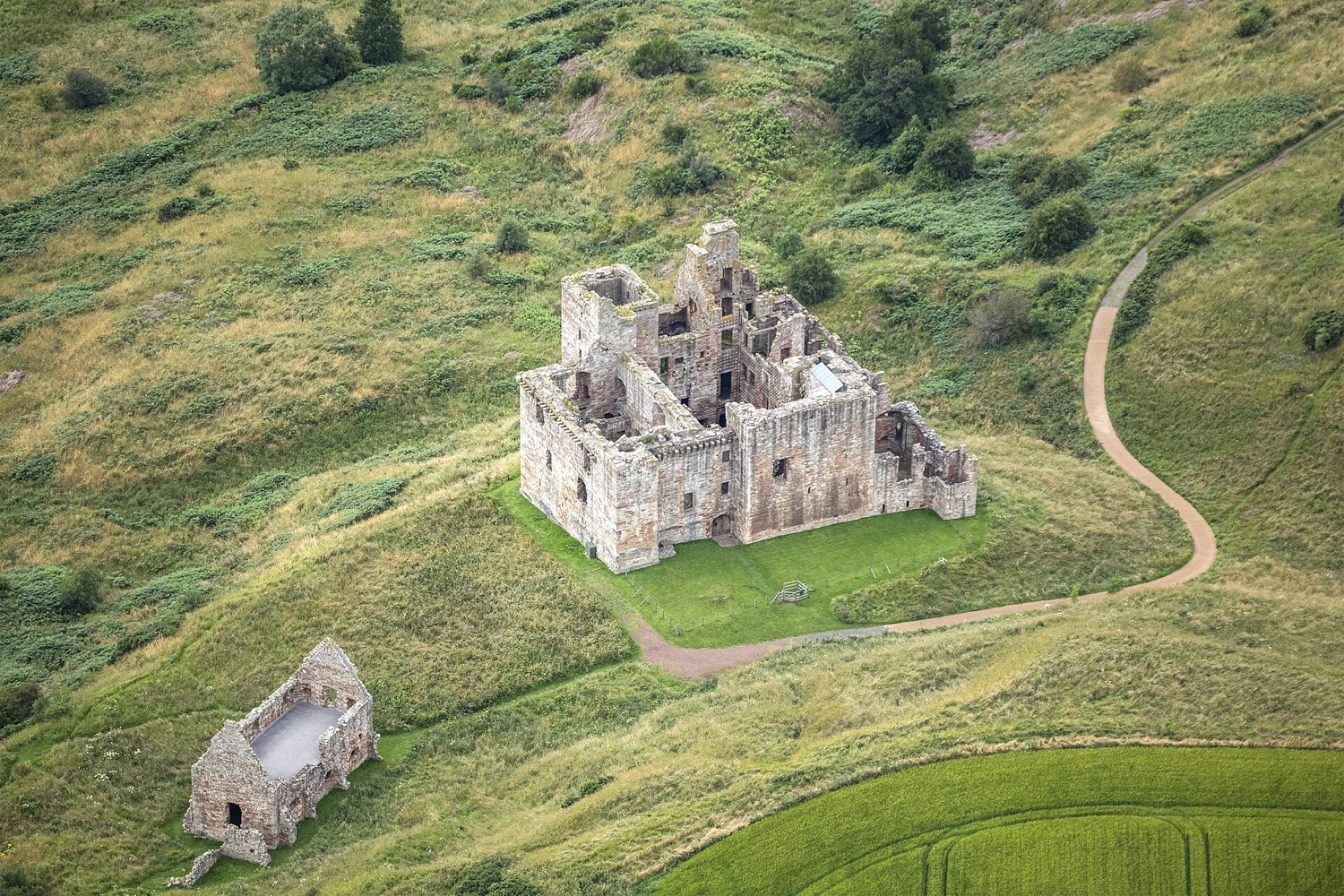
In a lonely valley of Midlothian, Crichton Castle hides, behind its Scottish-fortress walls, an astonishing surprise: an inner court adorned with a façade of diamond-point rustication, come straight from Italy. It is one of the rare and purest witnesses of the Italian Renaissance taste in Scotland.
A Scottish fortress
Crichton was, from the fourteenth to the sixteenth century, the stronghold of powerful Scottish families, among them the Crichtons and then the Hepburns. From the outside it is a classic Scottish castle: high walls, towers, a defensive air, in an austere landscape. Nothing lets one guess what hides in its court. The fortress was the scene of the intrigues of the high nobility of Scotland, notably under the Earls of Bothwell, closely involved in the turbulent history of Mary Stuart.
The Italian loggia
The marvel of Crichton dates from the end of the sixteenth century. Francis Stewart, Earl of Bothwell (nephew of Mary Stuart's third husband), a great traveller who had journeyed through Italy, had the inner court of the castle adorned with an extraordinary façade: a whole wall covered with rustication cut in diamond points, surmounted by a loggia (an open arcaded gallery), directly inspired by the Italian palaces he had admired — one thinks notably of the Palazzo dei Diamanti in Ferrara. In the very heart of a harsh and distant Scotland, a lord had thus wished to bring back, carved in stone, the memory of his journey to the land of the Renaissance. Crichton is the most striking testimony of the way in which, across the seas, Italian taste penetrated even into the Scottish valleys.
What to see
- The diamond-point rustication façade of the inner court.
- The Italianate arcaded loggia, unique in Scotland.
- The tower-house and the walls of the original fortress.
- The lonely setting of the Midlothian valley.
Did you know?
The diamond-point façade of Crichton irresistibly evokes the famous Palazzo dei Diamanti in Ferrara, Italy — that same palace which, in the HitsMap atlas, holds the Pinacoteca of Ferrara. That one should find, thousands of kilometres away, in a lost Scottish valley, an echo of this Ferrarese motif says everything about the reach of the Italian Renaissance: its forms travelled in the heads and notebooks of travellers, and could resurface, intact, at the end of the known world.
Practical information
Crichton Castle lies near Pathhead, in Midlothian, south of Edinburgh. It is today a ruin in the care of Historic Environment Scotland, open to the public (often seasonally). Opening hours and days are liable to change; it is best to check them against the official sources before visiting.
Quiz
- What surprise does the inner court of Crichton hide?
- An Italian façade of diamond-point rustication
- A mosque
- A pyramid
- Who had the court adorned, on returning from a journey to Italy?
- Francis Stewart, Earl of Bothwell
- John Knox
- James V
- Which Italian palace does the Crichton façade evoke?
- The Palazzo dei Diamanti in Ferrara
- The Doge's Palace in Venice
- The Palazzo Vecchio in Florence