
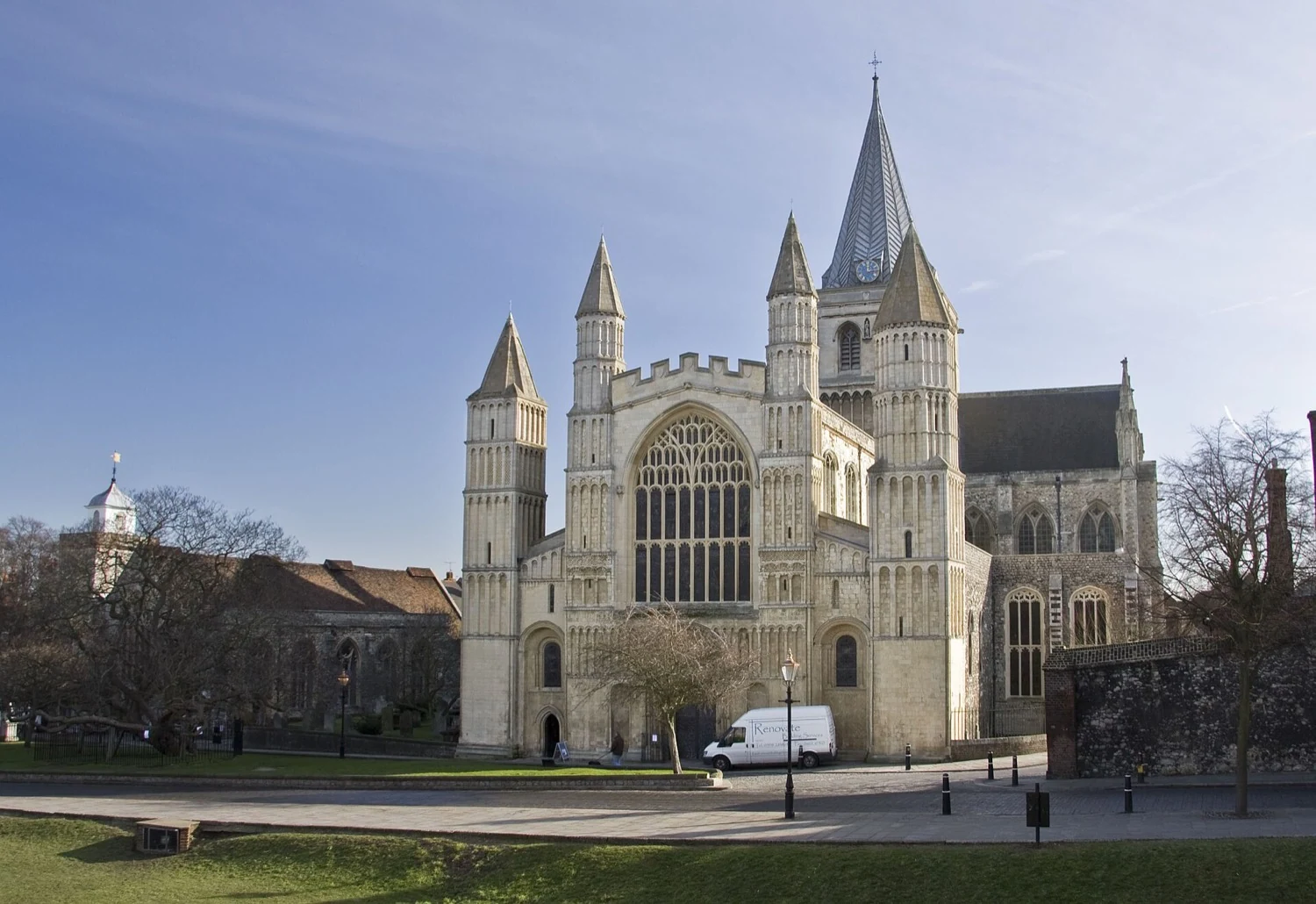
England's second-oldest cathedral, Rochester dominates the valley of the Medway, in Kent. In the Reformation, this episcopal see was at the heart of the religious rendings of the century: it gave both a Catholic martyr and a Protestant martyr, symbols of the two camps that the Tudor reign would set against each other.
Bishop Fisher, martyr of conscience
From 1504 to 1535, the Bishop of Rochester was John Fisher, a renowned humanist, friend of Erasmus and Thomas More, an uncompromising defender of the pope's authority. When Henry VIII demanded the oath acknowledging his supremacy over the Church of England, Fisher refused. He was beheaded on 22 June 1535 — a few days before More — for holding to his loyalty to Rome. Later canonised by the Catholic Church, he embodies the resistance of conscience in the face of royal power. The cathedral's Benedictine priory was dissolved and refounded as a secular chapter in 1540, as everywhere.
Ridley, Anne of Cleves and the reversals of the century
The history of Rochester sums up the abrupt religious reversals of the Tudors. After Fisher, a Catholic martyr, came Nicholas Ridley, bishop from 1547, who had the stone altars removed in the name of the Protestant Reformation — and who would himself end at the stake under Mary I, a Protestant martyr this time. Between the two, a lighter episode: on 1 January 1540, it was at Rochester that Henry VIII met for the first time Anne of Cleves, his betrothed, and was so disappointed by her appearance that the failure of the marriage was thereby sealed. To see: the Norman west portal with its tympanum, the Gundulf tower (eleventh century), the medieval wall paintings of the choir ('Wheel of Fortune') and the Norman crypt.
Did you know?
The same cathedral gave a saint to the Catholics and a martyr to the Protestants: John Fisher, Bishop of Rochester, died beheaded in 1535 for his loyalty to Rome; Nicholas Ridley, bishop after him, perished at the stake under Mary I for his reformed faith. Rochester thus carries, in a single line of bishops, the whole religious tragedy of the Tudor century.
Notes
Rochester Cathedral lies at Rochester, Medway, Kent; a working cathedral, open to visits. Hours to check.
Quiz
- Why was Bishop John Fisher executed in 1535?
- For refusing Henry VIII's religious supremacy
- For military treason
- For Protestant heresy
- Which Protestant bishop of Rochester ended at the stake under Mary I?
- Nicholas Ridley
- Thomas Cranmer
- John Knox
- Whom did Henry VIII meet at Rochester on 1 January 1540?
- Anne of Cleves
- Catherine Howard
- Mary Stuart