
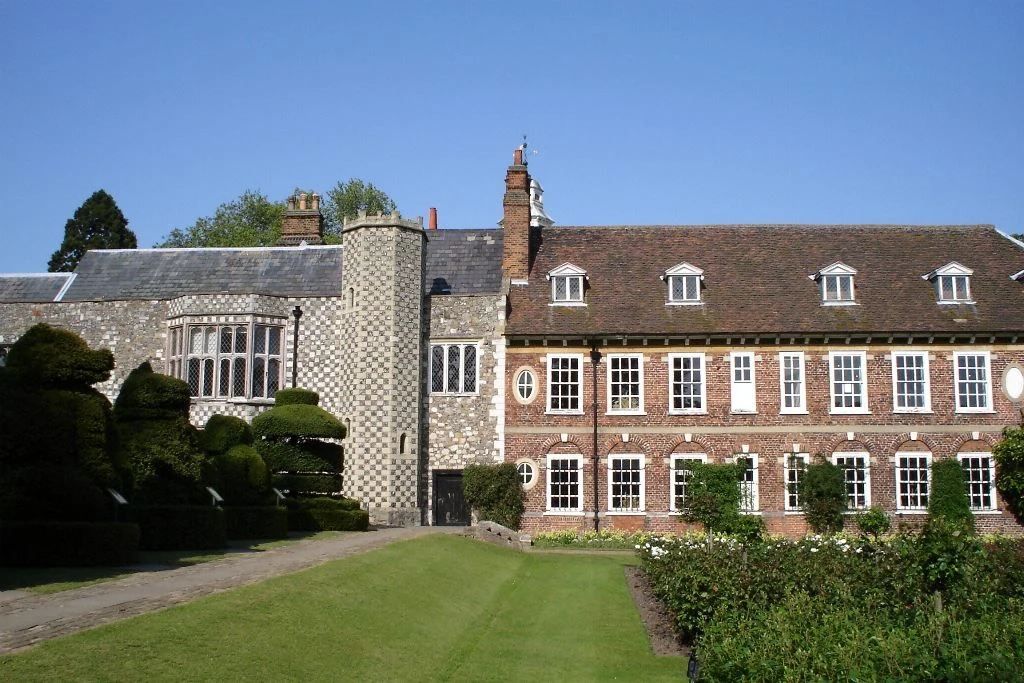
At Bexley, south-east of London, Hall Place spreads its curious chequerboard façade of flint and stone. This Tudor house, built by a rich merchant become Lord Mayor, tells in its very walls one of the great upheavals of Henry VIII's reign: the Dissolution of the Monasteries.
The house of a Lord Mayor
Hall Place (Grade I listed) was built in 1537 for Sir John Champneys, a rich merchant and former Lord Mayor of London. Like many of these new men enriched by trade, Champneys wanted a country house worthy of his rank, arranged around a Great Hall in the traditional way. Its façade, made of a chequerboard alternating dark flint and light stone, is immediately recognisable and illustrates the skill of the Tudor masons.
The stone of Lesnes Abbey
The history of Hall Place is inseparable from Henry VIII's religious policy. To build his house, Champneys reused the stone of the nearby abbey of Lesnes, dissolved shortly before as part of the Dissolution of the Monasteries. Thus, the walls of Hall Place are literally made of the remains of a suppressed monastery — a direct and tangible illustration of how the Reformation transferred the wealth of the Church to the rising nobility and bourgeoisie. The house was enlarged in 1649, but its Tudor core remains legible. To see: the Tudor Great Hall, the flint/stone chequerboard façade reusing the stone of Lesnes, and the award-winning gardens.
Did you know?
One need only look at the walls of Hall Place to read the Reformation: the light stone of its façade comes from Lesnes Abbey, closed by Henry VIII a few years earlier. The merchant who built the house bought the rubble of a monastery — and a gentleman's residence rose on the stones of a place of prayer.
Notes
Hall Place lies at Bexley (Bexleyheath), south-east London (historic Kent); house and gardens (65 ha) open to the public, run by a local trust. Hours to check.
Quiz
- For whom was Hall Place built in 1537?
- Sir John Champneys, former Lord Mayor of London
- Cardinal Wolsey
- Anne Boleyn
- Where did part of the house's stone come from?
- Lesnes Abbey, dissolved by Henry VIII
- A Roman quarry
- The Tower of London
- What does this reuse of stone illustrate?
- The Dissolution of the Monasteries
- The Wars of the Roses
- The Great Fire