
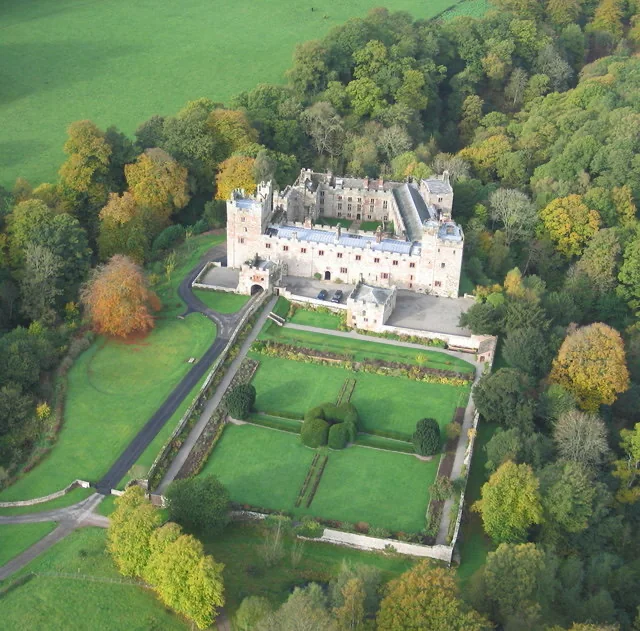
In Cumbria, near Brampton, Naworth Castle is a powerful border fortress, famous for having contained the Scottish incursions and the raids of the Border Reivers. Its history in the Renaissance culminates with a colourful figure: Lord William Howard, called 'Belted Will', who pacified this so long bloodied border.
The lock of the Dacres
A border castle of the Dacres, Naworth was enlarged by Thomas Dacre, 2nd Baron, nicknamed 'the Builder' (1467-1525); in 1488 he even abducted the heiress Elizabeth of Greystoke to secure her domains — an expeditious method of the border nobility. The Dacres were among those great lords of the marches whose power rested on the ability to contain the Scots and to keep in check the Border Reivers, those clans of raiders who ceaselessly plundered the Anglo-Scottish frontier. Naworth, robust and austere, was made for this permanent war.
'Belted Will' and the pacification of the border
The major Renaissance figure of Naworth is Lord William Howard, 'Belted Will' (1563-1640). Son of the Duke of Norfolk, he married the heiress Elizabeth Dacre, bringing the Howard name to the house. In the early seventeenth century, after the Union of the Crowns (1603) that at last united England and Scotland, he played a key role in the pacification of the Border Reivers: the border no longer being a front line between two hostile kingdoms, the age-old raids had to be ended. 'Belted Will' used firmness and justice, while also enlarging the castle. He thus embodies the passage from the border of war to the eased border. To see: the Great Hall (the largest in the North, 4.5 m chimneypiece), the 'Dacre Beasts' (heraldic beasts; originals at the V&A since 2000), the medieval chambers and the dungeon, the well-preserved 'priest hole'.
Did you know?
'Belted Will' Howard fitted out at the top of a Naworth tower a study-library where he gathered manuscripts and antiquities — for this tamer of raiders was also a passionate scholar. In August 1874, the poet and craftsman William Morris visited this study and judged it 'the most poetical (place) in England'. A strange destiny for a border-fortress tower, born for the war of the marches, become a haven of study and poetry.
Notes
Naworth Castle lies near Brampton, Cumbria; a private castle (Howard family), accessible for events. Hours to check.
Quiz
- Against whom did Naworth defend the border?
- The Scots and the Border Reivers
- The Spanish
- The Vikings
- Who was 'Belted Will'?
- Lord William Howard, pacifier of the reivers
- A king of Scotland
- A bishop
- Who judged the Naworth study 'the most poetical place in England'?
- William Morris (1874)
- Shakespeare
- Queen Elizabeth