
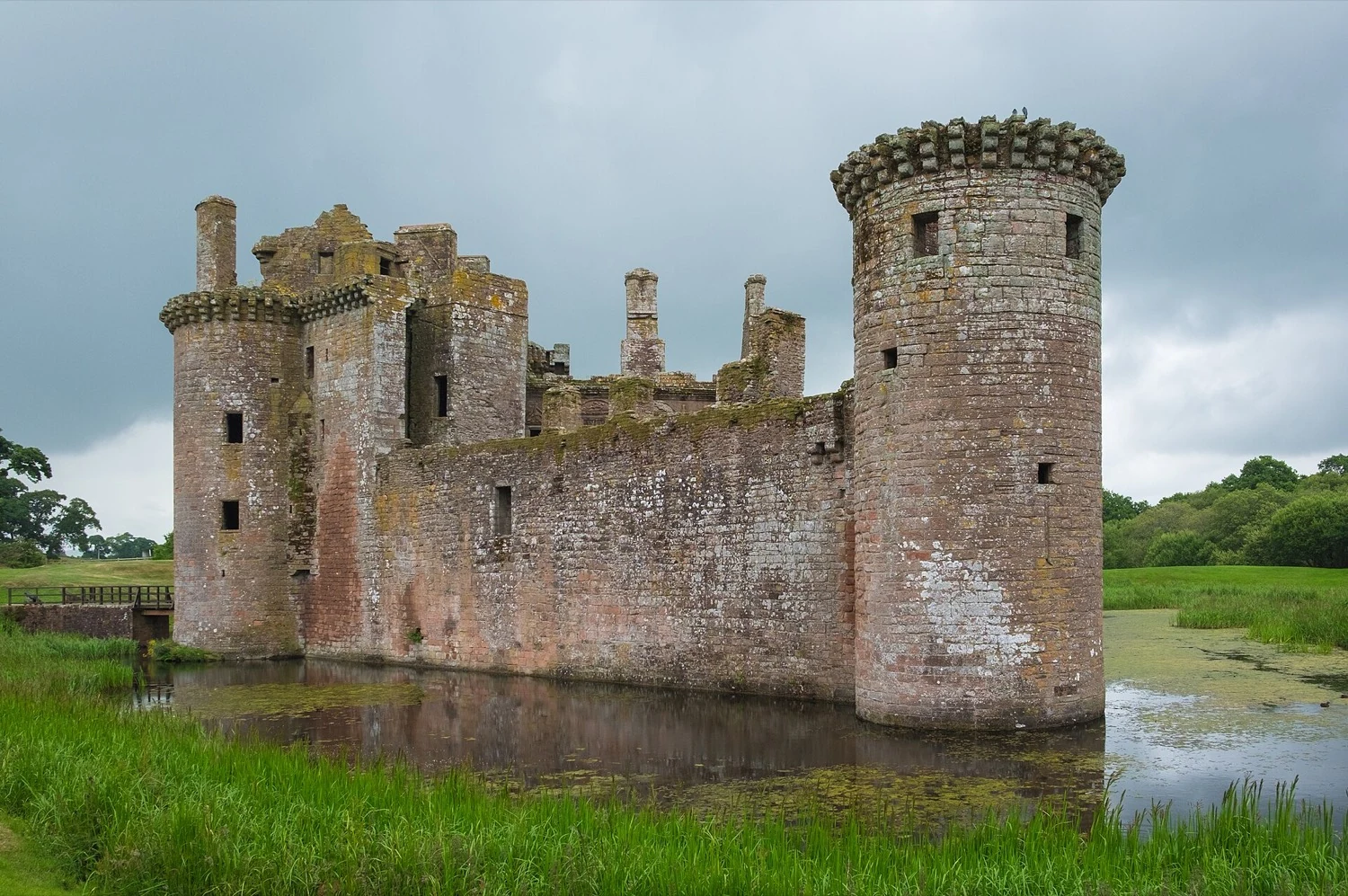
South of Dumfries, Caerlaverock is a unique castle: a triangular moated fortress, a Maxwell stronghold in the full turmoil of the border. Besieged and partly razed in 1570, it received at the hinge of our period one of the finest classical lodgings in Scotland.
A stronghold of the marches
Originally a late-thirteenth-century fortress, famous for its triangular plan and its great twin-towered gatehouse, Caerlaverock was at the heart of the border conflicts under the Stuarts. In 1570 it was besieged and partly demolished — a reminder of the permanent violence of the Scottish marches. The Maxwell family, its masters, played a major role in the defence (and the unrest) of the border with England.
The Nithsdale Lodging
In 1619, Robert Maxwell was made 1st Earl of Nithsdale, just before raising within the fortress the Nithsdale Lodging (completed around 1634): a residential wing with nine windows surmounted by carved pediments, one of the most ambitious classical domestic architectures in Scotland — at the very hinge of the end of our window (1625). Thus, in a single castle, can be read the medieval fortress, the wars of the Renaissance and the nascent classical elegance. To see: the triangular plan and the moat, the gatehouse, the Nithsdale Lodging.
Did you know?
As early as 1300, only sixty men held Caerlaverock for a long time against the whole army of Edward I of England before surrendering — a feat celebrated at the time. Three centuries later, the same triangular fortress held a lodging with pedimented windows worthy of a palace: from heroic resistance to refinement, the whole road of a border castle.
Notes
Caerlaverock Castle lies about 11 km south of Dumfries; a site in the care of Historic Environment Scotland. Hours to check.
Quiz
- What unusual shape does Caerlaverock have?
- Triangular
- Circular
- An eight-pointed star
- Which family was its master?
- The Maxwells
- The Gordons
- The Douglases
- What is the Nithsdale Lodging?
- A classical residential wing (c. 1634)
- A medieval keep
- A chapel