
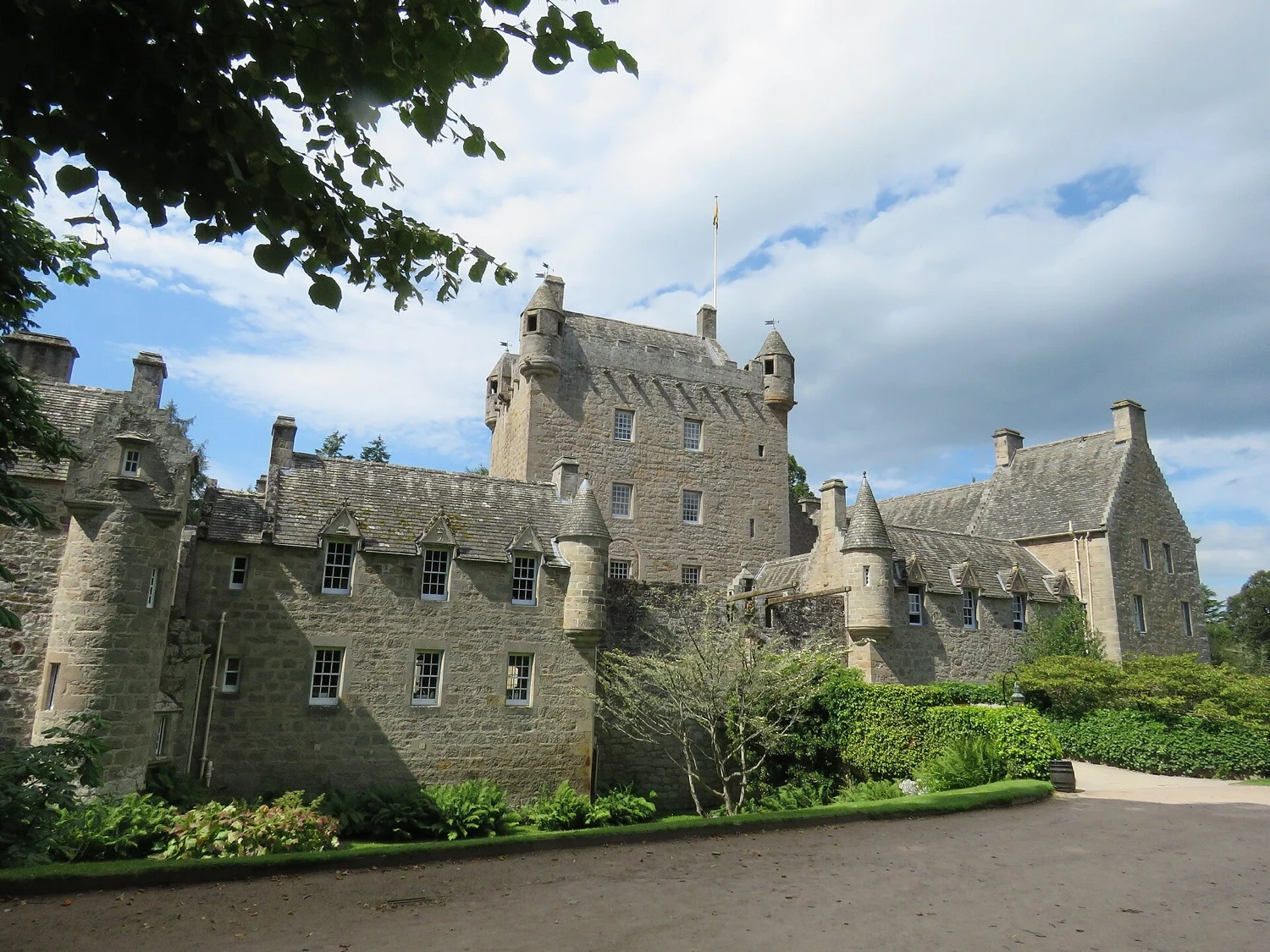
In Nairnshire, at the gates of the Highlands, Cawdor Castle has kept its fifteenth-century tower keep, around which a residence gathered in the Renaissance. Its name, popularised by Shakespeare's Macbeth, hides a very real dynastic history.
From the Calder tower to the Campbells
The central tower, licensed in 1454, was the seat of the Calders, Thanes of Cawdor. In 1510, through the — forced — marriage of the heiress Muriel Calder to Sir John Campbell, the castle passed to the mighty Clan Campbell: a founding episode that inscribes Cawdor in the great dynastic strategies of the Scottish Renaissance. It was under the Campbells that the old tower grew with lodgings, in the sixteenth and seventeenth centuries.
Macbeth and the invention of a title
The title of 'Thane of Cawdor' owes its fame to Shakespeare's Macbeth. But the association of the castle with Macbeth is in reality an invention of the Scottish humanist Hector Boece (sixteenth century), whose romanticised history of Scotland inspired Shakespeare: a delicious irony, the 'medieval' legend of Cawdor is a pure product of learned Scottish Renaissance. One still visits the fifteenth-century tower, its tapestries and its Renaissance lodgings.
What to see
- The fifteenth-century tower and the legendary holly at its base.
- The tapestries and the Renaissance lodgings.
- The gardens (eighteenth-century walled garden).
Did you know?
Legend has it that a donkey laden with gold lay down under a holly, marking the place to build the tower; scientific tests have dated the death of this tree to around 1372. As for Shakespeare's 'Thane of Cawdor', he descends not from history, but from the romanticised chronicle of a sixteenth-century humanist.
Practical information
Cawdor Castle lies at the village of Cawdor, in Nairnshire (Highland); a private castle open to the public with its gardens. Hours liable to change; check against the official sources.
Quiz
- How did Cawdor pass to the Campbells in 1510?
- Through the forced marriage of the heiress Muriel Calder
- Through a battle
- Through a purchase
- Does Macbeth's 'Thane of Cawdor' come from history?
- No, from a romanticised Renaissance chronicle (Hector Boece)
- Yes, it is an established fact of the eleventh century
- He never existed
- What does the legend of the Cawdor holly tell?
- A donkey laden with gold lay down there, marking the tower's site
- A dragon slept there
- A queen was crowned there