
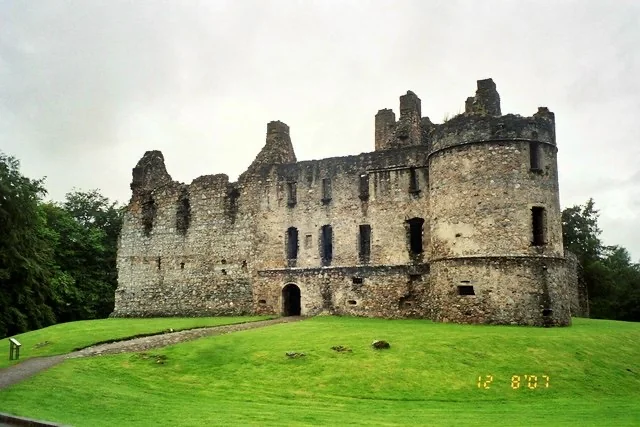
North of Dufftown, in Moray, the ruins of Balvenie tell the passage from the medieval castle to the residence of prestige. Onto a thirteenth-century curtain wall, the Stewarts of Atholl grafted in the sixteenth century a Renaissance wing — and Mary Stuart halted here in 1562.
From the Comyns to the Stewarts of Atholl
Originally a thirteenth-century fortress (the Comyns), Balvenie was confiscated from the Douglases in 1455 and given to Sir John Stewart, 1st Earl of Atholl. His family then set about transforming the old stronghold: in the mid-sixteenth century a Renaissance residential wing was added, grafted onto the medieval curtain, marking the passage from the defensive keep to the comfortable seigneurial lodging.
The queen's halt
On 4 September 1562, Mary Stuart was received here during her great progress in the North — the same campaign that led her to crush the Gordons at Corrichie. Balvenie thus illustrates, in a single silhouette, the stratigraphy of Scotland: the rampart and moat of the Middle Ages, the wing of pleasure of the Renaissance, and the memory of the queen who travelled her kingdom.
What to see
- The Atholl Renaissance wing grafted onto the curtain.
- The medieval rampart and moat.
- The portcullis wicket-gate.
Did you know?
On 4 September 1562, Mary Stuart stopped at Balvenie during her northern campaign against the Gordons — one of those royal journeys that, better than anything, made the presence of the crown felt to the edges of the kingdom.
Practical information
Balvenie Castle lies about 1 km north of Dufftown, in Moray; a ruin in the care of Historic Environment Scotland. Hours liable to change; check against the official sources.
Quiz
- Which family transformed Balvenie into a Renaissance residence?
- The Stewarts of Atholl
- The Comyns
- The Campbells
- Which queen stopped here in 1562?
- Mary Stuart
- Elizabeth I
- Margaret Tudor
- Onto what was the Renaissance wing grafted?
- A thirteenth-century medieval curtain wall
- A Roman temple
- A cathedral