
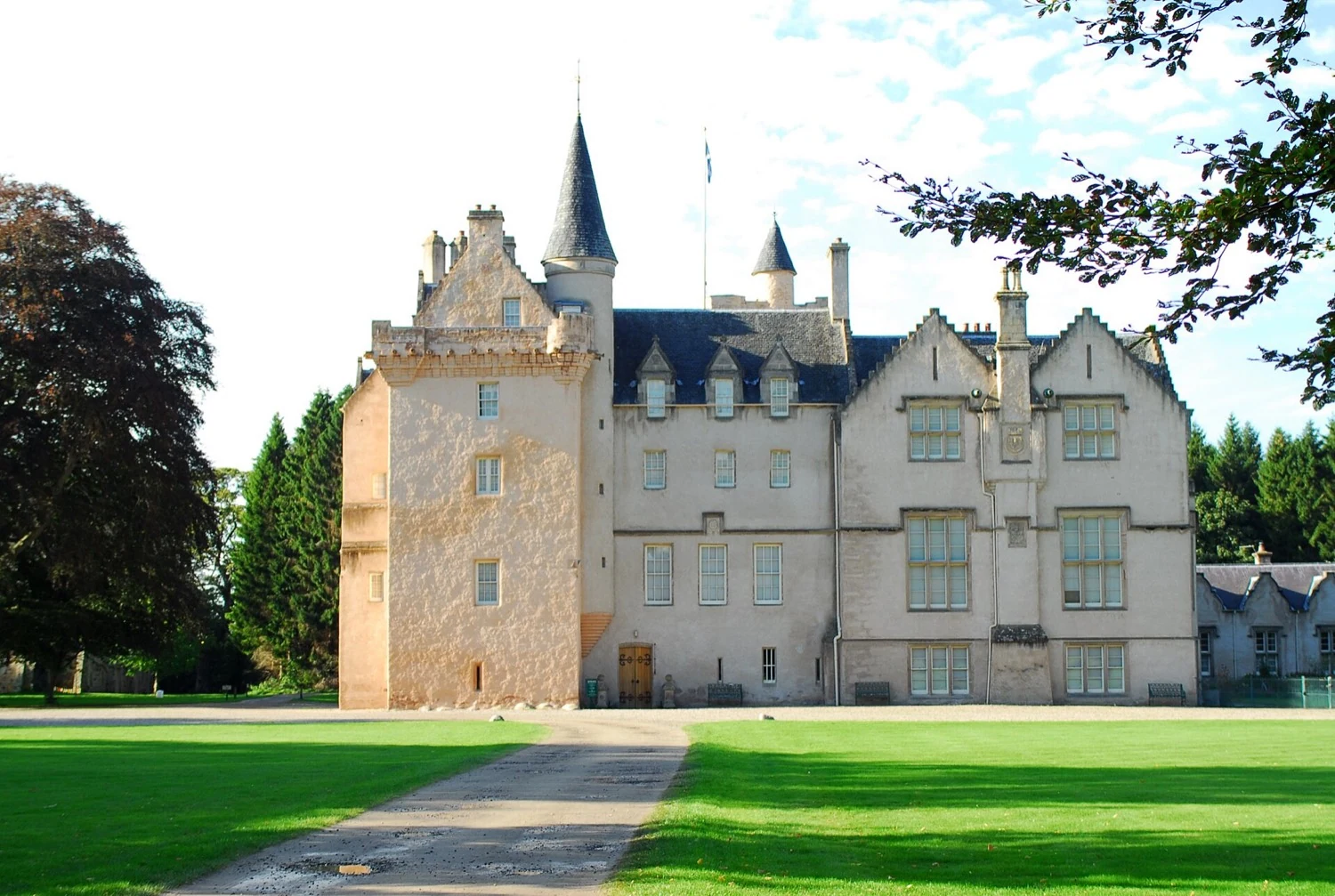
West of Forres, in Moray, Brodie Castle has at its core a Z-plan tower house dated 1567 — a characteristic example of the Scottish seigneurial architecture of the Renaissance, built under the reigns of Mary Stuart and James VI.
The tower of the Clan Brodie
The heart of the castle is a Z-plan tower house completed in 1567: a central block flanked by two five-storey towers at opposite corners, a device at once defensive and residential typical of the Scotland of the time. It is the seat of Clan Brodie, one of the old families of Moray. The Z-plan — also found at Claypotts, Castle Fraser or Elcho — was the architectural signature of the lesser and middle Scottish nobility of the Renaissance.
Wars and embellishments
The castle was partly burned in 1645 by Lewis Gordon, 3rd Marquess of Huntly, during the civil wars — a reminder that seventeenth-century Scotland remained a land of clan and religious conflict. Turned into a mansion in the nineteenth century, Brodie nonetheless keeps its Renaissance core and fine wrought ceilings. The estate also holds Rodney's Stone (a Pictish stele) and a famous collection of daffodils.
What to see
- The Z-plan keep of 1567.
- The wrought ceilings.
- Rodney's Stone (Pictish stele) and the garden.
Did you know?
In 1645, in the midst of the civil wars, Brodie Castle was partly burned by Lewis Gordon, Marquess of Huntly — an episode recalling that, even after the relative calming of the Renaissance, the old clan rivalries (Gordon against neighbours) could still set a house ablaze.
Practical information
Brodie Castle lies near Forres, in Moray; in the care of the National Trust for Scotland. Hours liable to change; check against the official sources.
Quiz
- From when does the Z-plan tower of Brodie date?
- From 1567
- From the twelfth century
- From the eighteenth century
- Which clan was seated here?
- The Clan Brodie
- The Clan Gordon
- The Clan Hay
- What did the castle suffer in 1645?
- A partial fire during the civil wars
- A flood
- An earthquake