
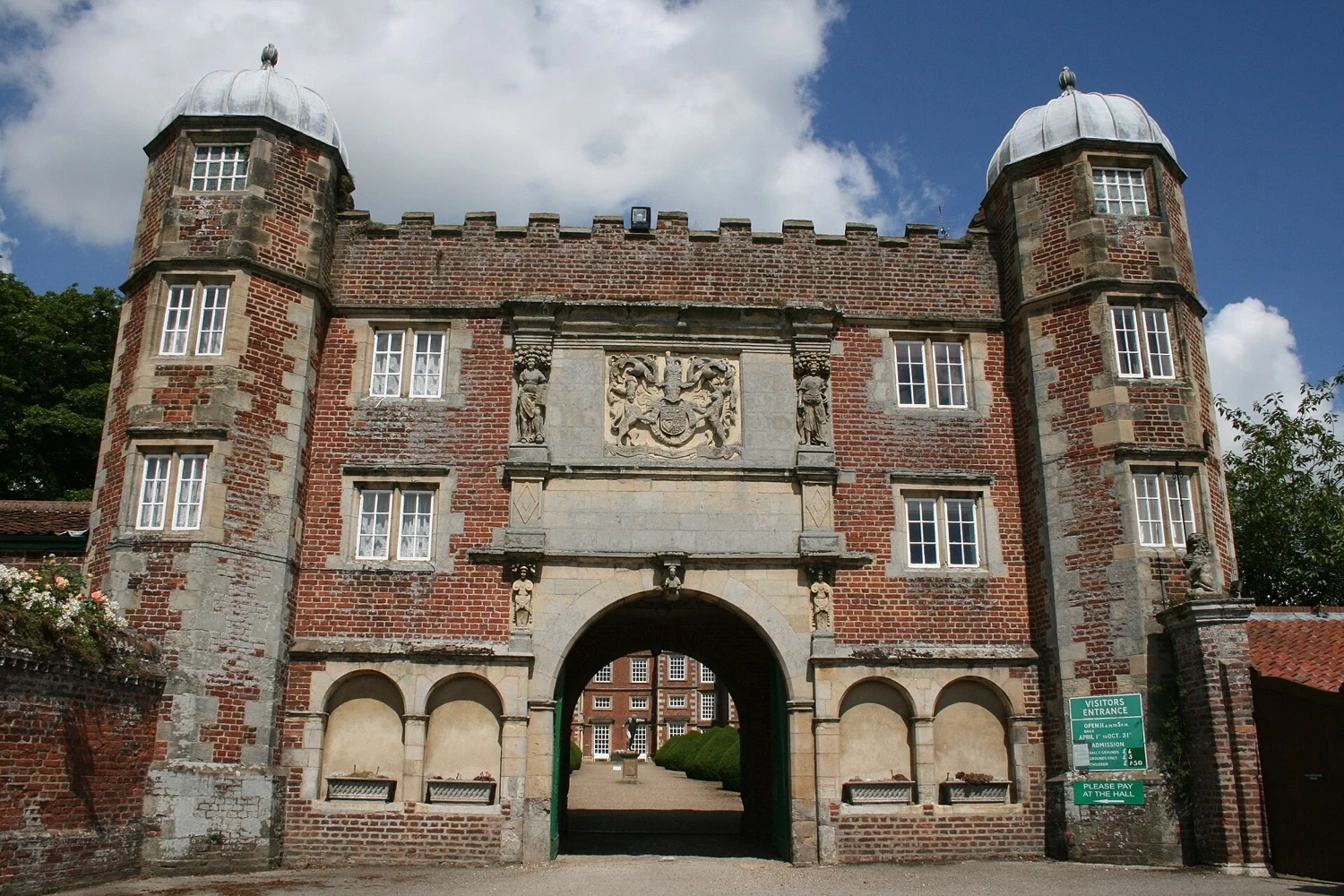
At the end of a long avenue, Burton Agnes Hall presents one of the finest Jacobean fronts in England: a learned play of projecting bays and windows, in rose brick, where all the decorative richness is concentrated on the entrance. It is a masterpiece of the great Elizabethan architect Robert Smythson, built at the turn of the seventeenth century.
A prodigy house of 1601-1610
When Sir Henry Griffith was named to the Council of the North in 1599, he decided to replace his cramped old manor with a new and fashionable house. Raised from 1601 to 1610 on plans attributed to Robert Smythson (the man of Longleat, Wollaton and Hardwick), the house is a compact block of brick, set with glazed bays, around a small inner court. Look at the entrance gatehouse and above all the interior: the great hall keeps an extraordinary screen of carved stone and stucco, teeming with allegories — one of the summits of Jacobean ornament.
The Norman manor and the new house
Rarely, the old Norman manor (1173) survives right beside the Jacobean house: both can be visited, a few steps apart, five centuries side by side. Burton Agnes has stayed in the same family and now holds a fine collection of paintings. Don't miss: Smythson's bayed front, the gatehouse, the carved screen of the great hall, the neighbouring Norman manor, the gardens.
Did you know?
Sir Henry Griffith built Burton Agnes because he had just joined the Council of the North — the royal government of the northern provinces. It is a rule of the century: one does not build a prodigy house to be housed, but to display a rank just attained. The house is a curriculum vitae in brick; its front says, to those who can read it, "I now sit on the Council".
Info
Burton Agnes Hall is at Burton Agnes, near Driffield (East Riding of Yorkshire); a private house, house, Norman manor and gardens open to the public in season. Hours to be checked.