
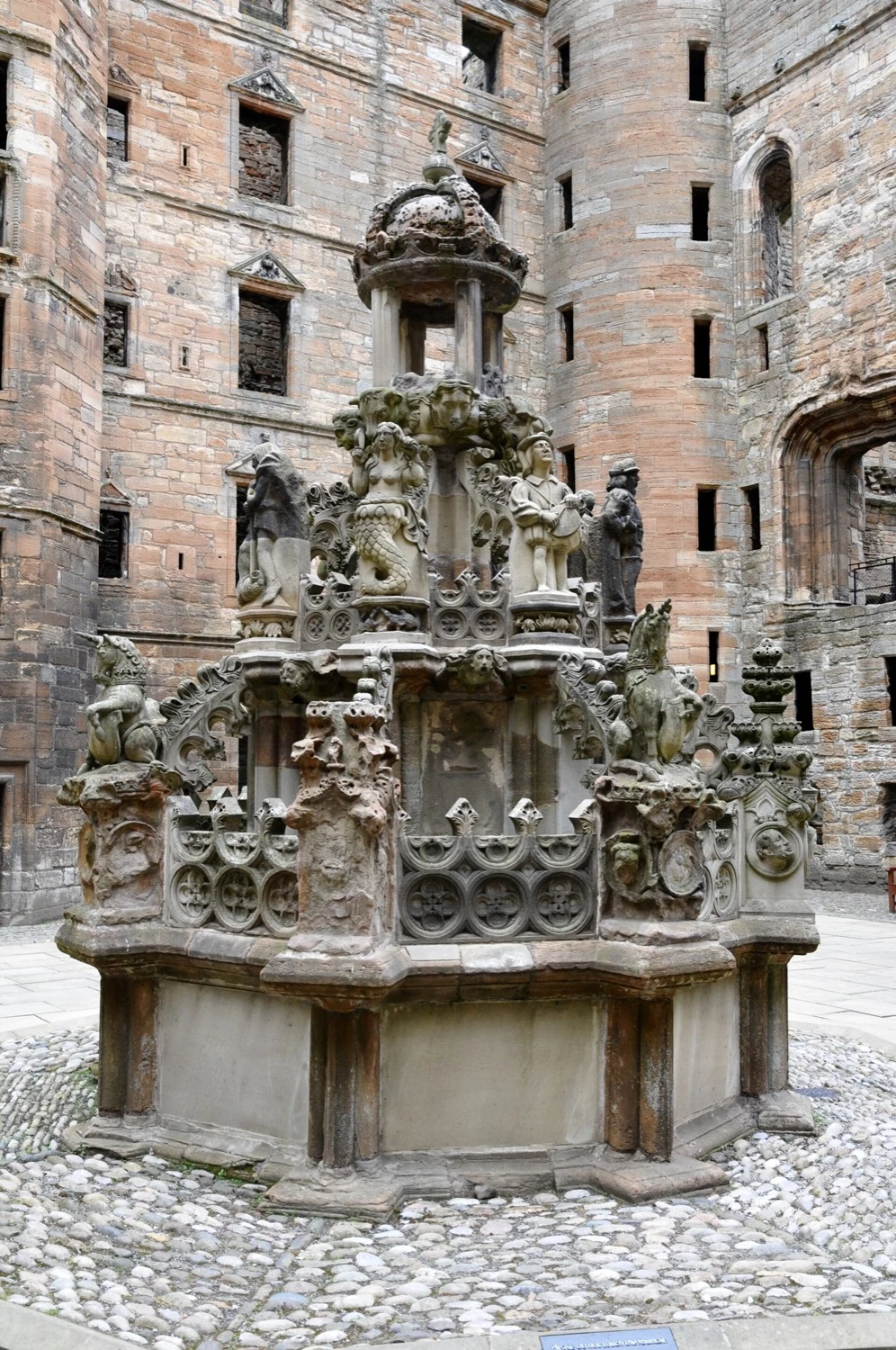
In the middle of the courtyard of Linlithgow Palace stands an extraordinary object: an octagonal, tiered stone fountain, over five metres high, bristling with sculpture. Raised for James V in 1536-1538, it is the oldest fountain in Britain surviving in its original place — and one of the summits of Scottish Renaissance decorative sculpture.
A crown that pours water
Look at the structure: water fell from a crown at the summit — an image of royal benevolence spreading over the people — then tumbled from bowl to bowl, spouting through rows of beast-shaped and human-headed spouts. Each level is laden with figures, arms and emblems proclaiming the power of the Stuart monarchy and its embrace of classical Renaissance. The fountain was commissioned around 1538 to mark James V's marriage to Mary of Guise: a gift of stone to a French queen.
The setting of a reign
Linlithgow was the Stuarts' favourite palace (Mary, Queen of Scots would be born here in 1542); its fountain was the court jewel, made to dazzle visitors on entering the courtyard. Tradition holds that on great occasions it ran not with water but with wine — at Charles I's coronation in 1633, and, it is said, when Bonnie Prince Charlie passed in 1745. To see: the tiered octagonal structure, the crowning crown, the zoomorphic spouts, the arms and emblems of James V.
Did you know?
The Linlithgow fountain was so admired that a modern copy was made of it — for Holyrood Palace in Edinburgh, in the queen's gardens. The original, so fragile, has been restored and sheltered: four and a half centuries of Scottish frost had gnawed its stone, but the "King's Fountain" still flows, in summer, in the courtyard where Mary, Queen of Scots was born.
Info
The King's Fountain is in the courtyard of Linlithgow Palace (West Lothian, Scotland); Historic Environment Scotland; running in summer.