
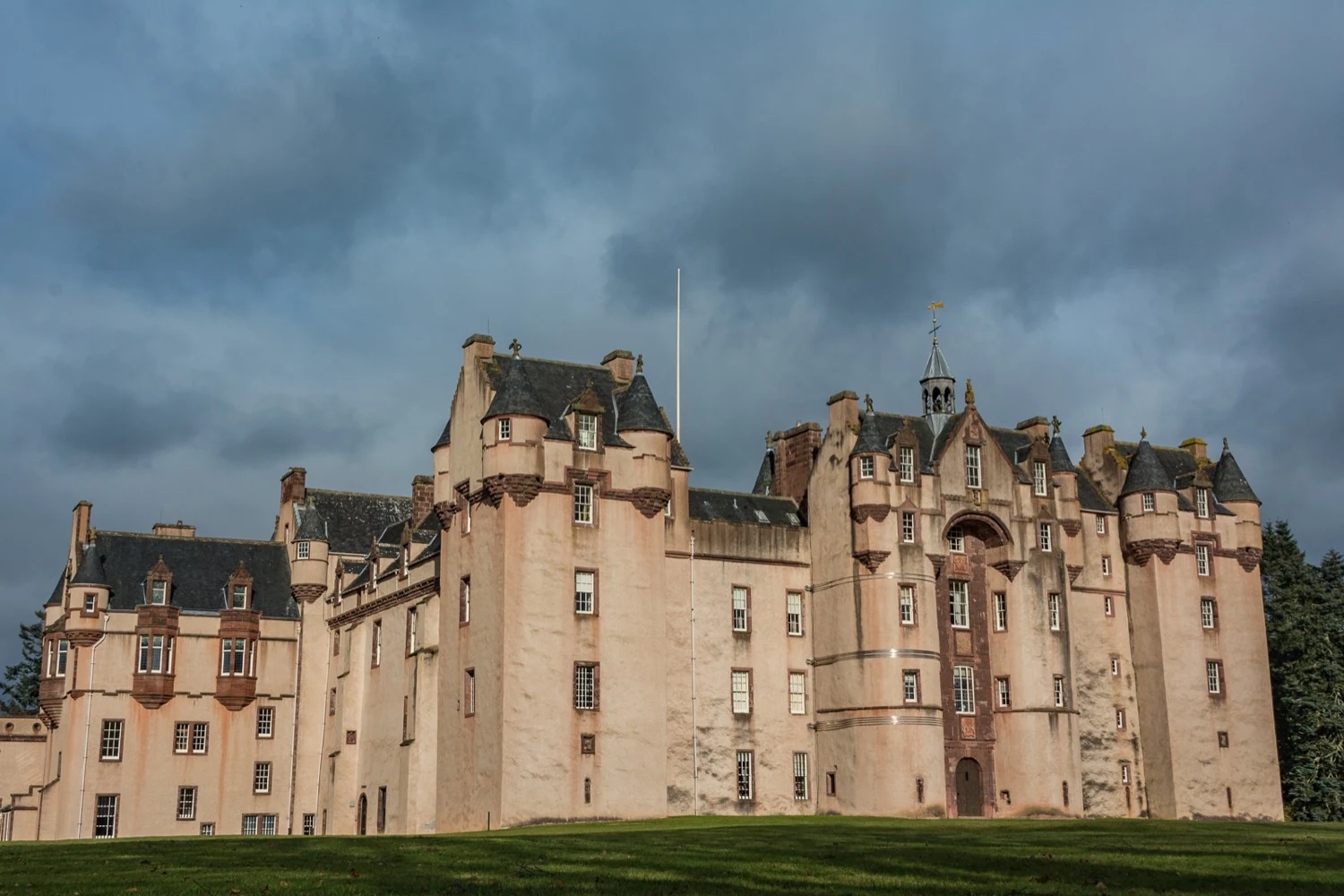
A must-see: Fyvie's south front unrolls a continuous ribbon of stone — corbelled turrets, corbelled galleries, carved dormers, finials, string-courses and armorial panels — of almost unreal richness. At its centre rises the Seton tower, flanked by two drum towers commanding the main entrance. This transformation, between 1596 and 1610, was the work of Alexander Seton, one of the most cultivated men in the Scotland of his day: drawing on Flemish and French sources, he made Fyvie one of the peaks of Scottish Renaissance architecture. Inside, the great turnpike stair is decorated with twenty-two coats of arms — the same heraldic pride, carried from the façade into the heart of the castle.
Did you know?
Alexander Seton also raised the two older towers flanking the Seton tower (Meldrum and Preston) to level their rooflines: each great family that had owned Fyvie had left its own tower, and Seton unified them into a single monumental composition.
Info
- Exterior decoration (south front) plus heraldic decoration indoors (staircase).
- The castle survives whole and furnished (National Trust for Scotland).
- The sculpture / decorative dimension of Fyvie Castle (see the linked monument entry).