
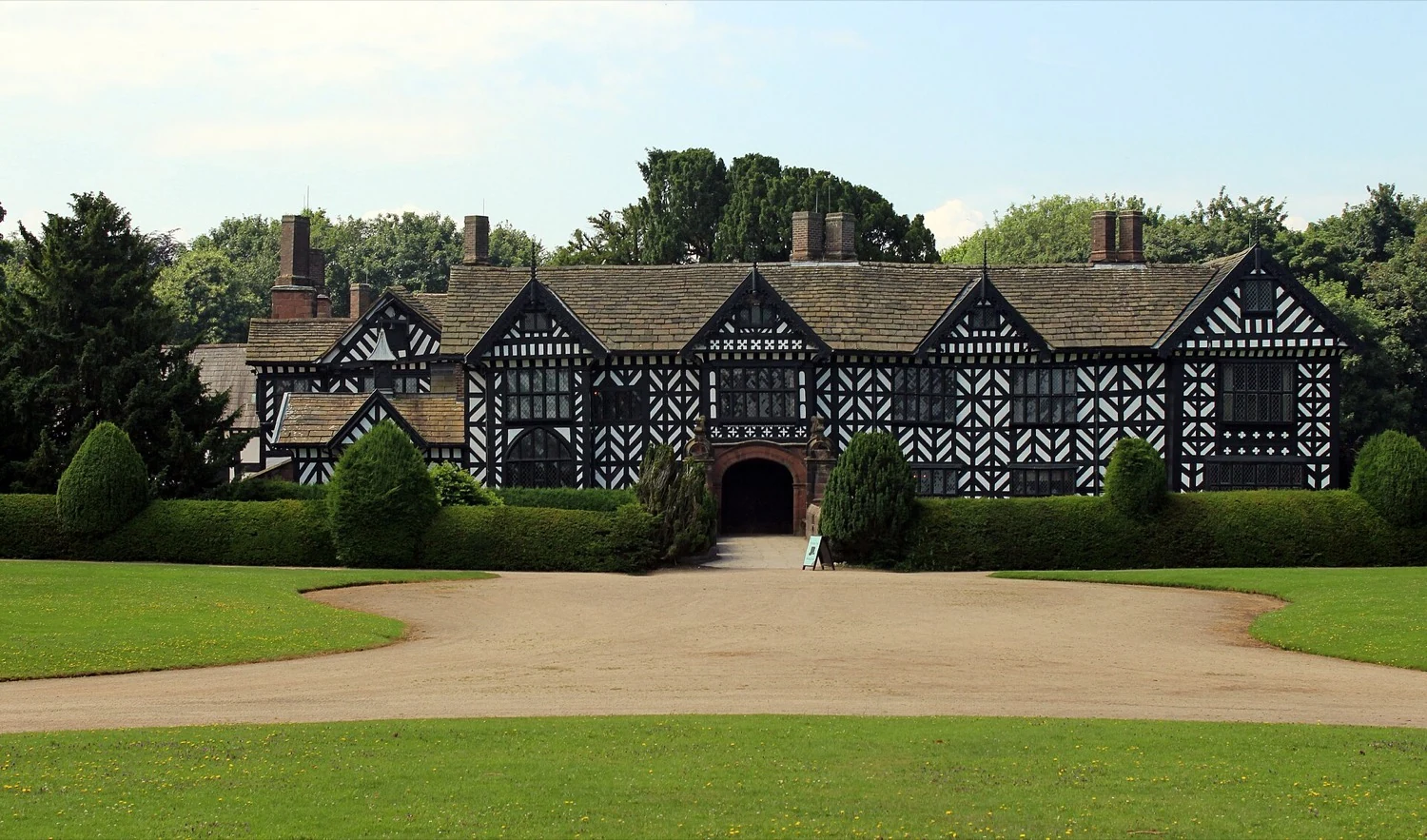
On the edge of Liverpool, beside the Mersey, Speke Hall is one of the finest timber-framed manors in Tudor England: a house of black wood and white plaster built around a courtyard, whose every front speaks at once of new-found comfort and of a forbidden faith kept in secret.
A house of wood around a court
Raised for the Norris family between 1530 and 1598, Speke Hall is arranged around a cobbled courtyard where two ancient yews, "Adam and Eve", still stand. Look at the exposed framing: the blackened beams draw diamonds, lozenges and quatrefoils across the white plaster, the decorative exuberance typical of the North-West. The panelled Great Hall, the Great Parlour with its plaster ceiling and the Oak Drawing Room make an interior of rare warmth. Over the hall chimney runs a carved overmantel showing three generations of Norrises — a way of setting the bloodline into the very timber of the house.
A faith hidden in the walls
The Norrises remained Catholic after the Reformation, at a time when the Roman Mass was a crime. Look, hidden in the thickness of walls and chimneys, for the priest holes — the hiding places where a priest could vanish during a search — and for the eavesdrop, a small spy-hole under the eaves of the entrance that let someone listen, before opening, to those waiting at the door. All the house is built to see who is coming. Don't miss: the courtyard with its two yews, the Great Hall and its Norris overmantel, the priest holes, and the Elizabethan plasterwork.
Did you know?
Above the front door, a narrow channel set into the plaster — the "eavesdrop" — allowed someone hidden inside to hear the talk of visitors still outside. The English word eavesdropping comes from this very device: at Speke Hall, spying on your own guests was a matter of architecture.
Info
Speke Hall stands in Liverpool (Merseyside), near the airport; a National Trust property, house and gardens open to visitors. Seasonal hours to be checked.