
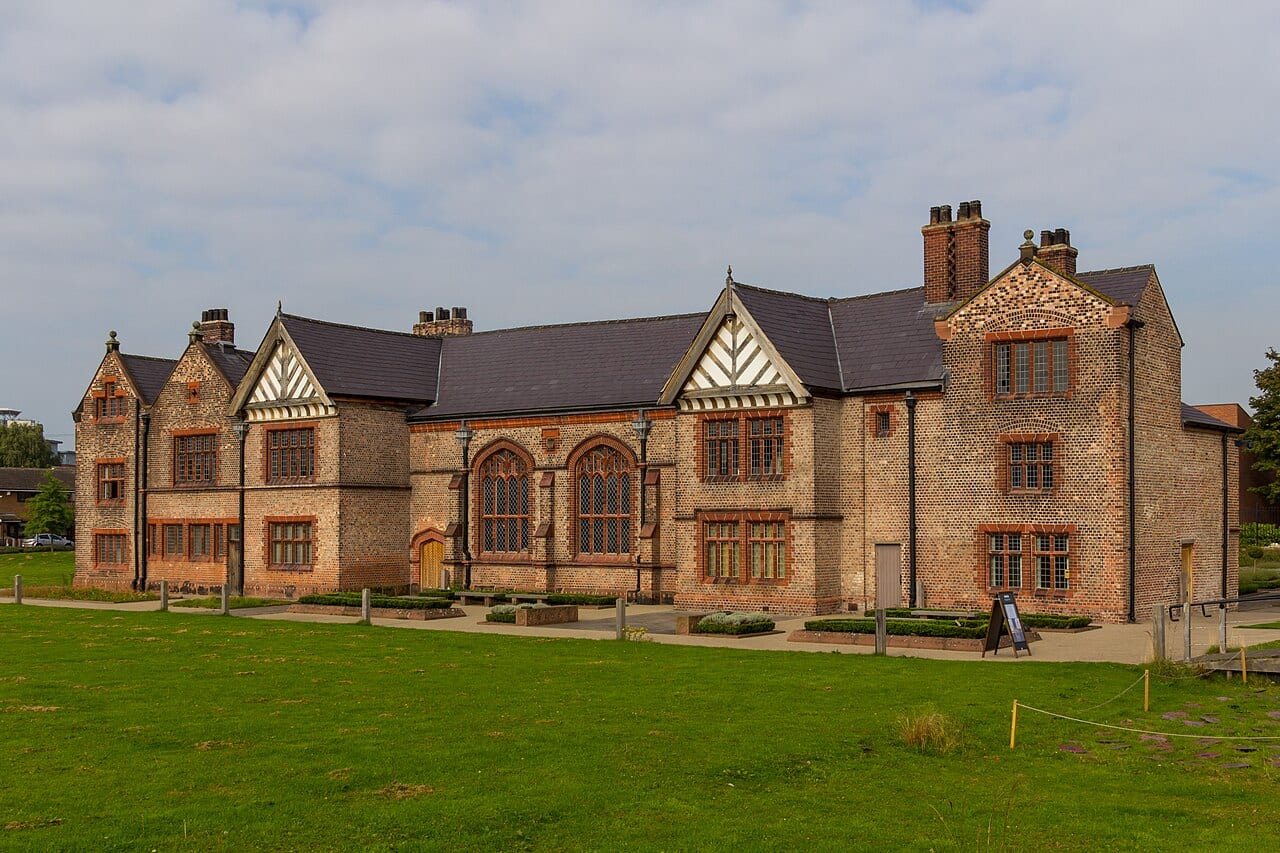
Hemmed in today by the streets of an industrial city, Ordsall Hall rises like an apparition: a house of black-and-white timber framing, set down like a fragment of Tudor countryside stranded in the heart of Salford. This contrast is the whole value of the place. Where so many old manors stand in a setting of greenery, Ordsall has survived the urban tide, a stubborn witness to a rural world the Industrial Revolution buried. The eye, expecting warehouses and terraced streets, meets instead the dark timbers and white gables of another age, and the shock of that encounter is half the meaning of the place.
The site's origins are medieval — it appears in written record as early as 1177 under the name "Ordeshala" — but Ordsall is above all the story of one family: the Radclyffes, its lords for more than three hundred years. The estate came to them around 1355, after disputes over the succession, and it was Sir John Radclyffe who secured it for good in 1374. Over the generations the Radclyffes enlarged and embellished the house. Its jewel, the Great Hall, was built in the early sixteenth century — attributed to Sir Alexander Radclyffe, who died in 1549. It is a remarkable example of Tudor carpentry: a vast panelled space, an elaborate roof, and on the floor a hexagon marking the site of the open central hearth around which the household's life once gathered. To stand in it is to meet the very archetype of the English great hall, the social heart of the manor where people ate, received guests and settled their affairs.
The Radclyffes passed brilliantly through the Elizabethan age. The house saw the growing-up of the celebrated twins Alexander and Margaret Radclyffe: he became High Sheriff of Lancashire, she one of Elizabeth I's favourite ladies. Then came decline. Loyal to the Royalist cause, the Radclyffes ruined themselves during the English Civil War, and in 1662 the heir John was forced to sell the ancestral house to Colonel John Birch. Ordsall then passed from hand to hand, came close to ruin in the industrial era, before being bought by Salford Council in 1959 and opened to the public in 1972 as a period house and local-history museum.
It is to this time of decline that the place's most persistent legend belongs. In 1842 the writer William Harrison Ainsworth set his novel Guy Fawkes at Ordsall, embroidering on an unverifiable local story that the Gunpowder Plot of 1605 — the Catholic conspiracy to blow up Parliament and King James I — was partly hatched within these walls. Nothing attests to it historically, but the tale has taken such root that it now belongs to Ordsall's aura: one likes to imagine the plotters whispering by the hearth of the great hall.
The great hall is not the only Tudor fragment of the house. Around it survive a service wing and panelled chambers that, with their blackened timbers and pale plaster infill, compose the very archetype of the "black and white" of north-west England — that contrasted half-timbering which Lancashire and Cheshire carried to a high degree of refinement. Each generation of Radclyffes left its mark here, reworking, adding, modernising, so that the house reads less as the work of a single design than as an accumulation of building campaigns spread over centuries.
Beyond the fiction, Ordsall offers a precious and honest document. Its timber framing, its early-sixteenth-century great hall, its central hearth speak of a provincial seigneurial England that predates the age of great stone houses. In our atlas it stands for that Renaissance of the North, less splendid than that of the courts but deeply rooted in wood, in land and in family lines — and for the small miracle of a Tudor house that, against all odds, held firm in the midst of the modern city.