
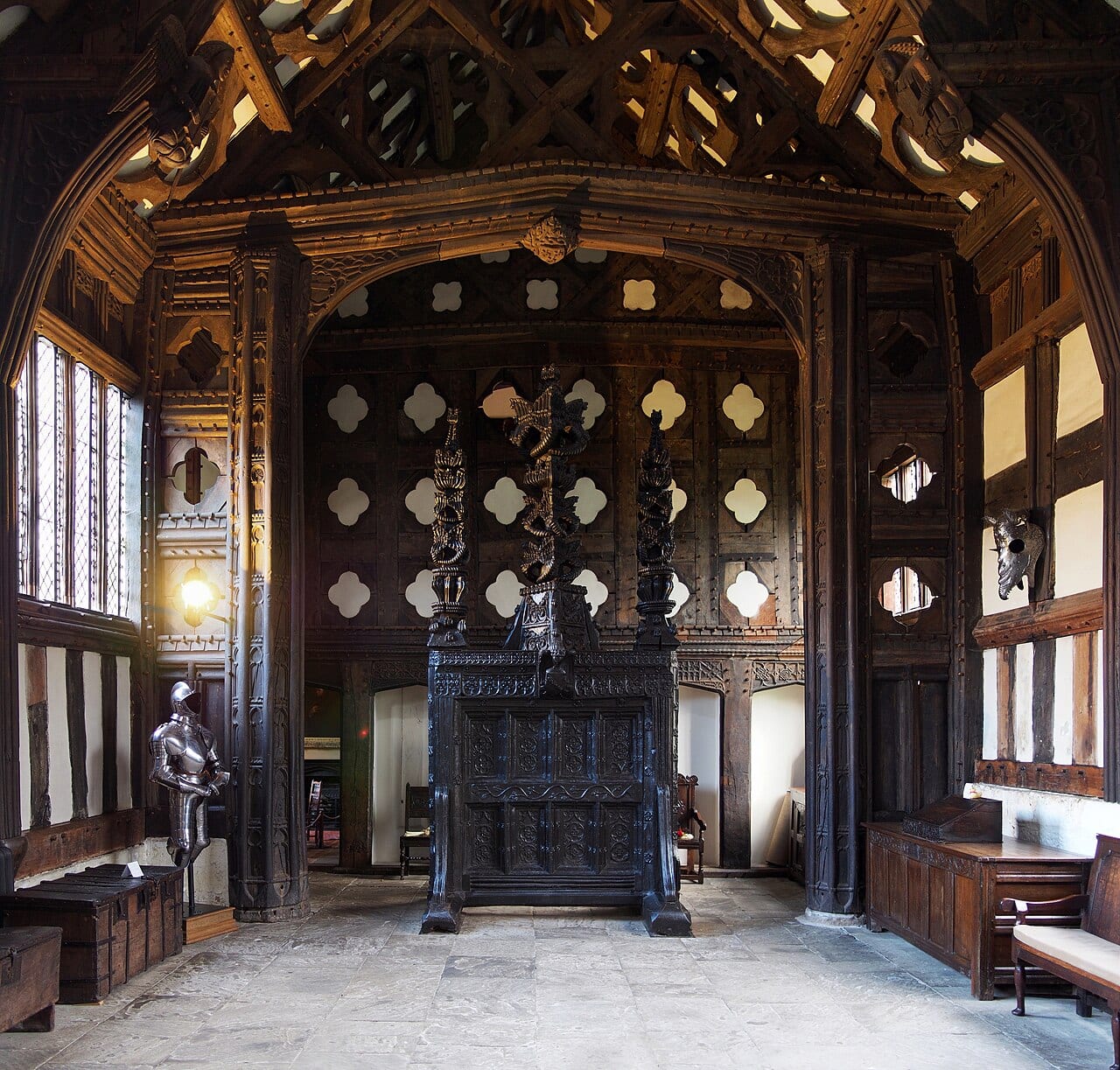
In the flat countryside of west Lancashire, Rufford Old Hall looks unassuming from the outside, its timber-framed great hall seeming modest beneath its high gables. It is within that the place reveals one of the most sumptuous displays of Tudor carpentry in England. Whoever pushes open the door of the great hall finds a space of unexpected majesty, crowned by a hammerbeam roof of arresting carved richness.
The house was built around 1530 for the Hesketh family, great landowners of the county. Sir Robert Hesketh then raised a house on an H-plan: a central range — the great hall — linking two wings. The original wings have since vanished or been replaced, but the great hall itself has come through the centuries. Some forty-six feet long and about twenty-two wide, it spreads five hammerbeams, each carrying at both its ends a carved wooden angel — a detail of remarkable grace and ambition for a house of provincial gentry. The eye climbs this forest of worked timbers as toward the vault of a church.
Rufford's treasure, its unique piece, is nonetheless an object of wood: the movable screen of the great hall, its panels pierced with Gothic tracery and topped by an exuberant carved cresting. Such a movable screen, meant to shield from draughts the high end of the hall where the master sat, is extremely rare — scarcely an equivalent is known in England. It embodies in itself the domestic refinement of the late Tudor age, that art of living in which even the most utilitarian furniture became a pretext for virtuosity. The house also keeps a drawing room with sixteenth-century arched-brace roof timbers, extending the same lesson in carpentry.
Rufford is bound up, too, with one of the most debated Shakespearean traditions. A local legend holds that the young William Shakespeare performed before the Heskeths in this great hall. The matter is not wholly fanciful: Thomas Hesketh did keep a company of players, and some scholars suppose he took on the young Shakespeare after the death of Alexander Hoghton, another Catholic notable of Lancashire. But no proof supports the dramatist's presence at Rufford, and the story must be taken for what it is: a seductive hypothesis, driven by the wish to give a setting to the poet's obscure early years. Caution is due — yet beneath this roof of angels one understands the temptation to let the first lines of the greatest author in the English language ring out here.
The Heskeths, who had this marvel built, were one of those Lancashire gentry families whose fortune rested on land and on a shrewd place within the networks of the county. In endowing their house with so ambitious a hall, they asserted a rank: the great hall was the room of display par excellence, the place where the power of a lineage was measured by the richness of its roof and the generosity of its table. Rufford had then the good fortune to come down through the centuries without suffering the radical rebuildings that effaced so many Tudor interiors; now in the care of the National Trust, the place keeps today, with rare fidelity, the atmosphere of dark wood and softened light of an early-sixteenth-century dwelling.
Rufford Old Hall thus holds a singular place in our atlas: that of a masterpiece in the art of wood, where the English Renaissance speaks not through marble or fresco but through the genius of carpenters. It is a place that teaches one to look upward, to read in the interlace of beams the ambition of a family and the skill of a craft, and to measure how far, in sixteenth-century England, the great hall remained the theatre where prestige, hospitality — and perhaps, one evening, the theatre itself — were played out.