
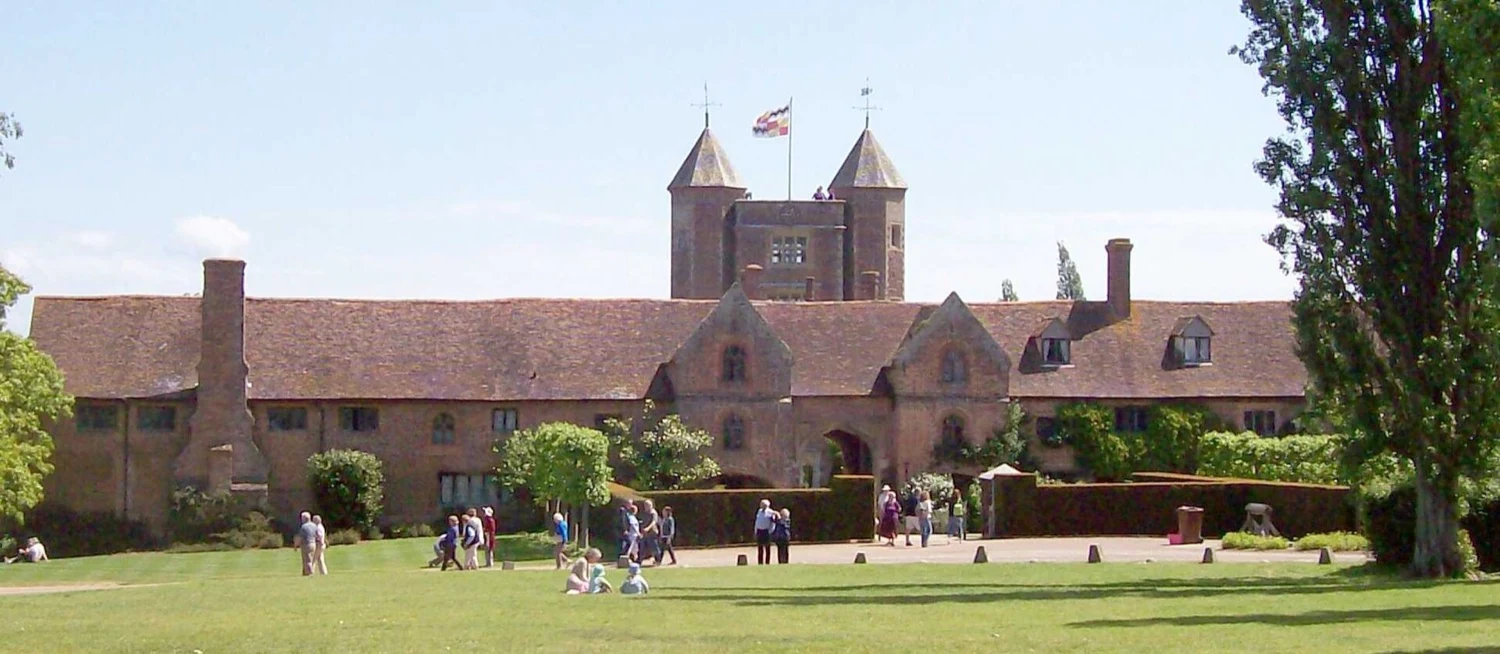
In the Weald of Kent, Sissinghurst is today famous for its twentieth-century gardens — but beneath the flowers survives a great Tudor court residence, built by a family of servants of the Crown. Its rose-brick tower and its gatehouse are the remains of an Elizabethan 'prodigy house' that welcomed the queen in person.
From the Baker gatehouse to the prodigy house
The estate owes its Tudor face to the Bakers. Sir John Baker, privy councillor of Henry VIII, raised in the 1530s a brick gatehouse — still standing. His son Sir Richard Baker transformed the whole, in the 1560s-1570s, into a vast house of state arranged around a tall four-storey brick tower: a 'prodigy house', of those sumptuous residences the nobility built to dazzle the court and, if possible, the queen. The word 'Castle' came later: Sissinghurst was not a fortress, but a house of prestige with court and tower.
Elizabeth's visit (1573)
In August 1573, Elizabeth I honoured Sissinghurst with her presence during one of her summer 'progresses' — those tours where the queen stayed with her great subjects, at their expense. To receive the sovereign was a ruinous and coveted honour: she had to be lodged, fed and entertained with a splendour worthy of her. The visit of 1573 marks the apogee of Tudor Sissinghurst, before the long decline that, in the eighteenth century, reduced it to a prison camp. To see: the brick tower of the 1560s, the west wing / gatehouse (c. 1533, now a library), the Priest's House and the South Cottage, and the medieval moat.
Did you know?
Fallen into ruin, the Tudor house of Sissinghurst served in the eighteenth century as a prison camp of the Seven Years' War. The historian Edward Gibbon, author of The Decline and Fall of the Roman Empire, was posted here as a militia officer and complained of the 'inconceivable dirtiness' of the place — and it is from those French prisoners that the name 'Castle' comes.
Notes
Sissinghurst Castle Garden lies near Cranbrook, in the Weald of Kent; a National Trust property, gardens and Tudor remains open to the public. Seasonal hours to check.
Quiz
- Who built Sissinghurst's brick gatehouse in the 1530s?
- Sir John Baker, councillor of Henry VIII
- Cardinal Wolsey
- Thomas Cromwell
- Which queen stayed here in August 1573?
- Elizabeth I
- Mary Stuart
- Anne of Cleves
- What was Sissinghurst in Tudor times?
- A great house of state (prodigy house)
- A border fortress
- A monastery