
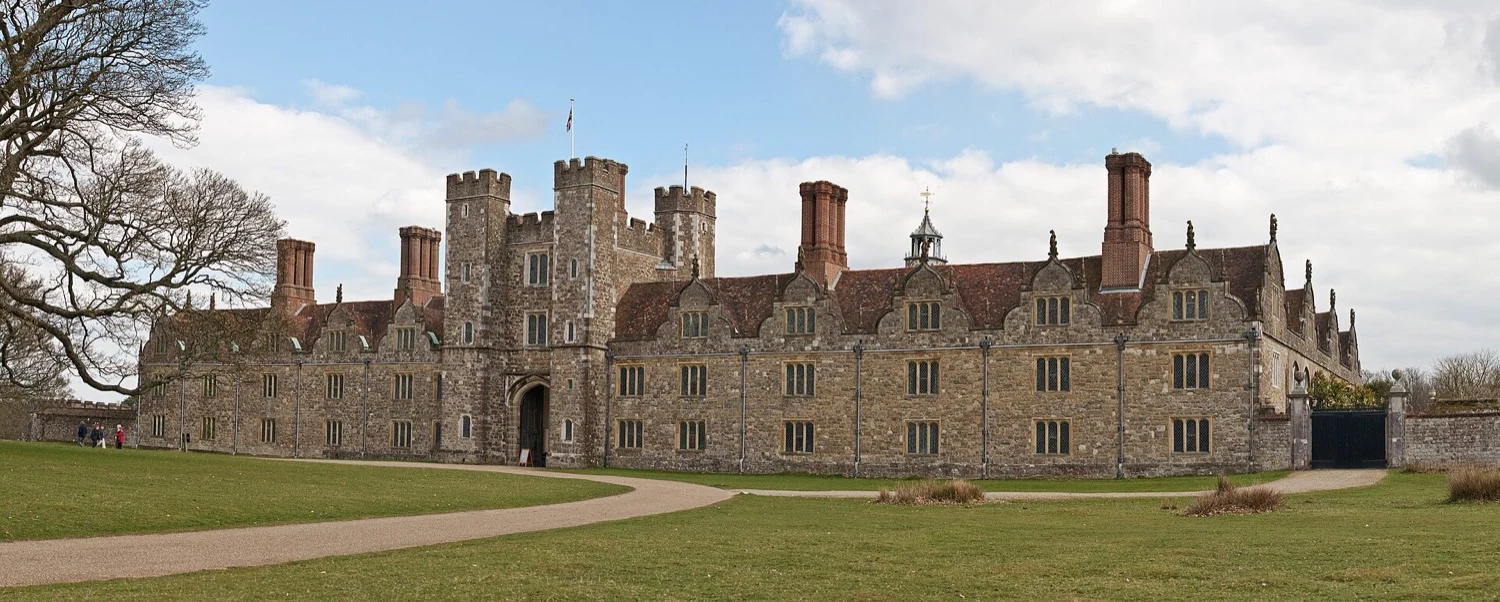
In the middle of a vast deer park, near Sevenoaks, Knole spreads its courts, its towers and its grey roofs as far as the eye can see. A former residence of the Archbishops of Canterbury seized by Henry VIII, this immense house is one of the largest in England, a labyrinth of stone in which the whole passage from Church to aristocracy can be read.
From archbishop to king
In the fifteenth century Archbishop of Canterbury Thomas Bourchier bought Knole and made it an episcopal palace, enlarged by his successors. In 1538, at the height of the Reformation, Archbishop Cranmer had to cede it to Henry VIII, who coveted this house near London. Like so many other Church properties, Knole thus passed to the Crown, and then, over the reigns, from royal hand to favourite's hand. In 1566 Elizabeth I gave it to her cousin Thomas Sackville, whose family (the Earls and then Dukes of Dorset) owned it for centuries and gave it its final shape in the early seventeenth century.
The house of a thousand rooms
Knole owes its fame to its prodigious size and to a pretty arithmetical legend: it is said to have as many courtyards as there are days in the week (7), as many staircases as there are weeks in the year (52), and as many rooms as there are days in the year (365) — hence its nickname of 'calendar house'. Under the Sackvilles the house filled with royal furniture, tapestries and portraits, making it an extraordinary conservatory of English decorative art. Built of brick and grey stone, deliberately sober outside, it hides an interior of rare refinement. Knole inspired the novelist Vita Sackville-West, who grew up there, and her friend Virginia Woolf.
What to see
- The successive courts and the 'calendar house' silhouette.
- The great hall and the painted staircase of the Sackvilles.
- The Stuart royal furniture and the tapestries.
- The immense deer park surrounding the house.
Did you know?
The 'calendar' legend (7 courts, 52 staircases, 365 rooms) was probably born after the fact, so vast is the house: no one, in truth, has ever been able to count its rooms exactly. But the fable says well the giddiness Knole produces — a house so great that it is measured, for want of better, on the scale of time itself.
Practical information
Knole lies at Sevenoaks, in Kent, south-east of London. It is today a house in the care of the National Trust, surrounded by a deer park open to the public. The opening hours and days of the house and park are liable to change; it is best to check them against the official sources before visiting.
Quiz
- To whom did Knole belong before being seized by Henry VIII?
- The Archbishop of Canterbury
- The King of France
- A monastic order
- What is Knole's nickname, tied to its size?
- The 'calendar house'
- The 'glass house'
- The 'king's house'
- Which family received Knole from Elizabeth I in 1566?
- The Sackvilles
- The Boleyns
- The Cecils