
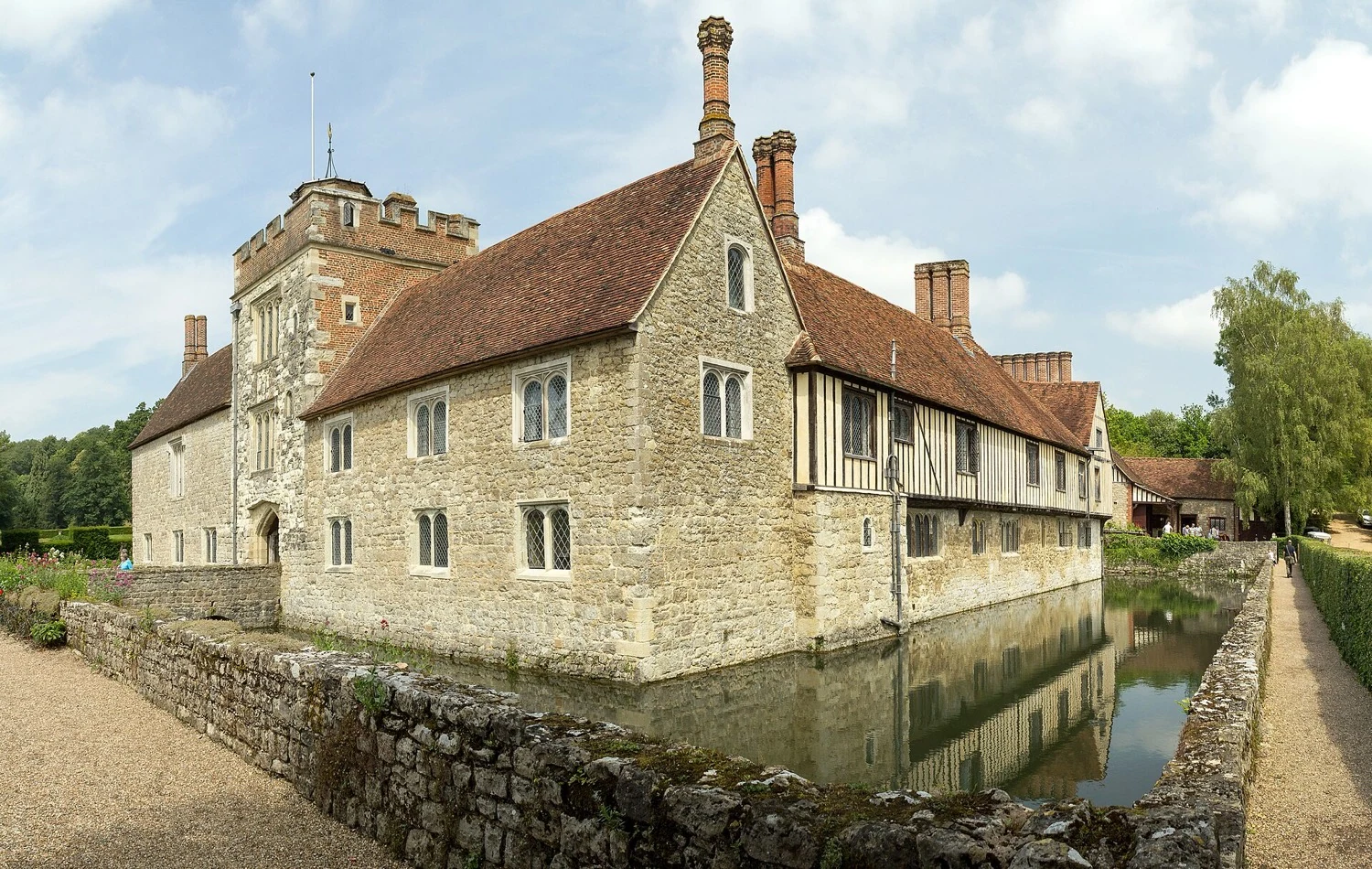
Hidden in a wooded fold of Kent, Ightham Mote is one of the best-preserved medieval manors in England: a moated house, whose stone and timber ranges close around a courtyard, on the water. In the Renaissance it received a chapel whose ceiling keeps the trace of the Tudor colours.
A manor crossed by the centuries
Built in the fourteenth century, Ightham Mote ('mote' here means the moat) owes its rare preservation to its very modesty: never turned into a great palace, it passed from family to family of the minor gentry without being demolished or rebuilt. In it can be read, one upon another, all the ages — medieval great hall, chapel, Tudor apartments, later additions — around its water-girt courtyard. It is an open-air book of domestic architecture, in which the life of the English gentry can be deciphered over six centuries.
The chapel and the Tudor colours
In the early sixteenth century the manor received a new chapel, whose wooden ceiling was painted with brightly coloured motifs — among them the Tudor roses and, it is said, emblems linked to Catherine of Aragon and then to Henry VIII's court. This modest but rare decoration shows how fashion and dynastic loyalty reached even the country manors: far from the palaces, the minor gentry too displayed their allegiance to the Tudors on the beams of their chapel.
What to see
- The moated manor and its inner courtyard on the water.
- The medieval Great Hall.
- The Tudor chapel with its wooden ceiling painted in the dynastic colours.
- The layering of the ages, from the Middle Ages to the modern era.
Did you know?
Ightham Mote holds a macabre legend: during works, the walled-up remains of a woman are said to have been found — whom tradition identifies as a lady accused of treason under the Tudors, immured alive in the manor. Nothing attests it, but the stubborn legend adds to the mysterious charm of this house on the water, where the past never seems quite to have left.
Practical information
Ightham Mote lies near Sevenoaks, in Kent, south-east of London. It is today a manor in the care of the National Trust, open to the public. Opening hours and days are liable to change; it is best to check them against the official sources before visiting.
Quiz
- What is a 'mote', in the name Ightham Mote?
- The moat that surrounds the manor
- A watchtower
- A hill
- Why is Ightham Mote so well preserved?
- It was never turned into a great palace
- It was rebuilt in the nineteenth century
- It was protected by the army
- What does the manor's Tudor chapel keep?
- A wooden ceiling painted in the Tudor colours
- A gilded dome
- Modern stained glass