
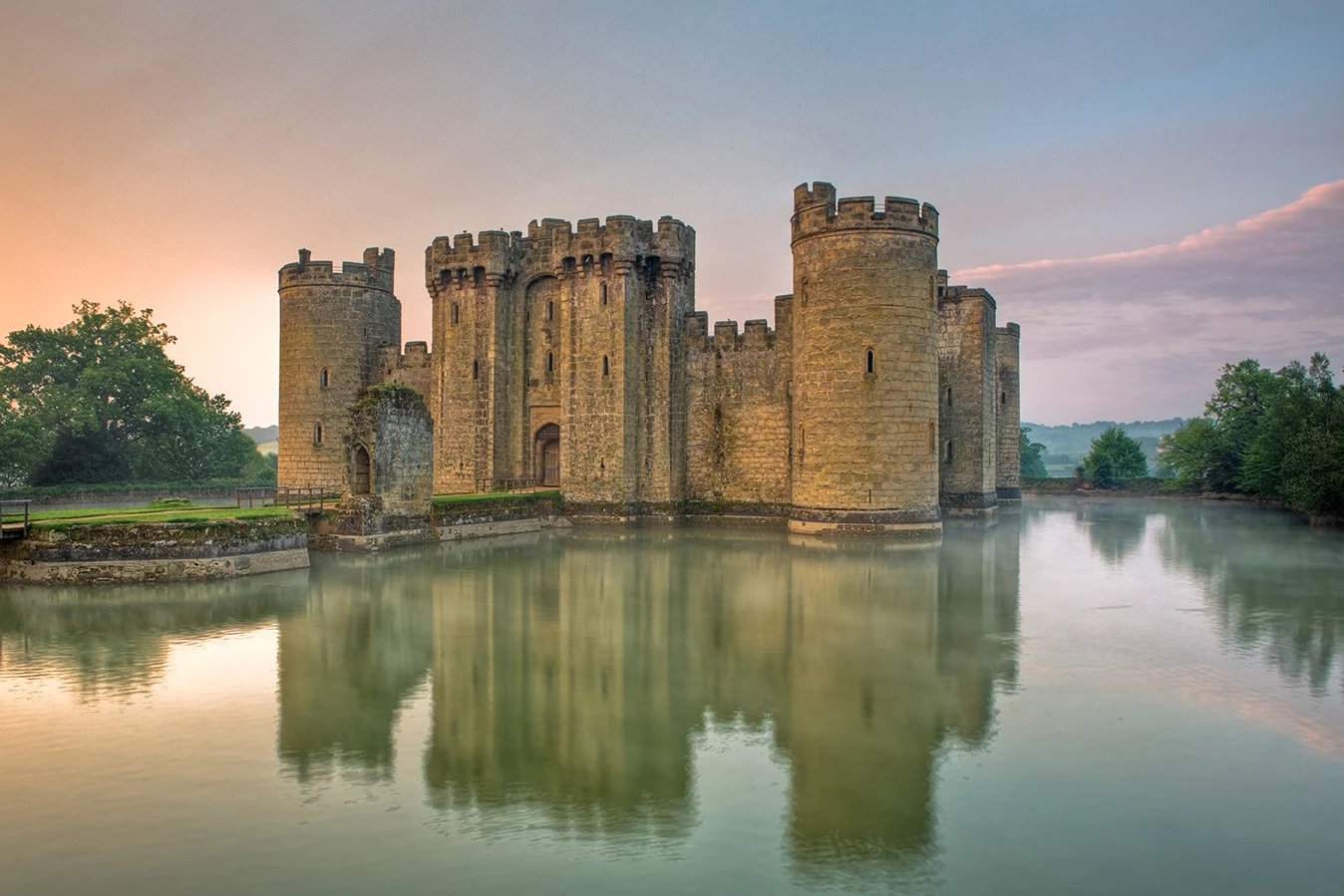
Mirrored in its broad moat, bristling with corner towers, Bodiam is the very image of the medieval castle — the one of children's books. But its history in the Renaissance is of another nature: it is that of a slow fading, the discreet story of those fortresses the Tudors let slip into oblivion.
A fortress at the threshold of the Tudor age
Built in the late fourteenth century, a quadrangular moated castle with a twin-towered gatehouse and intact curtain walls, Bodiam entered the Tudor age at the very moment of the turning-point of 1485. On the eve of Bosworth, in November 1483, Richard III had authorised Thomas Howard to besiege the castle, where Sir Thomas Lewknor, suspected of disloyalty, resided; whether the siege took place is unknown, but a surrender without a fight is likely. Victorious, Henry VII restored the Lewknors to their rights as early as 1485 — one of the many settlings of scores that accompanied the coming of the dynasty.
The slow seigneurial fading
After this restoration, Bodiam's Tudor history is one of quiet decline. The castle passed from hand to hand in the sixteenth century without it even being known for certain whether it was still inhabited. On the death of Sir Roger Lewknor in 1543, the estate was divided; it fragmented further when John Levett of Salehurst bought a share in 1588, before being finally reunited by Sir Nicholas Tufton, future Earl of Thanet, in 1623. Bodiam thus embodies the fate of so many medieval fortresses in the Tudor age: become militarily useless, they cease to be centres of power to become mere holdings to be divided and bought back. To see: the quadrangular moated castle with corner towers, the twin-towered gatehouse, the intact curtain walls and the interior remains (great hall, kitchens, chapel).
Did you know?
The most 'medieval' of English castles may never have served in war under the Tudors — nor even been truly inhabited in the sixteenth century. If Bodiam has come down to us so intact, it is precisely because it was forgotten: neither besieged, nor transformed, nor razed, it came through the Renaissance like a sleeping beauty, until it became the romantic icon admired today.
Notes
Bodiam Castle lies near Robertsbridge, East Sussex; a National Trust property, open to the public. Seasonal hours to check.
Quiz
- Who restored the Lewknors at Bodiam in 1485?
- Henry VII
- Richard III
- Henry VIII
- What does Bodiam's Tudor history tell?
- The slow fading of a medieval fortress
- A great Elizabethan siege
- The building of a new palace
- Why is Bodiam so well preserved?
- It was forgotten, neither razed nor transformed
- It was restored by Henry VIII
- It never had a moat