
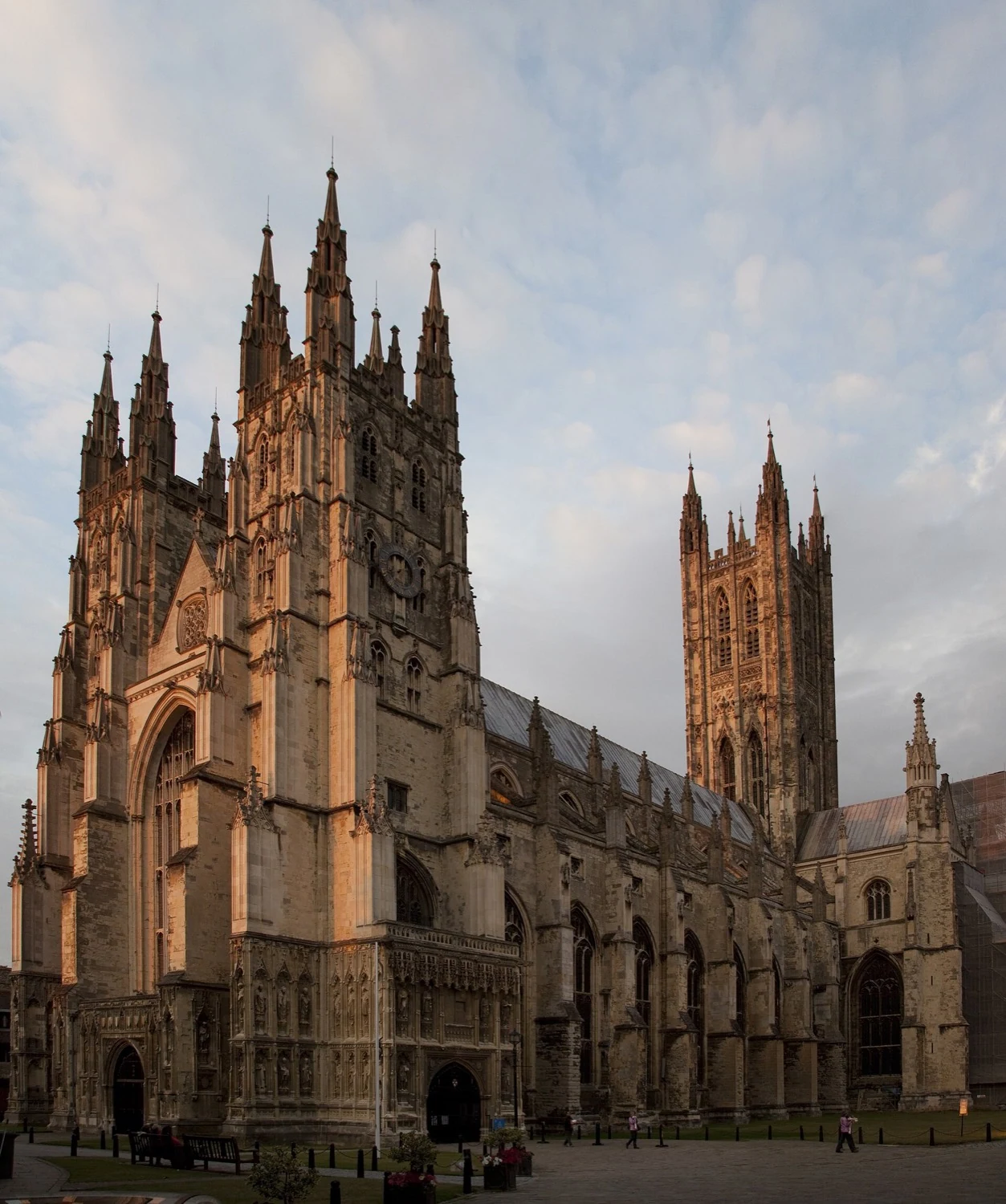
The spiritual heart of England, seat of the primate archbishop, Canterbury Cathedral was also one of the great battlefields of the Reformation. This sanctuary, long the most frequented in the realm thanks to the tomb of St Thomas Becket, saw Henry VIII wipe out this thousand-year pilgrimage at a stroke — an emblematic act of the break with Rome.
The destruction of Becket's shrine
Since the murder of Archbishop Thomas Becket in 1170, his tomb at Canterbury had been England's greatest pilgrimage, the goal of Chaucer's 'Canterbury Tales', covered with gold and jewels offered by generations of the faithful. Around 1512-1514, the humanist Erasmus had still visited and described it in its splendour. But in 1538, Henry VIII had the shrine destroyed, its treasures confiscated and the relics dispersed; tradition even holds that he had the dead saint 'summoned' to answer for treason. To abolish the cult of Becket — that archbishop who had defied a king of England — was a limpid message: no saint, no pope now took precedence over the Crown.
From dissolution to Huguenot exile
The Benedictine priory that served the cathedral was dissolved on 30 March 1539, then the cathedral refounded as a secular chapter (dean and canons) on 8 April 1541 — a pattern applied across all England. Half a century later, another face of the Reformation appeared: in 1576, the crypt was granted to a Huguenot congregation of French Protestant refugees, fleeing the religious wars of the continent. A 'French Church' still celebrates its worship there, a living echo of the European persecutions. To see: the Trinity Chapel (site of the former Becket shrine) and its windows, the Norman crypt, the Perpendicular nave, the Bell Harry tower and the Huguenot chapel in the crypt.
Did you know?
Before Henry VIII had everything destroyed, the humanist Erasmus had seen, around 1512-1514, the prior of Canterbury display the jewels of Becket's tomb, 'naming each stone in French, its value and the name of the donor'. This testimony of one of the greatest minds of the Renaissance is one of the rare direct looks at the splendour of the shrine, only a few years before its disappearance.
Notes
Canterbury Cathedral lies at Canterbury, Kent; a working cathedral, open to visits (admission charge). A UNESCO World Heritage Site.
Quiz
- Which cult did Henry VIII abolish at Canterbury in 1538?
- That of Thomas Becket (destruction of the shrine)
- That of the Virgin
- That of St Augustine
- Who visited and described the shrine around 1512-14?
- The humanist Erasmus
- Shakespeare
- Christopher Columbus
- Who received the crypt in 1576?
- A refugee Huguenot congregation
- The Benedictines
- The Jesuits