
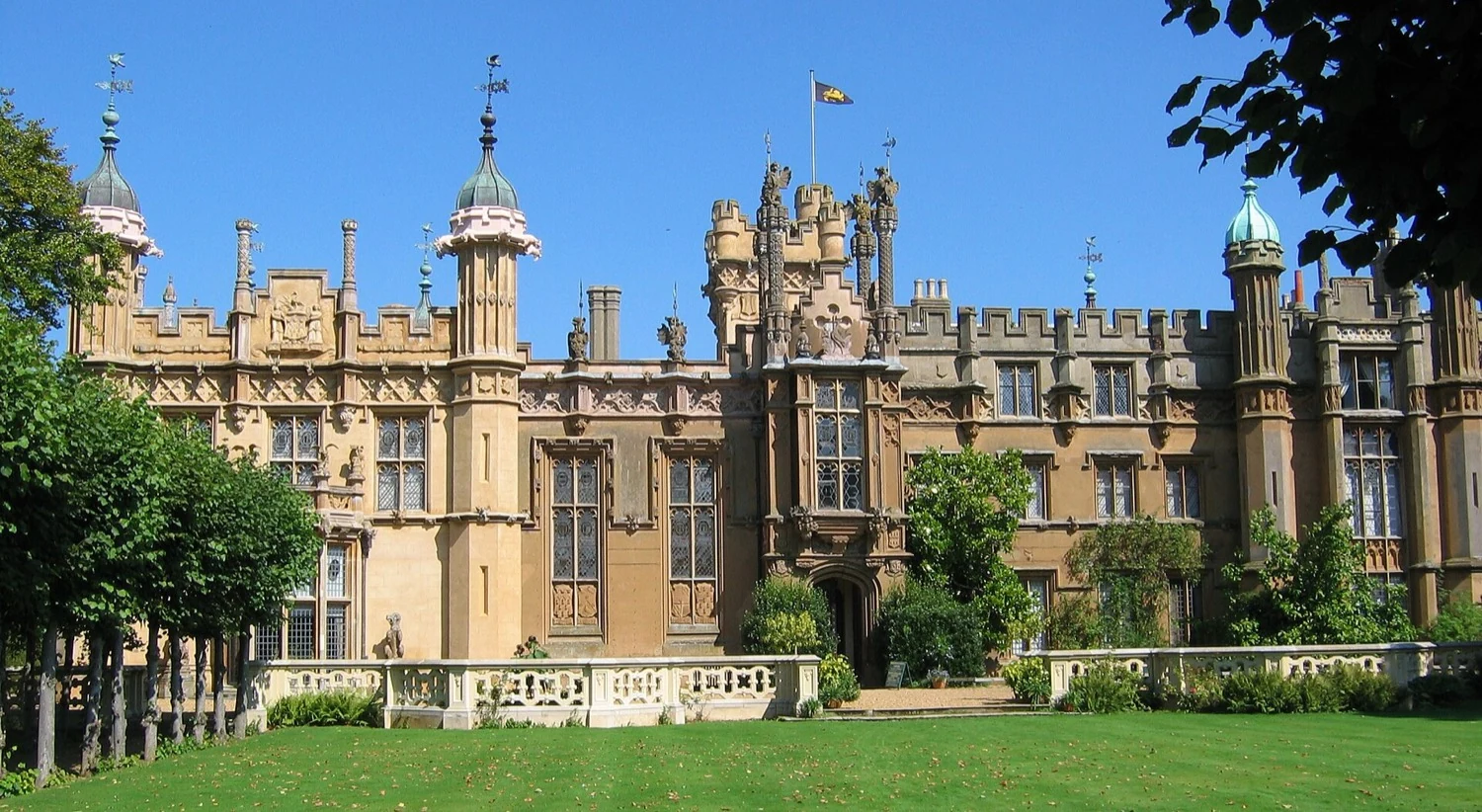
Famous today for its Gothic Revival skyline bristling with gargoyles and domes, Knebworth House is in truth a Tudor house in disguise: beneath the romantic dress of the nineteenth century lies the core of a brick manor raised around 1490 by the Lytton family, who occupy it still.
A Tudor manor beneath the Victorian dress
Robert Lytton acquired Knebworth in the late fifteenth century and built a large red-brick manor around a court, with its gatehouse and great hall. It was a classic Tudor house, enlarged under the Tudors and Stuarts. Look, beneath the Gothic Revival additions, for the older structure: the Banqueting Hall keeps its carved Jacobean wooden screen and its ceiling, the preserved heart of the Renaissance manor.
The great romantic transformation
In the nineteenth century, the novelist Edward Bulwer-Lytton (author of The Last Days of Pompeii) demolished three of the old manor's four wings and clothed what remained in an extravagant Gothic Revival dress — turrets, domes, gargoyles. Knebworth is thus a palimpsest: Tudor at heart, Victorian on the surface. Don't miss: the Tudor Banqueting Hall and its Jacobean screen, the Gothic Revival front, the park (now famous for its concerts).
Did you know?
The novelist Bulwer-Lytton, master of Knebworth, is the man who wrote the most mocked opening line in English literature — "It was a dark and stormy night" — now the byword for overwrought prose. He transformed his Tudor house as he wrote: by covering it in romantic ornament. The Renaissance core, though, survived beneath the dress.
Info
Knebworth House is near Stevenage (Hertfordshire); the private house of the Lyttons, house, gardens and park open to the public in season. Hours to be checked.