
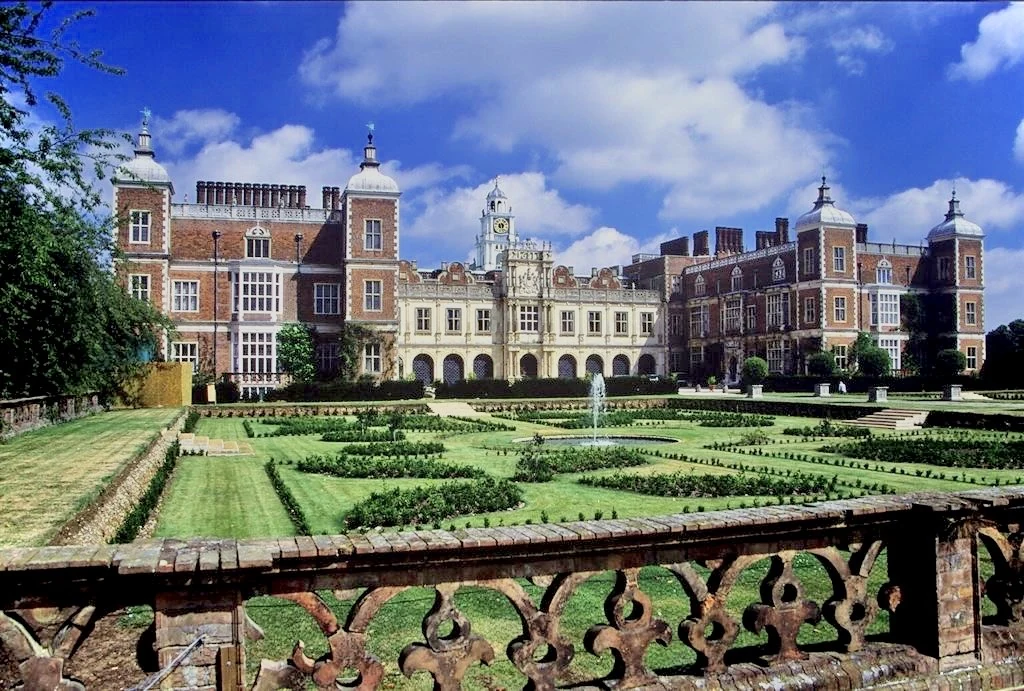
In Hertfordshire, Hatfield brings together two ages in a single estate: the old brick Tudor palace, where the princess Elizabeth grew up and waited, and the sumptuous Jacobean house that her most faithful minister, Robert Cecil, set beside it. It was here, tradition says, that Elizabeth learned she had become queen.
The palace of childhood and waiting
The first Hatfield is a brick palace built at the end of the fifteenth century by a bishop, then seized by Henry VIII. It served as a residence for his royal children. The young Elizabeth spent part of her childhood here and, later, under the reign of her Catholic half-sister Mary I, was kept apart here, almost under house arrest, in waiting and in danger. Tradition relates that it was at Hatfield, in November 1558, seated beneath an oak in the park, that she learned of Mary's death and her own accession: 'This is the Lord's doing, and it is marvellous in our eyes', she is said to have murmured in Latin. She held her first council here.
The house of a minister
Half a century later, Robert Cecil, son of William Cecil and minister of James I, obtained the estate. He had part of the old palace demolished and raised beside it, between 1607 and 1611, a magnificent house of brick and stone, a masterpiece of the Jacobean style: a long symmetrical façade, a great gallery, a carved staircase, decoration on the hinge of the Renaissance and the classical age. Hatfield also keeps precious portraits of Elizabeth I (among them the famous Rainbow Portrait and the Ermine Portrait) and relics of the queen. The estate thus unites, in a single place, the cradle of the sovereign and the monument of the generation that followed her.
What to see
- The old brick Tudor palace (Old Palace), surviving wing of Elizabeth's childhood.
- Robert Cecil's Jacobean house (1607-1611) and its great gallery.
- The portraits of Elizabeth I (Rainbow Portrait, Ermine Portrait) and her relics.
- The park and the oak (planted in memory of the one of the accession).
Did you know?
Tradition holds that Elizabeth learned of her accession to the throne while reading beneath an oak in the park of Hatfield, in November 1558. The original tree has long since died, but others have been planted to mark the spot. So one of the greatest reigns in English history is said to have begun not in a palace, but in the open air, beneath a tree — an image England cherished as an omen of fruitfulness.
Practical information
Hatfield House lies at Hatfield, in Hertfordshire, north of London. It is a private house, still linked to the Cecil (Salisbury) family, open to the public with its park and gardens. Opening hours, prices and days are liable to change with the seasons; it is best to check them against the official sources before visiting.
Quiz
- Which sovereign spent her childhood and her waiting at the old palace of Hatfield?
- Elizabeth I
- Mary Queen of Scots
- Catherine of Aragon
- Who built the Jacobean house of Hatfield between 1607 and 1611?
- Robert Cecil
- William Cecil
- Thomas Wolsey
- Where, according to tradition, did Elizabeth learn of her accession in 1558?
- Beneath an oak in the park of Hatfield
- In Canterbury Cathedral
- At the Tower of London