
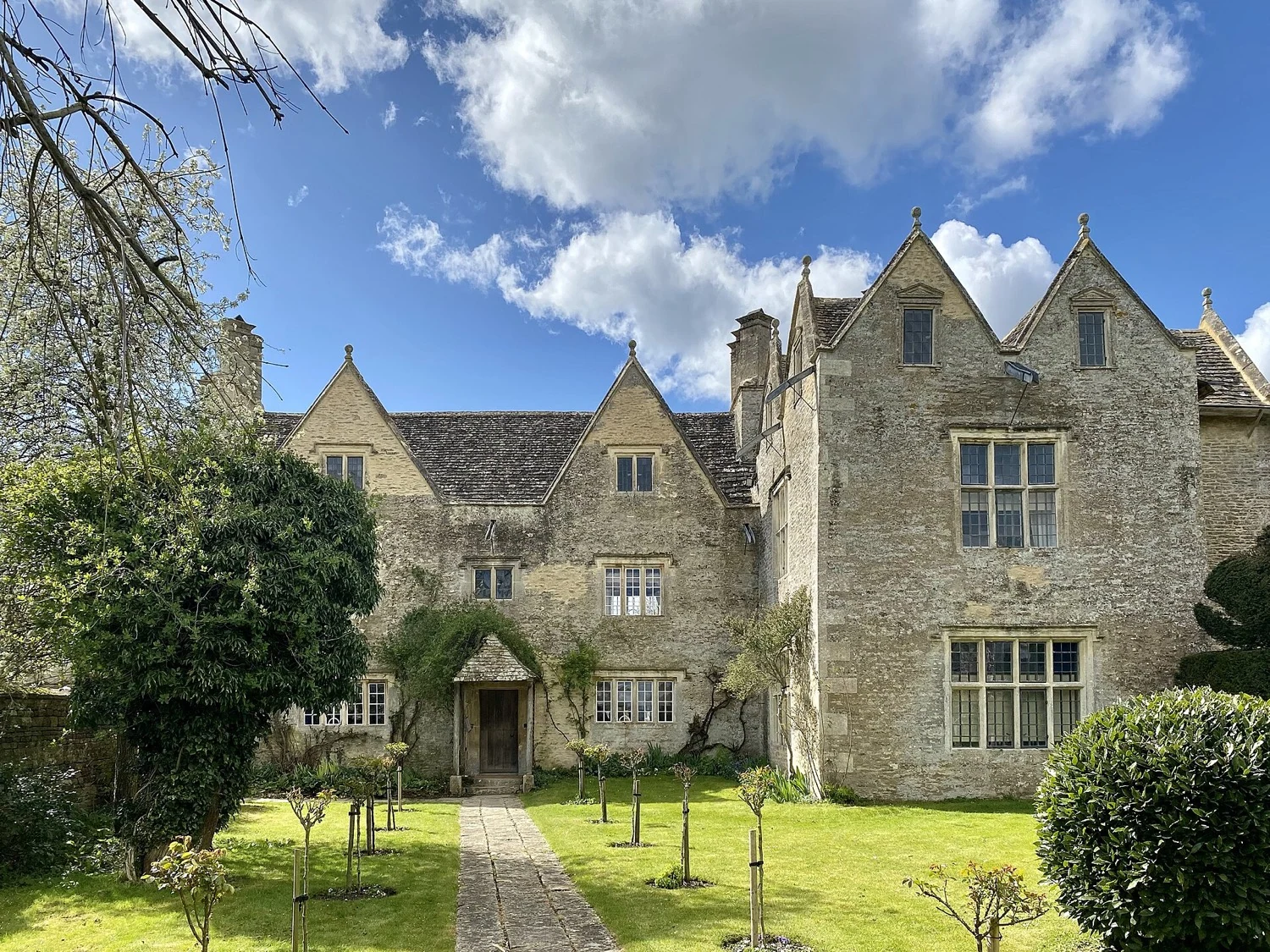
By the Thames, in a quiet corner of Oxfordshire, Kelmscott Manor is a charming grey-stone Cotswold farmhouse-manor. Famous in the nineteenth century as William Morris's retreat, it is first, by its structure, an authentic vernacular house of the English Renaissance, remaining almost unchanged since its building.
A farmhouse-manor of 1570
The building itself is an Elizabethan farmhouse-manor, built around 1570 for the local farmer Thomas Turner, in Cotswold stone. It is a fine example of Tudor vernacular architecture: a solid, unpretentious stone house, built for a family of the yeomanry (the well-off farmers), with its original frame and its harmonious proportions. A wing was added in the late seventeenth century. What strikes is the authenticity of the place: Kelmscott has come through the centuries without being disfigured, keeping the character of a rural Renaissance house.
The authenticity that charmed Morris
It was precisely this intact Tudor authenticity that, much later, charmed the poet, artist and thinker William Morris, a major figure of the Arts & Crafts movement, who rented the house from 1871 to 1896 (that is, long after our period — to be mentioned as a context of fame, not as a Renaissance link). Morris saw in Kelmscott the ideal of an honest architecture, born of the place and the work of local craftsmen, the opposite of Victorian industrialism. He made it an aesthetic model and borrowed from it the name of his utopia, News from Nowhere (1890). To see: the Tudor stone house and its original frame, the walled garden and its listed gazebo, the very old black mulberry, (the Morris collections inside, nineteenth century).
Did you know?
The 'intact' charm of this Elizabethan house was praised by William Morris as the very ideal of architecture: a house born of its land, built of local stone by local hands. He loved it so much that he made it the culmination of his utopia News from Nowhere (1890) — a novel where a regenerated England resembles an eternal summer around Kelmscott. A Tudor farm thus became, three centuries after its building, the symbol of a better world.
Notes
Kelmscott Manor lies at Kelmscott, West Oxfordshire (Cotswolds, near the Thames); managed by the Society of Antiquaries of London, open to the public seasonally. Morris collections inside. Hours to check.
Quiz
- What is Kelmscott Manor by its structure?
- An Elizabethan farmhouse-manor (c. 1570)
- A castle
- A cathedral
- Which nineteenth-century artist lived there and admired it?
- William Morris
- Turner
- Constable
- What charmed Morris at Kelmscott?
- Its intact Tudor authenticity
- Its modernity
- Its cannon