
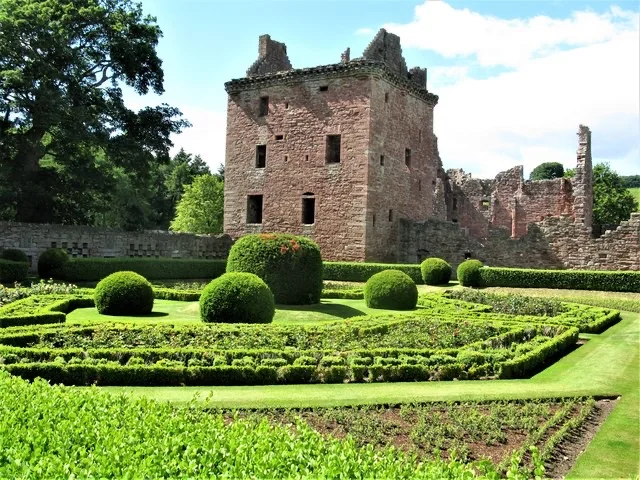
In Angus, Edzell Castle would be a fine Lindsay tower house among others — but for its extraordinary walled garden of 1604, unique in Scotland: a 'Pleasance' whose walls bear a whole humanist iconographic programme, imported from the Continent.
The Lindsay builders
The new castle was begun around 1520 by David Lindsay, 9th Earl of Crawford, and the cultivated family enlarged it throughout the sixteenth century. Mary Stuart stayed two nights here in August 1562, on her journey north. But the glory of Edzell is the garden created in 1604 by Sir David Lindsay, Lord Edzell, the year after the Union of the Crowns.
A unique carved programme
The four walls of the garden bear a series of carved panels depicting the seven Cardinal Virtues, the seven Liberal Arts and the seven Planetary Deities — a learned programme meant to instruct and charm guests, directly inspired by German engravings. To these are added flower niches, birds' nesting-boxes cut into the stone, and symbols of the union of England, Scotland and Ireland (1603). It is the most accomplished example of the Renaissance garden in Scotland. To see: the Virtues/Arts/Planets panels, the flower niches, the corner pavilion, the ruined tower house.
Did you know?
Sir David Lindsay died in 1610, before the completion of his humanist garden — which nonetheless remains, four centuries later, the most learned and complete of its kind in Scotland: a rare case of a garden designed as a lesson in philosophy carved in stone.
Notes
Edzell Castle lies near Brechin, in Angus; a site in the care of Historic Environment Scotland. Hours to check.
Quiz
- What is unique about the garden of Edzell (1604)?
- Walls carved with the Virtues, Liberal Arts and Planets
- An underground labyrinth
- A wine fountain
- Who created this garden?
- Sir David Lindsay, Lord Edzell
- Mary Stuart
- Robert Bruce
- Which event of 1603 does the garden also celebrate?
- The Union of the Crowns (England-Scotland-Ireland)
- The defeat of the Armada
- The death of Elizabeth I alone