
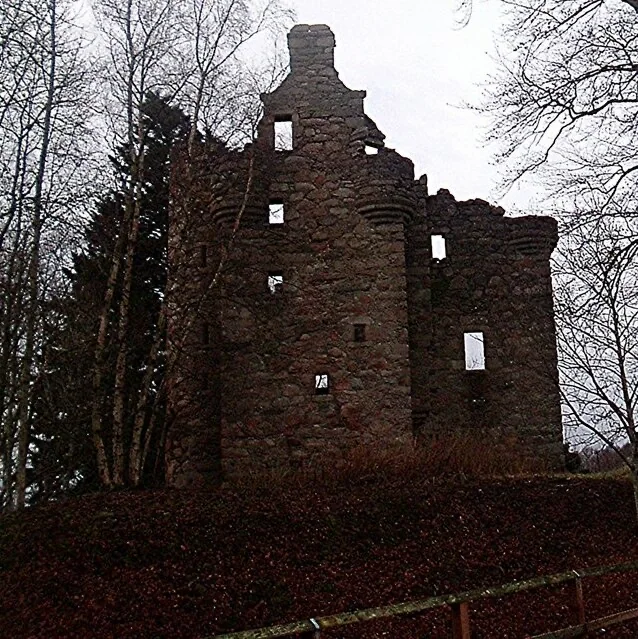
North-west of Lumphanan, in Aberdeenshire, the ruins of Corse Castle keep the memory of a famous retort. A property of the Forbes, the present castle was built in 1581 by a laird determined never to be plundered again.
A house against thieves
After the destruction of the original house by robbers in a raid, the laird Sir William Forbes is said to have sworn: 'Please God I will build me such a house as thieves will need to knock at ere they enter.' He raised the present castle, bearing his initials and the date 1581 — an unusual combination of L- and Z-plans, typical of the compact Renaissance tower house of the north-east. Now a ruin (a scheduled monument), it illustrates the persistent insecurity of the Scottish countryside and the lairds' architectural answer: to build stronger. To see: the remains of the L-plan block, the stair and corner towers, the initials and date 1581.
Did you know?
Two sons of Corse marked their time: Patrick Forbes (1564-1635), born at the castle before its rebuilding, became Bishop of Aberdeen in 1618; and his younger brother William Forbes bought in 1610 the castle of Craigievar, which he completed as a masterpiece — 'Danzig Willy'. From one Aberdeenshire family thus came a great bishop and the builder of the finest fairy-tale castle in Scotland.
Notes
Corse Castle lies about 5 km north-west of Lumphanan, Aberdeenshire; a ruin (scheduled monument), an obscure but verified site (Wikipedia, Canmore). Access to check.
Quiz
- Why did Sir William Forbes build Corse in 1581?
- After the plundering of his house by robbers
- To receive the king
- To install an abbey there
- Which son of Corse became Bishop of Aberdeen?
- Patrick Forbes
- John Knox
- George Buchanan
- Which other castle did a son of Corse complete?
- Craigievar
- Edinburgh
- Stirling