
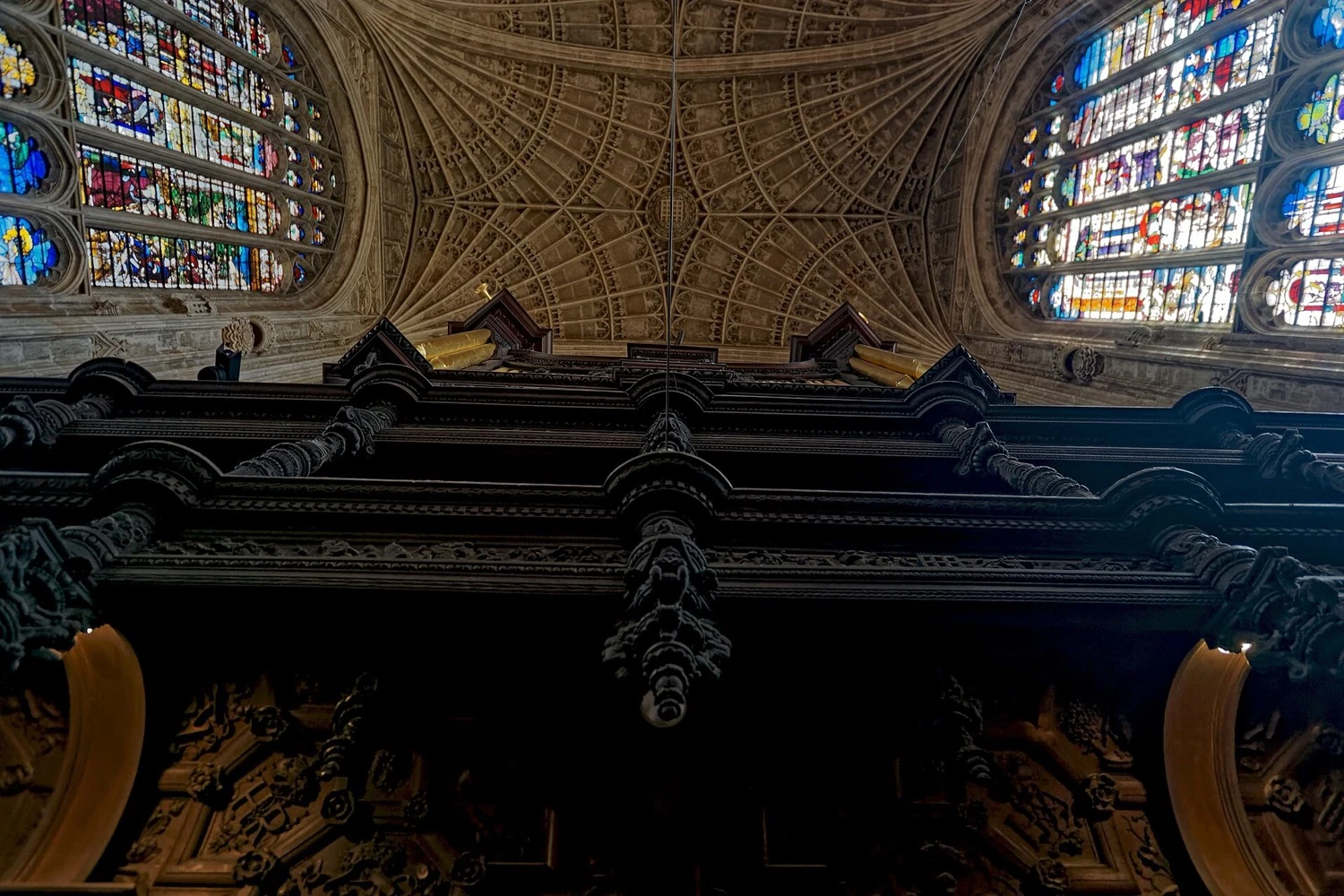
Beneath the fan vaults of the most perfect of English Gothic chapels stands an intrusion from another world: a dark oak screen, all Renaissance pilasters, garlands and grotesques. Erected between 1533 and 1536, it carries, carved everywhere, the secret of a marriage — that of Henry VIII and Anne Boleyn.
A screen dated by a love
The screen separates the ante-chapel from the choir and carries the organ. It was set up by Henry VIII to celebrate his union with Anne Boleyn, and the iconography dates it almost to the day: one reads the interlaced ciphers HR (Henricus Rex) and RA (Regina Anna), the couple's impaled arms, lovers' knots, a woman's profile and a bull's head (the bull, a punning emblem of the Boleyns). As Anne was executed in May 1536, these ciphers could only have been carved between 1533 and 1536 — a rare monument to survive the damnatio memoriae of the beheaded queen.
England's first Renaissance masterpiece
This screen is the first major timber structure entirely in the Renaissance style raised in England. Pevsner saw in it "the most exquisite piece of Italian decoration surviving in England". Against the Perpendicular Gothic of the chapel, it announces, in 1533, the new taste — and proclaims, beneath its garlands, Henry's divine right to rule the Church of England. To see: the HR and RA ciphers, the impaled arms, the Boleyn bull's head, the Renaissance grotesques, the organ above.
Did you know?
Anne Boleyn was beheaded in 1536, and Henry VIII erased her memory wherever he could — portraits destroyed, emblems chiselled off. But the King's College screen, too fine or too costly to undo, kept its initials. It is one of the few places in the world where the cipher of Anne, queen for a few months, still survives, carved in oak above the faithful.
Info
The screen is in King's College Chapel, Cambridge; visible with the chapel (King's College).