
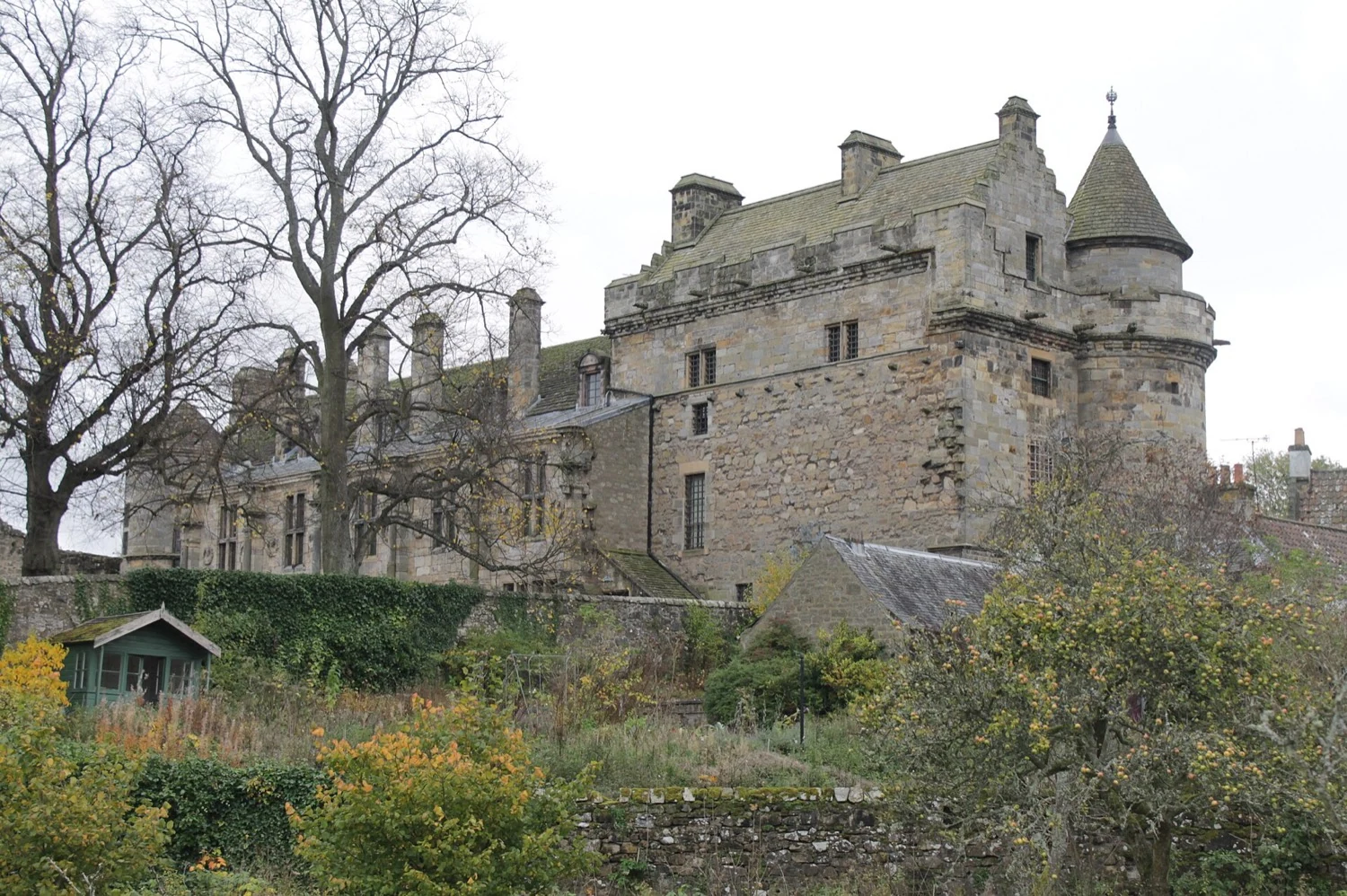
Enter the courtyard of Falkland and look up at the south and east façades: beneath a still wholly Gothic queen of Britain, one of the first fully Renaissance decorative schemes on the island unfolds — regular pilasters, engaged columns, antique medallions. It was the work of James V, king of Scots twice married to French princesses, who brought back from France the taste of the Loire châteaux.
A façade come from the Loire
After his stays in France and his marriages to Madeleine de Valois (daughter of Francis I) then Mary of Guise, James V launched the transformation of Falkland in 1537. Look at the rhythm of the east façade: six bays marked by pilaster-buttresses bearing engaged columns (square then round Corinthian), capped by statue niches rising to the cornice. Between the windows are set pairs of Italianate medallions with heads in profile, and the dormers receive segmental pediments. In 1539, as many as sixty masons worked here; the work was complete by about 1541.
The Franco-Scottish bridge
Falkland embodies the "Auld Alliance" in stone: French masons, among them Nicolas Roy, transposed here the vocabulary of the early French Renaissance, when England was still applying ornament piecemeal. Falkland's antique medallions are cousins of those at Edinburgh and Stirling — a whole generation of Scottish royal sculpture fed by France. To see: the south and east courtyard façades, the pilasters and engaged columns, the profile medallions, the statue niches.
Did you know?
While James V's Scotland covered its palaces with antique medallions from France, Henry VIII's England remained largely Gothic in its great façades. For once, it was through the north that Renaissance architecture entered the island: Falkland and Stirling precede, by nearly a century, the classical palaces of Inigo Jones.
Info
The Renaissance façades are seen in the courtyard of Falkland Palace (Fife, Scotland); National Trust for Scotland.