
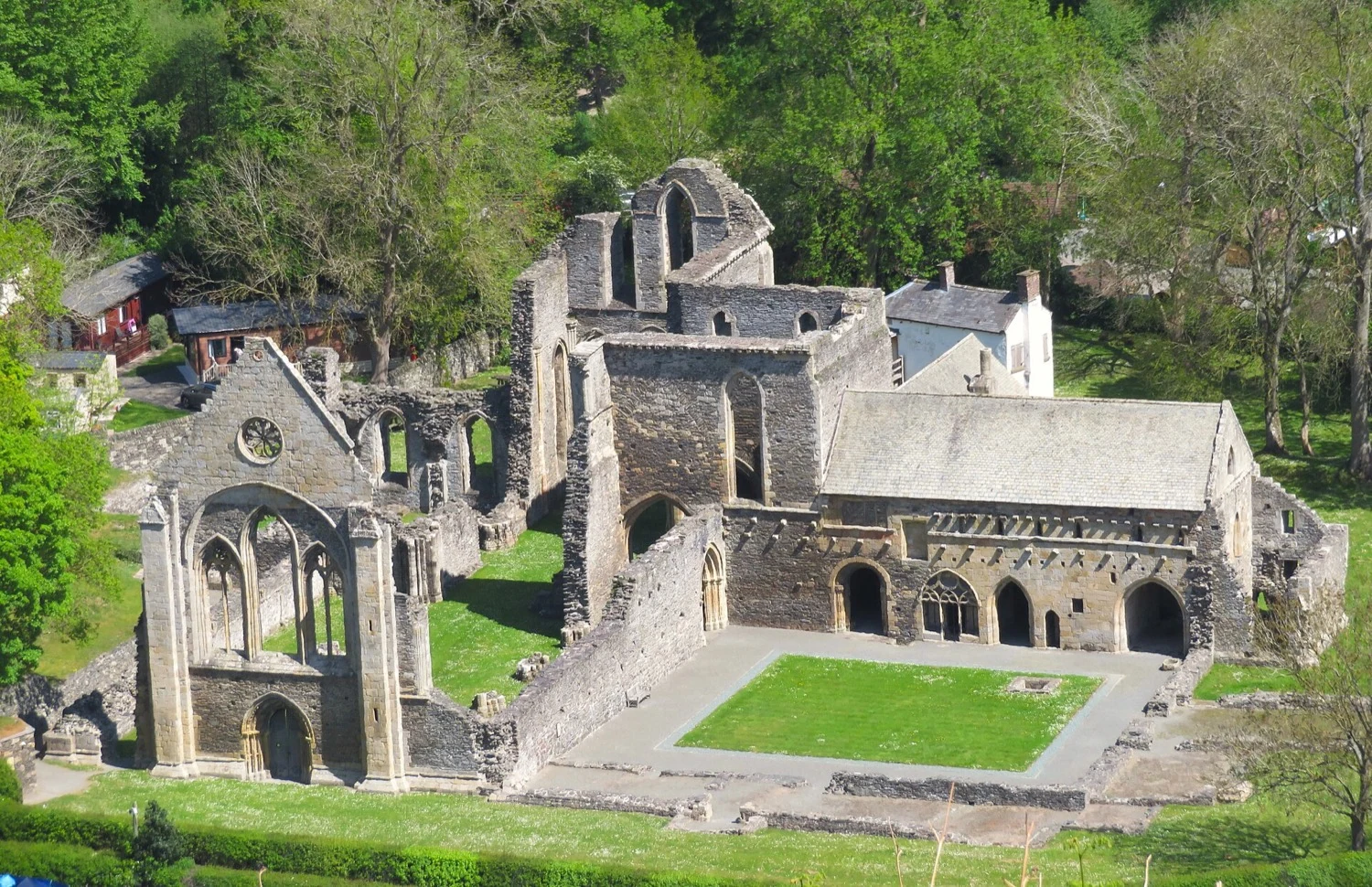
In a green valley near Llangollen, in Denbighshire, the ruins of Valle Crucis were those of the last great Cistercian abbey of Wales. On the very eve of the Reformation, it was at its cultural zenith — a home of hospitality for the poets and bards of the Welsh language.
A home of Welsh culture
Founded in 1201, Valle Crucis reached its cultural apogee in the late fifteenth century. Under three learned and patron abbots — Siôn ap Rhisiart, Dafydd and Siôn Llwyd — the abbey became a high place of hospitality to Welsh poets and bards. In a country where the Welsh language and poetry were a threatened treasure, these abbots protected and nourished the beirdd (poets), perpetuating a thousand-year literary tradition. The great poet Guto'r Glyn was indeed buried there. Valle Crucis was thus, at the hinge of the Middle Ages and the Renaissance, one of the last great homes of Welsh-language culture before the break.
The dissolution of 1537
The end came with the Dissolution of the Monasteries. Valle Crucis, whose revenue (£188) was just under the £200 threshold set by the first Act of Suppression, was dissolved in 1537. Its end was moreover inglorious: the second-to-last abbot, mixed up in extortions and thefts, was imprisoned in the Tower of London, and at the suppression, five of the last seven monks had already fled to other houses, sickened by these exactions. Thus disappeared, with the abbey, one of the great homes of Welsh poetry — the Reformation dealing a blow to vernacular culture as much as to religion. To see: the west front with its rose window and gable, the surviving dormitory and chapter house, the monastic fishpond, the nearby Pillar of Eliseg.
Did you know?
Valle Crucis takes its name ('the valley of the cross') from the Pillar of Eliseg, a ninth-century stone cross raised in a neighbouring field, one of the oldest written monuments in Wales. Thus, the last great Welsh Cistercian abbey was built near a monument already three centuries old at its founding — and still standing today, the silent guardian of a valley where princes, monks and poets have followed one another.
Notes
Valle Crucis Abbey lies at Llantysilio, near Llangollen, Denbighshire; ruins run by Cadw, open to visits. The Pillar of Eliseg is nearby. Seasonal hours to check.
Quiz
- Whom did Valle Crucis welcome on the eve of the Reformation?
- Welsh poets and bards
- Spanish soldiers
- Wool merchants
- When was the abbey dissolved?
- In 1537
- In 1201
- In 1605
- Where does the name 'Valle Crucis' come from?
- The Pillar of Eliseg (nearby stone cross)
- A battle
- A Norman king