
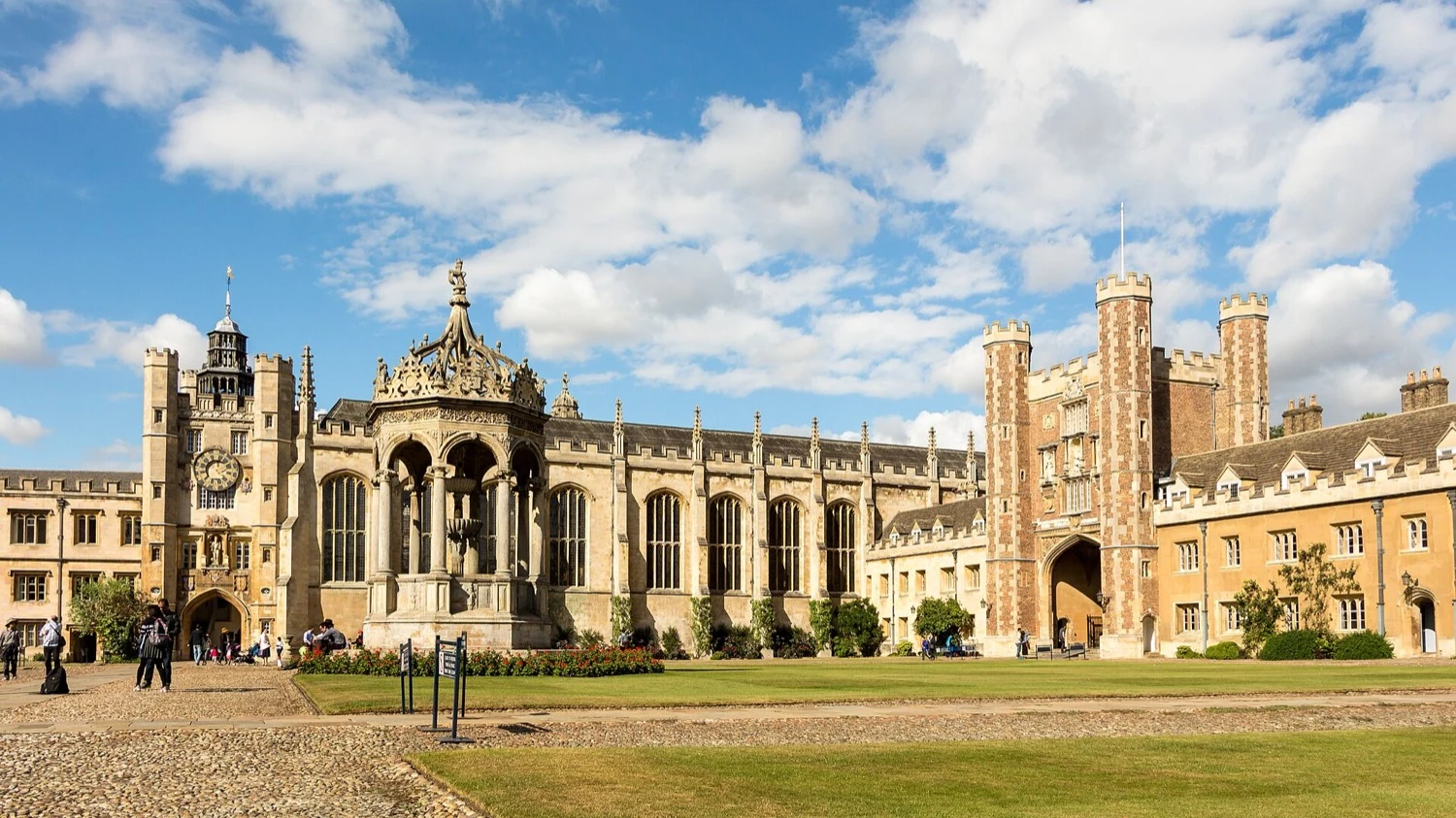
Trinity College, the largest and most prestigious of the Cambridge colleges, was founded by Henry VIII in 1546, a few months before his death. Around its 'Great Court', the largest in the university, it embodies the idea the English Renaissance held of power: the one that runs through learning too.
A king's foundation
In 1546, at the end of his reign, Henry VIII brought together several older colleges and foundations to create, at a single stroke, a new and magnificent college: Trinity College. The king who had dissolved the monasteries and seized their wealth reinvested a part of it in education, affirming that the new England would also have its homes of learning. The gesture was not disinterested: to train clerks, lawyers and administrators loyal to the Crown and the reformed Church was a political necessity as much as a humanist ideal.
The Great Court and the spirit of the Renaissance
The heart of Trinity is its Great Court, laid out under Elizabeth I and James I by the master Thomas Nevile: the largest enclosed court in university Europe, ordered around a fountain, bordered by the chapel, the great hall and the clock tower. Later, Christopher Wren would add his famous library. Trinity trained some of the greatest minds in the kingdom: on the hinge of the Renaissance and the classical age, the philosopher Francis Bacon, father of the modern scientific method, studied here, as did Isaac Newton later. Henry VIII's college thus became one of the matrices of English thought.
What to see
- The Great Court, the largest enclosed court in the university, and its fountain.
- The Elizabethan chapel and great Hall.
- The clock tower (King Edward's Tower) and the gate adorned with the statue of Henry VIII.
- The setting of the 'Backs', the gardens running down to the Cam.
Did you know?
Above the great gate of Trinity, the statue of Henry VIII, the college's founder, holds in his hand not a sceptre but… a wooden chair leg. Student tradition holds that pranksters once replaced the original sceptre with this chair leg — and that ever since the college has declined to restore it. The royal founder thus reigns over Trinity, wooden sceptre in hand, with the stubborn humour of the students.
Practical information
Trinity College lies in the heart of Cambridge, on Trinity Street. It is a working university college; its courts and chapel may be visited on varying arrangements and hours, sometimes restricted during examinations. It is best to check against the official sources before visiting.
Quiz
- Which king founded Trinity College in 1546?
- Henry VIII
- Henry VI
- James I
- What is the name of the university's largest court, at the heart of Trinity?
- The Great Court
- The Square Court
- The Cloister
- Which philosopher, father of the scientific method, studied at Trinity?
- Francis Bacon
- Thomas More
- John Dee