
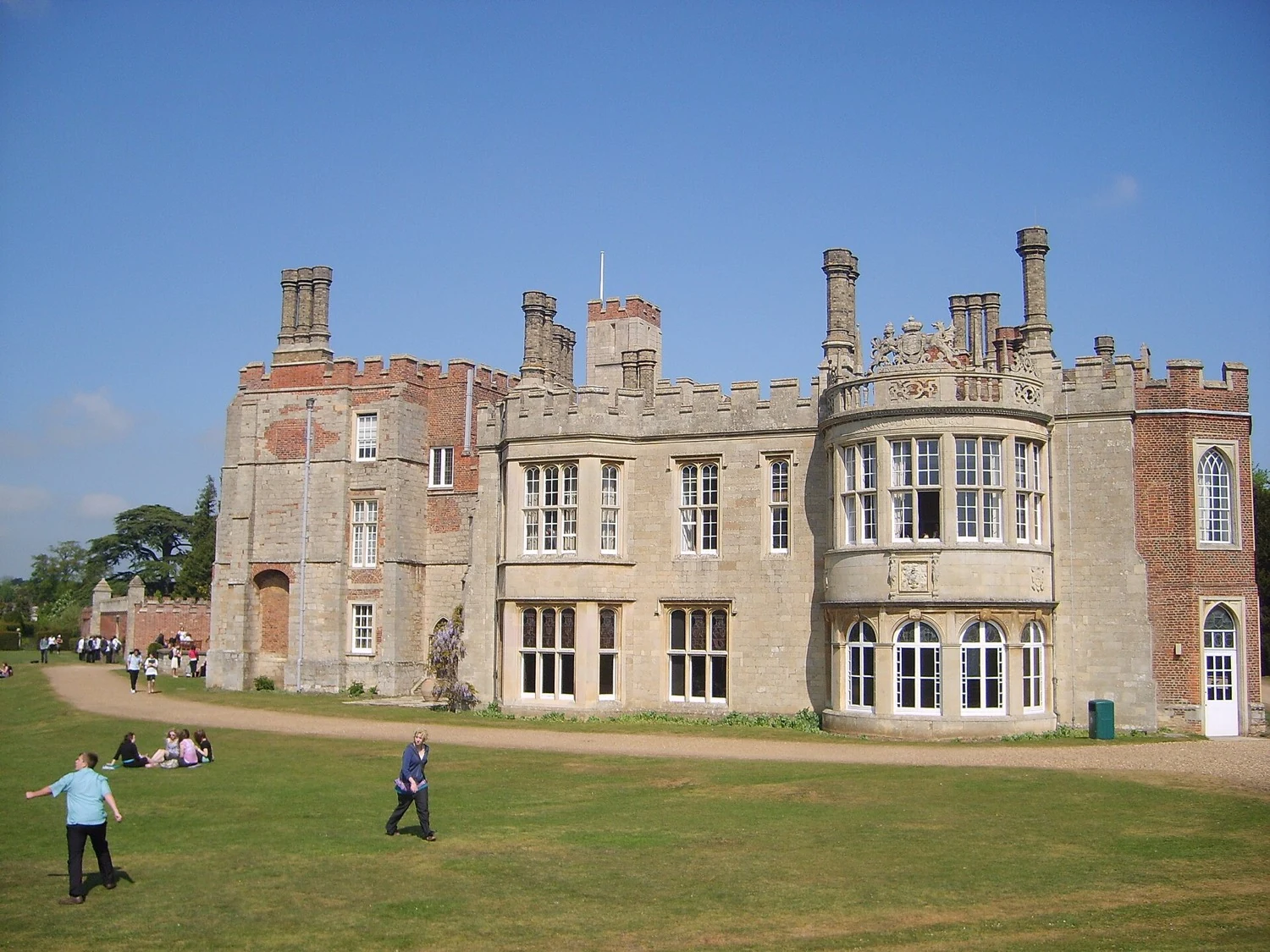
At the edge of Huntingdon, Hinchingbrooke House tells the English Reformation on its own: a nunnery turned, after the Dissolution, into the manor of an ambitious family — the Cromwells — from whom a century later would come the most famous of uncrowned Englishmen.
From a nunnery to a Tudor manor
A Benedictine priory of women had occupied the site since the eleventh century. At the Dissolution of the Monasteries, it was granted in 1538 to Sir Richard Williams (alias Cromwell), who made it a dwelling. His grandson Sir Henry Cromwell, "the golden Cromwell", turned the whole into a great Tudor manor in the late sixteenth century. Look at the most spectacular gesture: the gatehouse of nearby Ramsey Abbey, taken down and re-erected stone by stone at the north entrance — a piece of medieval abbey recycled into a house of display, the very image of a Reformation that dismantled the Church to build the house of the laity.
Bay windows and the memory of Oliver Cromwell
On the front, look for the great bay windows, of the same hand and stone as the gatehouse; in 1602 a bay window and a loggia were added on the east. It was here that part of the kin of Oliver Cromwell, the future Lord Protector, was born and raised: his grandfather Henry received Queen Elizabeth here. In 1627, Sir Oliver Cromwell (the uncle) sold the house to the Montagus, Earls of Sandwich, who held it thereafter. Don't miss: the Ramsey gatehouse, the Tudor bay windows, the great hall, the estate (now shared with a school).
Did you know?
The fine Gothic gatehouse that greets the visitor at Hinchingbrooke was not built there: it was taken down from an abbey — Ramsey — dissolved by Henry VIII, then carried and re-erected at the manor's entrance. After the Dissolution, the stones of the monasteries became a quarry: the new masters built their houses from the wreck of the Church they had just pulled down.
Info
Hinchingbrooke House is at Huntingdon (Cambridgeshire); the house, shared with a school, opens to the public on certain summer Sundays. Hours to be checked.