
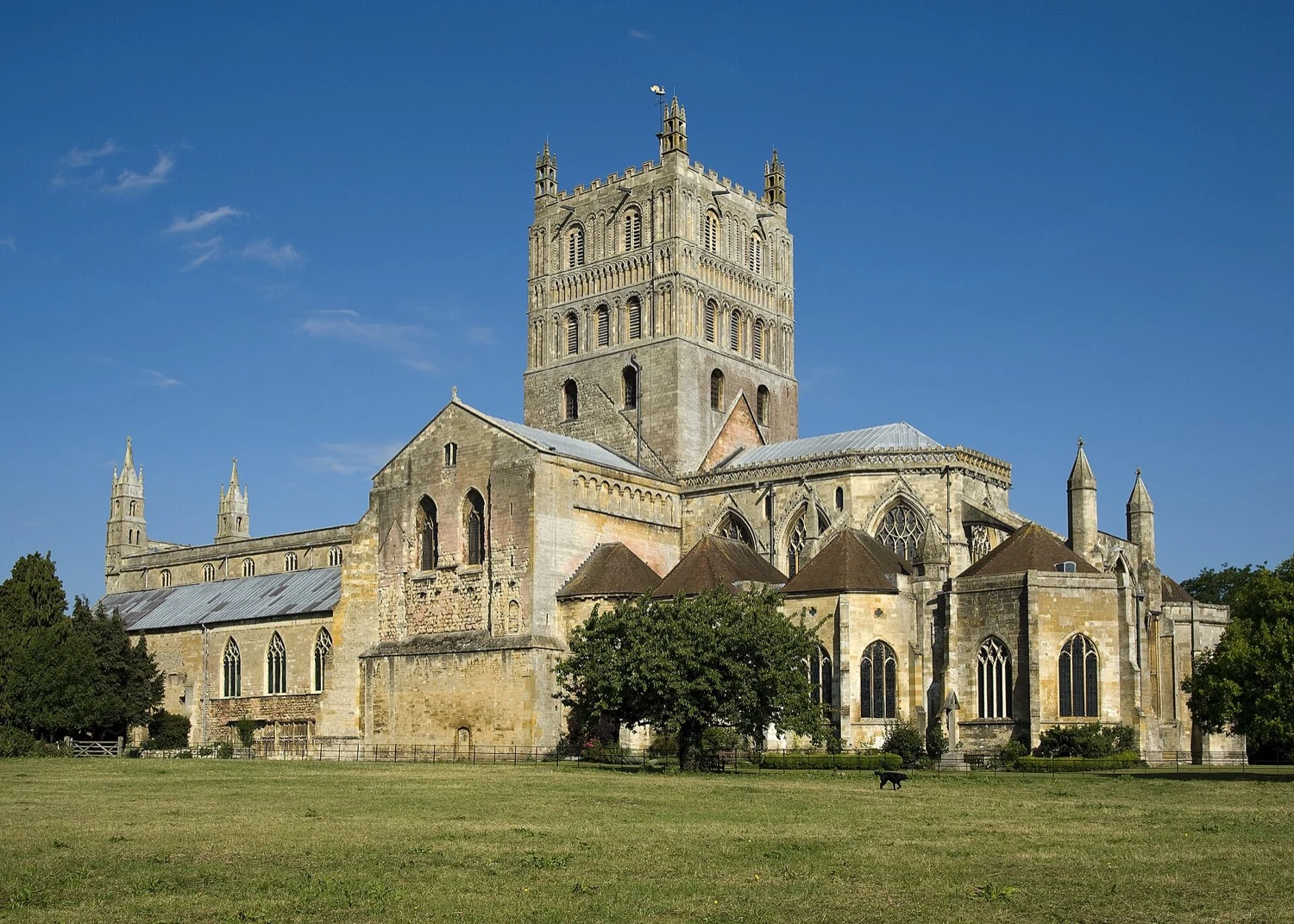
Its Romanesque tower — the largest in England — dominates the small town of Tewkesbury, in Gloucestershire. The scene of a bloody battle that sealed the fate of the Wars of the Roses, this abbey church was also one of the great survivors of the Dissolution, saved by the tenacity of its townsfolk.
The Battle of Tewkesbury (1471)
In 1471, the meadows around the abbey were the scene of the Battle of Tewkesbury, one of the most decisive of the Wars of the Roses: the Yorkist victory annihilated the Lancastrian hopes. The young Edward of Westminster, Prince of Wales and sole Lancastrian heir, was killed there at seventeen — his death opening the way that, fourteen years later, would lead Henry Tudor to the throne. Combatants took refuge in the abbey itself, which had to be re-consecrated after the carnage. The abbey church keeps the graves of several actors of the end of the Wars of the Roses, including George, Duke of Clarence, brother of Edward IV and Richard III.
The buy-back by the townsfolk (1540)
At the Dissolution, the Benedictine abbey was surrendered in January 1539 by its last abbot, John Wakeman. Like so many abbey churches, it risked demolition. But in 1540, the townsfolk of Tewkesbury bought it back — for about £453, the value of the roof lead and the bells — to make it their parish church, saving it from the fate of so many razed buildings. It is thanks to this buy-back that the town today keeps one of the finest Norman churches in England, with its exceptional set of medieval monuments. To see: the largest Romanesque tower in England, the brass plate marking the grave of Prince Edward at the centre of the sanctuary, the vault of George of Clarence behind the high altar, the set of medieval monuments.
Did you know?
After the battle of 1471, defeated Lancastrian soldiers took refuge in Tewkesbury Abbey, believing they would find sanctuary there; they were dragged out and executed, and the blood shed in the church required it to be re-consecrated. A few decades later, it was the townsfolk who in their turn saved the abbey — no longer from the sword, but from the hammer of the Reformation's demolishers.
Notes
Tewkesbury Abbey lies at Tewkesbury, Gloucestershire; a working parish (abbey) church, open to visits. The wooden spire collapsed in 1559 and was never rebuilt. Hours to check.
Quiz
- Which battle took place at Tewkesbury in 1471?
- A battle of the Wars of the Roses
- The Battle of Hastings
- The Battle of the Armada
- How was the abbey saved at the Dissolution?
- Bought back by the townsfolk in 1540
- Protected by the pope
- Hidden underground
- What is remarkable about its tower?
- It is the largest Romanesque tower in England
- It is of glass
- It leans