
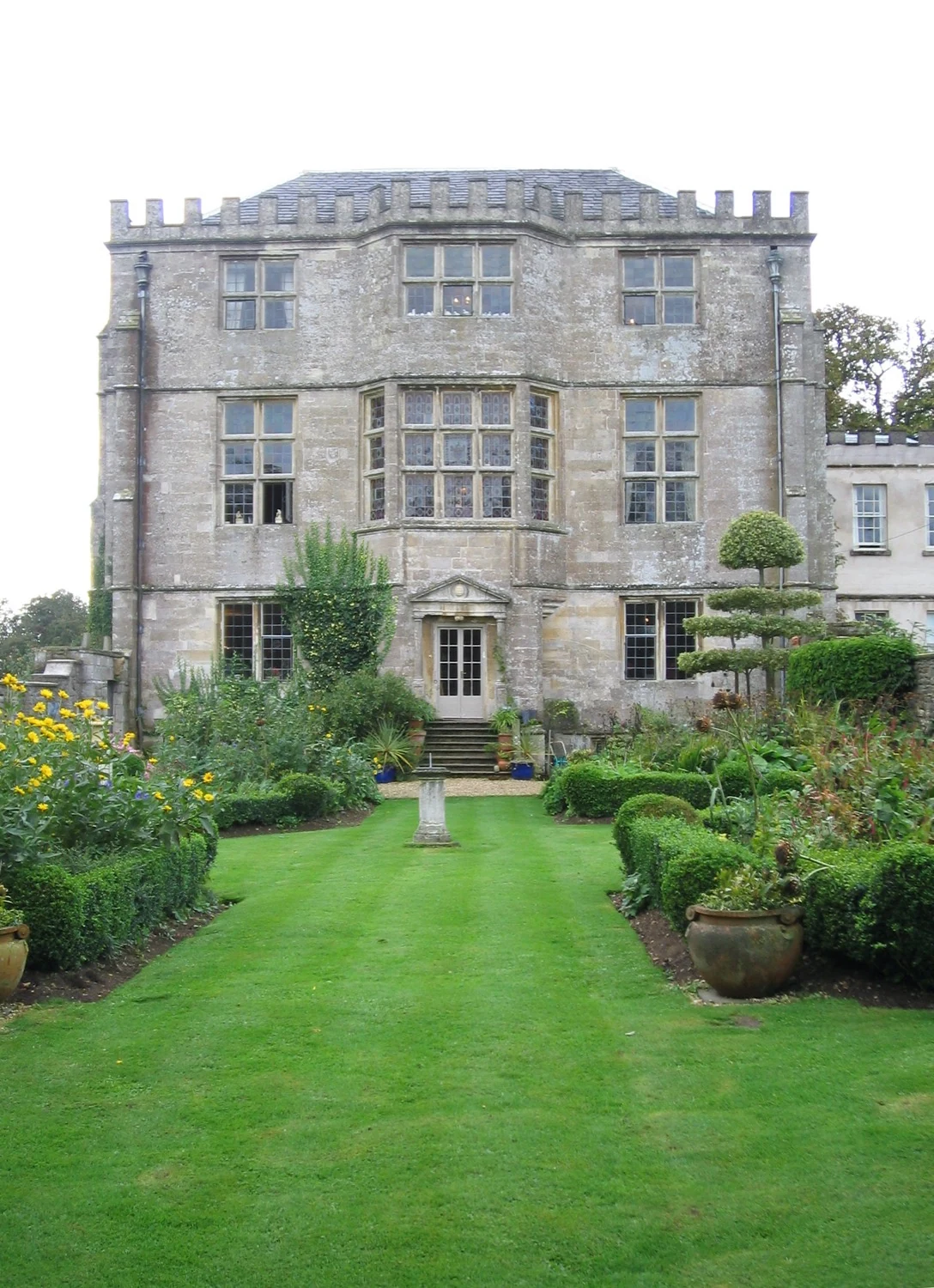
Perched on the edge of the Cotswold escarpment, in Gloucestershire, Newark Park is a rare Tudor hunting lodge of unexpected refinement. Built by a gentleman of the intimate circle of Henry VIII, it illustrates both the nascent taste for classicism and one of the great springs of the period: the Dissolution of the Monasteries.
A hunting lodge of an intimate of the king
Newark Park was raised around 1544-1556 for Sir Nicholas Poyntz, a gentleman of Henry VIII's Privy Chamber — that is, a member of the king's most intimate circle. He conceived Newark not as a principal residence, but as an elegant hunting lodge, intended for the pleasures of the chase and for receptions. What strikes is its rigorously symmetrical façade and its Tuscan order — an 'early classicism' rare for mid-sixteenth-century England, a sign that this intimate of the king was abreast of the new architectural ideas come from the continent.
The stones of Kingswood Abbey
Newark bears, in its very matter, the trace of the Reformation: part of its stones comes from the Cistercian abbey of Kingswood, dissolved shortly before as part of the Dissolution of the Monasteries. To reuse the materials of a suppressed convent to build one's house was a common act of the Tudor gentry enriched by the Reformation — Newark is a direct and tangible witness of it. The estate, 700 acres in extent with its deer park, was sold to the Low family in 1600. To see: the symmetrical Tudor façade, the period rooms and the basement kitchen, the 700-acre estate and the deer park, the views over the Severn valley.
Did you know?
Newark Park was saved from ruin in the twentieth century by an eccentric American architect, Robert Parsons, who found it decayed and undertook its restoration from 1970 — sometimes even paying for the works out of his own pocket and living on the spot. Without this enthusiast from across the Atlantic, this precious Tudor hunting lodge, one of the first witnesses of classicism in England, would doubtless have disappeared.
Notes
Newark Park lies at Ozleworth, Gloucestershire (near Wotton-under-Edge); a National Trust property, open to the public. Seasonal hours to check.
Quiz
- For whom was Newark Park built (c. 1544-1556)?
- Sir Nicholas Poyntz, intimate of Henry VIII
- Cardinal Wolsey
- Anne Boleyn
- Where does part of its stone come from?
- Kingswood Abbey, dissolved
- A Roman quarry
- The Tower of London
- What is unusual about its façade?
- An early, symmetrical classicism (Tuscan order)
- It is Gothic
- It is of timber