
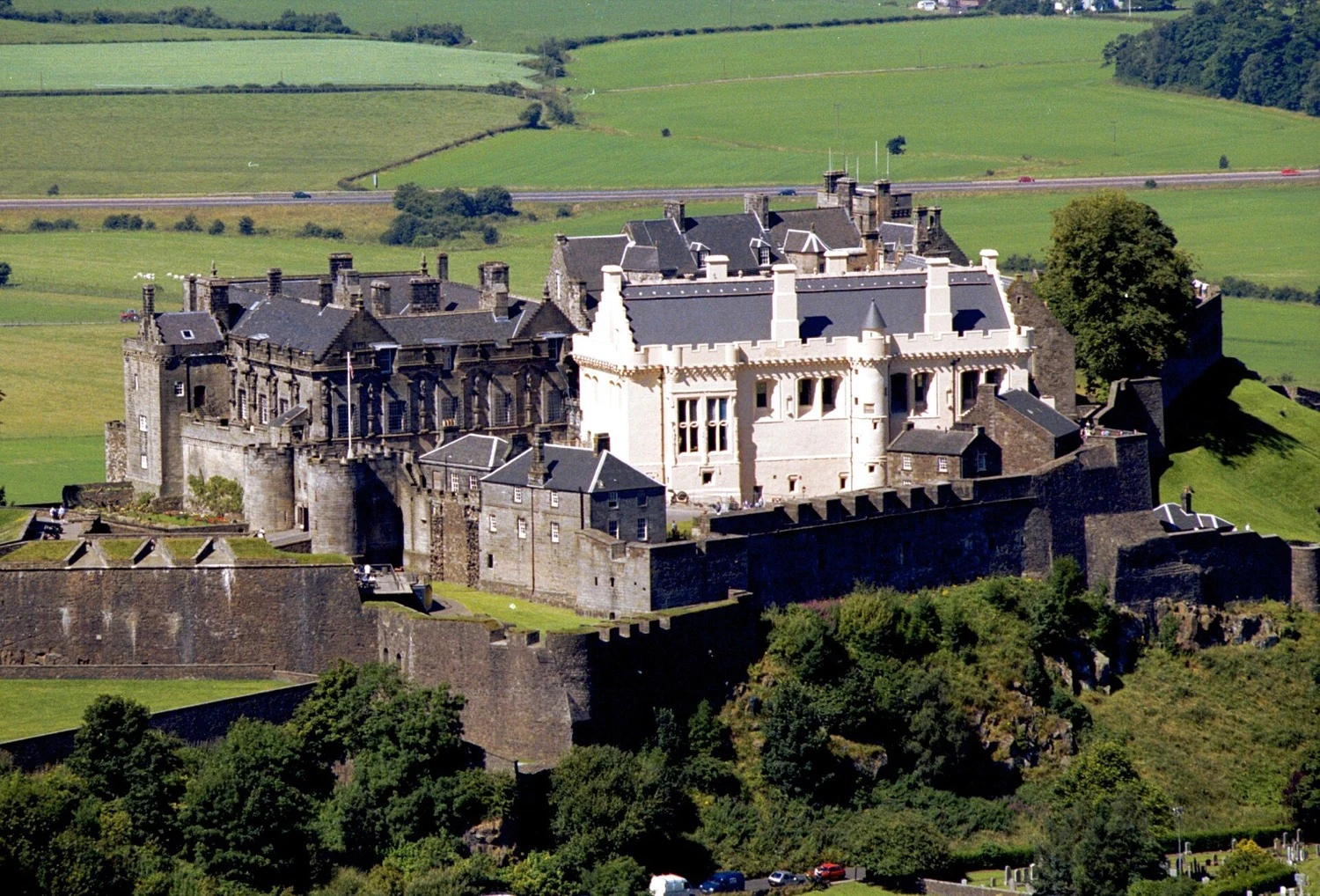
Standing on a volcanic rock overlooking the plain, Stirling Castle has always commanded the gateway to the Highlands. A strategic fortress of the kings of Scotland, it holds the most sumptuous Renaissance palace in the kingdom: the one that James V, married to French princesses, had raised in the taste of the Continent.
The fortress of the kings of Scotland
Perched on its crag, a bolt between the Lowlands and the Highlands, Stirling was at all times a capital place: whoever held Stirling held Scotland. A favourite residence of the Stuart kings, it saw several sovereigns crowned and raised. It was here that Mary Stuart was crowned, a child, in 1543, and here that her son, the future James VI, grew up. But the golden age of Stirling is the reign of James V (1513-1542), who made it a manifesto of the Scottish Renaissance.
The palace of James V
James V married in succession two French princesses — Madeleine of Valois, daughter of Francis I, then Mary of Guise — and turned resolutely towards French and continental culture. Around 1538-1542 he had a royal palace of a new kind in Scotland raised at Stirling: an outer façade adorned with statues, twisted columns and carved figures, in a Renaissance style inspired by France and Germany. Inside, the ceiling of the presence chamber was adorned with the famous Stirling Heads: a series of carved oak roundels of portraits of kings, queens, nobles and mythological figures — one of the masterpieces of Renaissance sculpture in Britain. Restored to their bright colours, the royal apartments of Stirling today give a dazzling image of the splendour the Stuarts, in imitation of the Valois, wished to give their court.
What to see
- The royal palace of James V and its sculpted façade with twisted columns.
- The Stirling Heads, oak roundels of the royal ceiling (originals and copies).
- The restored Great Hall and the Chapel Royal.
- The view from the rock over the plain and the gateway to the Highlands.
Did you know?
The Stirling Heads — those oak roundels carved with faces — were, in the eighteenth century, taken down and dispersed after a ceiling threatened to collapse; some long served as decorative objects, others nearly ended as firewood. Patiently found again, studied and copied, they once more adorn, in coloured replicas, the royal ceiling of Stirling, while the surviving originals are displayed under shelter. These wooden heads, once destined for the fire, are today one of the treasures of the Scottish Renaissance.
Practical information
Stirling Castle lies at Stirling, in central Scotland. It is today a site in the care of Historic Environment Scotland, open to the public, with the restored royal apartments. Opening hours and days are liable to change; it is best to check them against the official sources before visiting.
Quiz
- Which king had the Renaissance palace of Stirling raised?
- James V
- James VI
- Henry VIII
- Towards which culture did James V turn, through his two marriages?
- French culture
- Spanish culture
- Italian culture
- What are the 'Stirling Heads'?
- Carved oak roundels adorning a royal ceiling
- Marble statues
- Stained-glass windows