
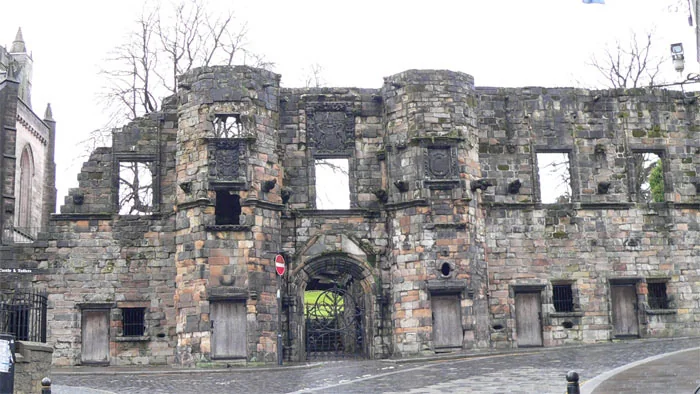
In the old town of Stirling, on the road climbing to the castle, stands a carved stone façade pierced by empty windows: Mar's Wark, what remains of one of the most ambitious townhouses of the Scottish Renaissance, left unfinished and never truly lived in.
A regent's unfinished dream
Around 1570, John Erskine, Earl of Mar, Regent of Scotland and guardian of the young king James VI, set out to raise in Stirling a house worthy of his rank, a step from the royal castle. Look at the façade: it unfolds a Renaissance carved decoration rare in Scotland — grotesque figures, armorial panels, cut inscriptions, a pair of stone guards flanking the entrance. The earl died in 1572, soon after work began; the house was never finished nor fully occupied.
A façade that speaks
Look for the inscriptions cut into the stone: one, half-defiant, answers in advance the slanderers who might mock the house — a very Renaissance way of making architecture speak. Later used as a barracks and then a workhouse, the building was wrecked by bombardment during the 1746 siege of Stirling. Only the façade remains, but it is enough to voice the ambition of the Scottish Renaissance. Don't miss: the carved façade, the stone guards at the entrance, the armorial panels and inscriptions.
Did you know?
On the façade of Mar's Wark, a cut inscription answers in advance those who would criticise the house: "I care not what these scorners say…". The Earl of Mar had his reply to the jealous carved into the stone — a four-and-a-half-century snub, still legible on a ruin.
Info
Mar's Wark is on Broad Street, at the top of Stirling's old town, near the Church of the Holy Rude; a ruin in the care of Historic Environment Scotland, freely visible from outside. Access to be checked.