
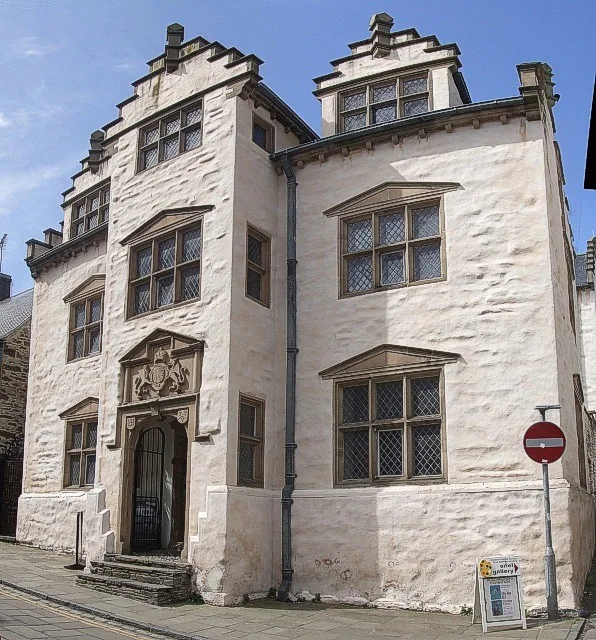
In the streets of Conwy, in the shadow of Edward I's great castle, Plas Mawr — 'the great house' in Welsh — raises its gabled façade. Inside, its ceilings and walls of brightly coloured plaster, adorned with emblems and mottoes, make it the best-preserved Elizabethan townhouse in Britain: dazzling proof that the Renaissance had reached Wales.
The house of a Welsh gentleman
Plas Mawr was built between 1576 and 1585 by Robert Wynn, a Welsh gentleman who had served on the Continent and travelled in Renaissance Europe. Enriched and ennobled, he wanted, on returning home, a house that would display his rank and his culture. He had it raised within the walls of Conwy, a walled town founded by the English kings around their powerful castle. The house, of several storeys and courts, arranged around a great hall, illustrates the rise of the Welsh gentry under the Tudors: integrated into the kingdom by the Acts of Union, the Welsh notables now had access to offices, fortunes and the taste of their time.
A setting of coloured plaster
What makes the glory of Plas Mawr is its interior decoration of rare richness: ceilings and friezes of moulded plaster, painted in bright colours, covering walls and chimneypieces with heraldic motifs, mottoes, royal and family emblems. Robert Wynn displayed here his arms, his loyalty to the Crown (the royal arms) and his culture. Miraculously preserved, restored to its original colours, this ensemble gives a striking idea of what Elizabethan interiors were — not the bare stone one imagines, but a festival of colours and symbols. Plas Mawr is thus the most eloquent witness of the domestic Welsh Renaissance.
What to see
- The gabled façade within the medieval walls of Conwy.
- The plaster ceilings and friezes painted in their original colours.
- The arms and emblems of Robert Wynn and the Crown.
- The great hall and the courts, heart of Elizabethan domestic life.
Did you know?
We often imagine Renaissance interiors in grey stone and dark wood; Plas Mawr proves the opposite. Its restored plasterwork bursts with white, red, gold and bright blue: the Elizabethans loved colour, and gladly covered their walls with painted motifs and shimmering emblems. To see Plas Mawr is to correct our vision of an austere Renaissance — and to understand that a sixteenth-century Welsh gentleman lived in a setting far livelier and more talkative than our museums lead us to believe.
Practical information
Plas Mawr lies at Conwy, in the north of Wales, within the walled town. It is today a site in the care of Cadw (the Welsh heritage service), open to the public. Opening hours and days are liable to change with the seasons; it is best to check them against the official sources before visiting.
Quiz
- What does 'Plas Mawr' mean in Welsh?
- 'The great house'
- 'The king's castle'
- 'The black tower'
- What makes Plas Mawr famous?
- Its plaster ceilings and friezes painted in bright colours
- Its collection of paintings
- Its fortified keep
- Who built Plas Mawr between 1576 and 1585?
- The Welsh gentleman Robert Wynn
- King Henry VIII
- The Archbishop of Canterbury